Europe's new normal: A continent on fire
Europe is having its warmest sustained heatwave in over 50 years. Climate change means these are temperatures we need to get used to, writes Padraig Hoare
Europe's new normal: A continent on fire

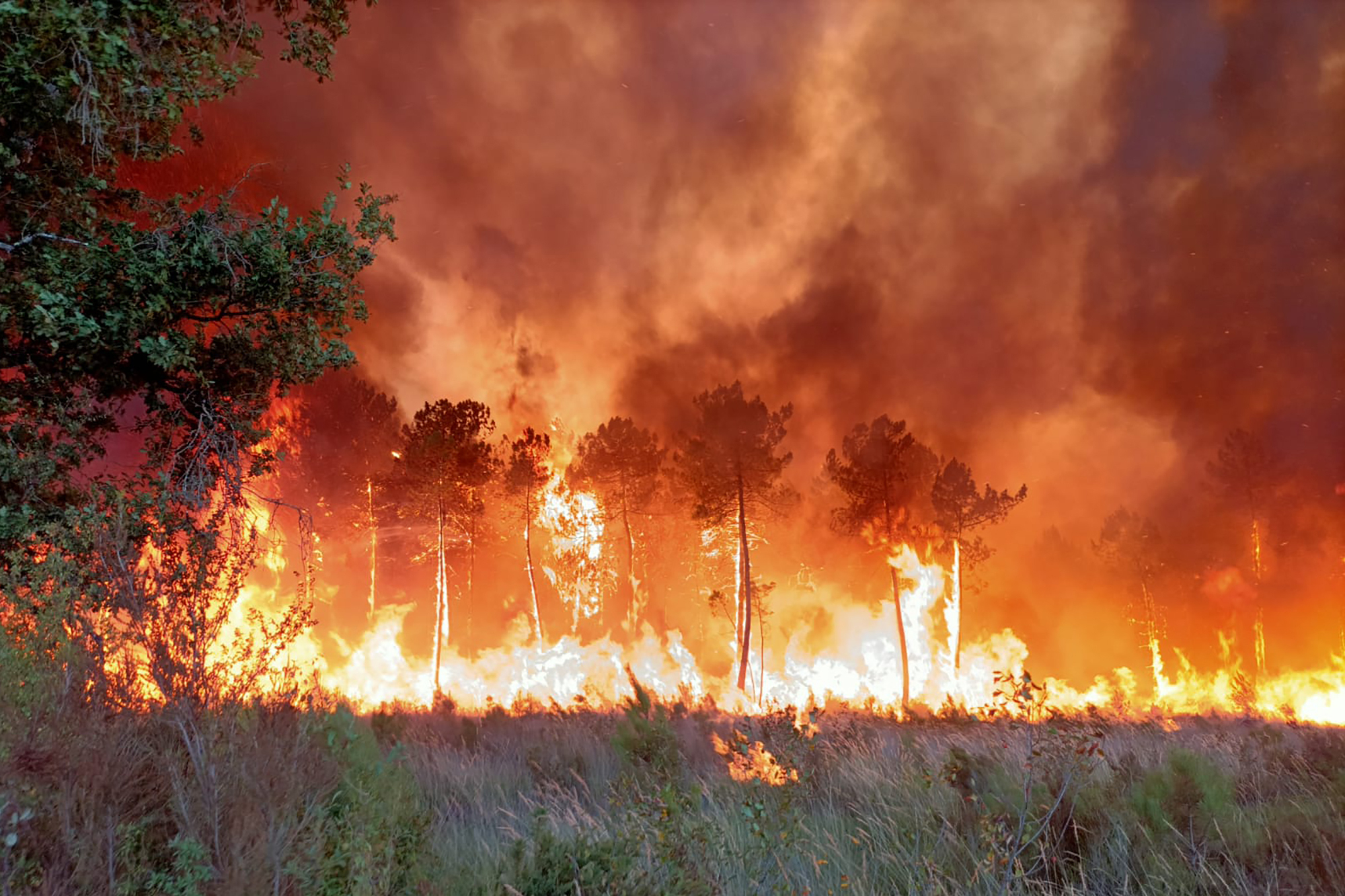
Fighting flames at the Gironde region near Landiras, southwestern France. Picture: AP

Suffocating urban temperatures, out of control raging wildfires, and new record-setting heatwaves forming just weeks after previous ones — this is Europe’s new normal as the ravages of climate change grip the continent.

Earlier this year, the EU’s Copernicus Climate Change Service said in its annual European State of the Climate report that the continent experienced the warmest summer on record in 2021, at 1C above the 1991-2020 average.

A previously unthinkable 48.8C became reality last summer, and with the intensity and frequency of this summer’s heatwaves across the continent, that record could be shattered sooner rather than later.

Asked by the Irish Examiner if the temperature could exceed 50C in the near future in Europe, Copernicus senior scientist and report lead author Freja Vamborg said: “We’re not necessarily in the business of extrapolating into the future, mainly focusing on monitoring what has happened, but of course, as temperatures warm, not only are the average temperatures expected to increase, but so are the maximums.

A dog drinks from a fountain in Paris. France is witnessing a second heatwave in less than a month. Picture: Bertrand Guay/AFP via Getty Images

“48.8C in not that far away from 50C, and the 48.8C was already 0.8C warmer than the previous European record. I won’t give a timeframe, but, for sure, this is not going to be the last temperature record we’ve seen in Europe.”

Kayan the orangutan licks a frozen juice bottle at Twycross Zoo in Leicestershire in Britain. Picture: Jacob King/PA 

With last month’s heatwave in the likes of France, Spain, and Portugal seeing temperatures rise into the 40s, an angry Mother Nature has not finished wreaking her wrath on the continent in July, aided by decades and decades of human-induced global warming behaviour.

Portugal, Spain, Croatia, the list goes on — all suffering through extreme heat and wildfires, with cities breaking previously imagine unattainable new temperature records.

A weary Portuguese prime minister Antonio Costa said of wildfires ravaging the nation: “It is absolutely crucial we avoid new events because it leads to the exhaustion of firefighters and all others ... who are doing their best to control the situation.”

Meanwhile, in the west of Spain, a fire led to the evacuation of 49 children from a summer camp in Extremadura; simultaneous fires are burning Croatia’s Adriatic Coast; in the southwest of France, more than 1,000 firefighters were called to action to try and halt two wildfires, with water-bombing planes brought into assist; and in Turkey, thousands of people had to be evacuated from homes in the Datca peninsula in the country’s southwest.

A recent study in the journal Nature concludes that Europe’s new crisis will become more frequent, with heatwaves increasing three-to-four times faster than the likes of the US and Canada.

“Europe is very affected by changes in

A resident uses a bucket of water to put out embers on olive trees in Moinhos Joao da Serra, in Ourem, Portugal. Picture: Pedro Rocha/AFP via Getty Images

atmospheric circulation,” co-author Kai Kornhuber, a climate scientist at Columbia University said.

It’s a heatwave hotspot.

In Ireland, we are not immune to the ravages of extreme weather, albeit far less hot than the 40C-plus on the continent.

Met Éireann believes Ireland could see a new record-high temperature next week — and with at least one rare tropical night thrown in.

A tropical night is a term used in Europe to describe days when the temperature does not fall under 20C during nighttime.

The highest recorded temperature for Ireland was 33.3C at Kilkenny Castle in June 1887, but that record is under threat with an advisory that temperatures of 32C and possibly above are likely on Monday, and potentially on Tuesday, before cooler air sweeps back over the country.

Met Éireann meteorologist Paul Downes said: “Over recent decades we have observed an increase in the frequency, duration and intensity of extremely hot weather across most global land regions. Human-caused climate change resulting from greenhouse gas pollution is the main driver of this increase in extreme heat.

“While extremely hot weather does occur within natural climate variability, the kinds of temperature extremes we are seeing in Europe are directly influenced by climate change. June 2022 was Europe’s second warmest on record, and the USA’s warmest. The eight hottest Junes on record globally all occurred in the last eight years.”

Keith Lambkin, head of Met Éireann’s Climate Services Division, said these extremes will become a new normal.

“Due to climate change, we are expecting to see heatwaves become longer, more frequent and intense than in the past.

A firefighting airplane drops its load on a forest fire raging in the village of Casal da Quinta, outside Leiria, central Portugal. Picture: AP Photo/Joao Henriques)

This increase in he

CLIMATE & SUSTAINABILITY HUB

More in this section

Lunchtime News

Newsletter

Keep up with stories of the day with our lunchtime news wrap and important breaking news alerts.

Cookie Policy Privacy Policy Brand Safety FAQ Help Contact Us Terms and Conditions

© Examiner Echo Group Limited