My surrogacy sister carried my baby 'out of pure love'
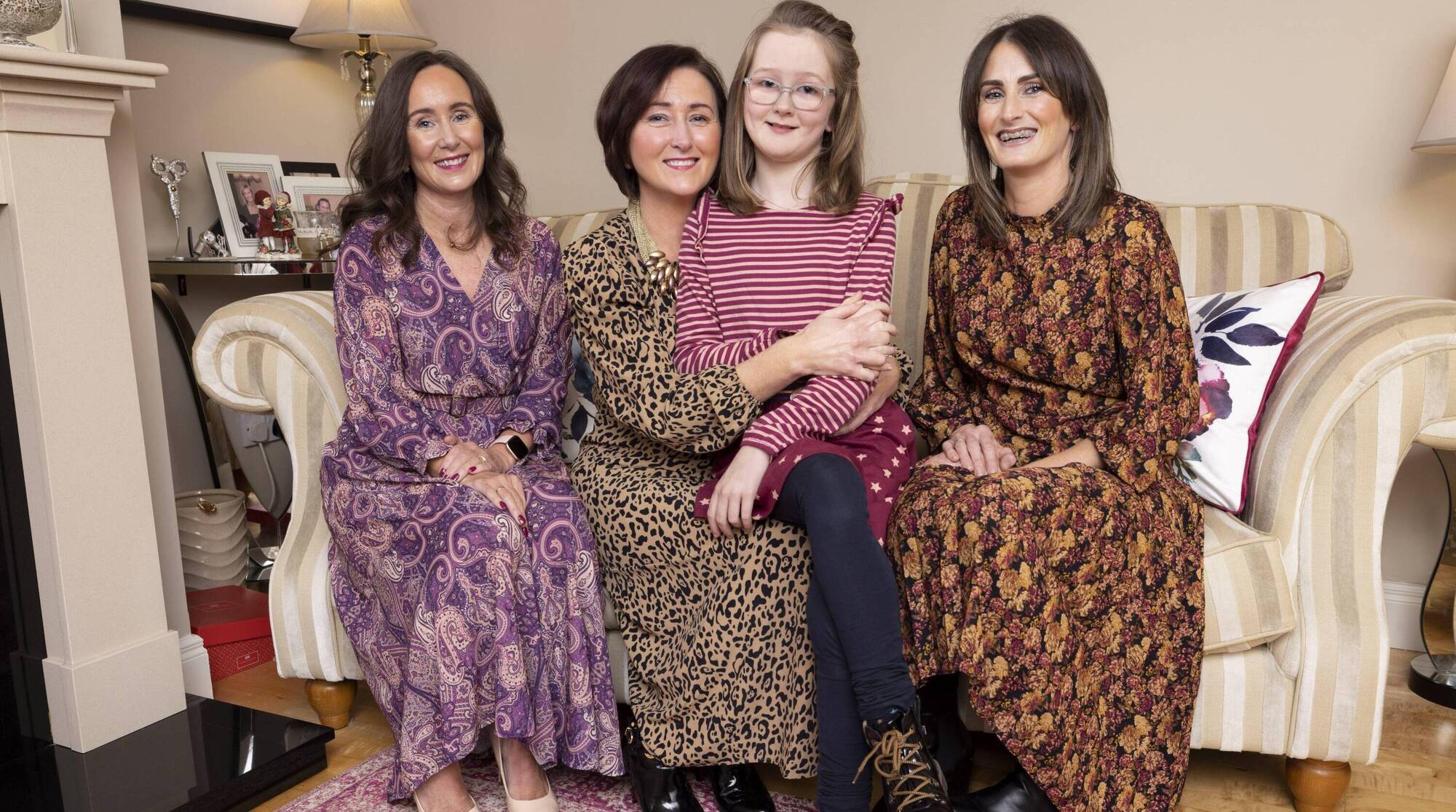
(Left to right) Sharon O’Shea (sister of Marie), Marie McPhilemy, her daughter Lucy and Marie's sister Catherine O’Donnell. “Sharon just said it like she was going to do the shopping, ‘sure, I'll carry a baby for you’.” Photo: Joe Dunne
Marie McPhilemy knew early on in life she could never give birth.
Doctors treating her for kidney problems when she was 16 found abnormalities with her womb. She didn’t think much of it at the time when her parents sat her down and told her what the doctors had told them because, at the time, the last thing on her mind was having a baby.
But, as she was discussing the issue in the kitchen of her parents Anne and Michael Watters' home in Ardara, Co. Donegal, her older sister Sharon told her not to worry. She said she would carry a child for her instead.
“Sharon just said it like she was going to do the shopping, ‘sure, I'll carry a baby for you’, she said,” she recalled, speaking at a time when the government is in the process of setting up another Oireachtas committee to look into legislation for, among other things, surrogacy.

“It wasn't a formal sit down chat about my intentions to be a mom, because — for a start — I didn't even have a boyfriend.
“It was just a very casual, laid-back conversation, and, when she said it, I just thought it was a very natural, caring, loving thing for her to offer because she's my big sister.” The 16-year-old may well not have thought much more about it then but, in later years, when she wanted to start a family, she went to a range of experts to see if there was any way she could ever give birth and they all said the same thing: No.
“In one clinic, one doctor actually turned around and said to me ‘the only way you're going to have your own baby is if you have somebody carry it for you’,” she recalled, her voice faltering with emotion.
“It was just literally coming home from Dublin. And I remember that day, John, my husband, and I coming home in silence. And we went to my hometown, which is an hour from Ballybofey, where I live now.
“And Sharon actually happened to be at the back door of the house.
“I just walked over to her and burst out crying and just told her ‘I can't do it myself’.”
Marie muffled sobs as she recalled that day, the day she finally had to accept she could never give birth. “Sorry, I'm getting emotional now thinking about it,” she said.
“Sharon looked at me as I stood in front of her, with tears streaming down my face and she just gave me a big hug and said ‘right, let's get the ball rolling’.
“And that's what we did.”

A sign of how close the couple was before this conversation with Marie’s sister took place is the one she had with John not long after they met in April 2001.
“I told John pretty early in our relationship because I wanted to be honest,” said Marie, whose family story will be one of 20 surrogacy stories from around the world in a book written by Surrogacy Australia founder Sam Everingham.
“I don't think the fact I couldn’t carry a child is something I could hide from anybody.
“And John happened to be that person I wanted to start a family with.
“And we just knew when we got together five years before we eventually married, we were meant to be together.
“And I told him early on in the relationship, long before we married, that if we were going to have a family, it would have to be this way, through surrogacy, for medical reasons for me.
“John, thankfully, is a pretty relaxed kind of character and he was happy to go with it.”
Marie, John and Sharon then together embarked down the route, in 2012, to IVF, with a clinic in Dublin and in Prague.
Sharon became pregnant with Marie’s fertilized eggs during the first round but, tragically, she suffered a miscarriage.
“I was devastated,” Marie said.
“I was devastated after everything we had invested emotionally in ourselves.
“And then there was the fact that Sharon was doing all of this out of just an act of pure love for me, there's no financial gain, no nothing.

“She was freely giving her whole time to leave her own family, travelling to Dublin from Donegal, and back again and then getting on a plane to Prague, and doing all the medication, taking all of that and coming home again.
“And then just to be faced with the blow that it didn't work.
“It was just so heart-wrenching and devastating.”
And she said of Sharon’s reaction: “Sharon is very black and white.
“It's not that she's cold — far from it, because she never would have done this if she was any other way.

“But she was, and is, always very practical, and very pragmatic.
“Her attitude had always been ‘this is Marie and John's baby. I'm not emotionally invested in this and anyway — I just want my sister to have a wee family’.
“And that was all her aim was all the time.” Marie, who is a clinical audiologist with the HSE, said the whole process of IVF was both emotionally and financially draining for her and 30-year-old husband John, who runs a family furniture store in Ballybofey.
“Because I live in Donegal, and I had to maybe go to Dublin two or three times in one week trying to do the IVF and then also juggle work, it wasn’t easy,” she said.
“Going through IVF on its own as a couple is a very difficult process, and a lonely process. This is not unless you happen to know people who have gone through it or are going through it and are willing to talk about it, and let’s face it, not everybody wants to talk about it.
“But then we also had my sister involved, who obviously was carrying our baby for us.
“But you would be worrying about her all the time as well.
“It’s a very natural thing to do, to worry about your sibling who's going to give up maybe two years of their life to give you a chance to become a wee family on your own.
“Sadly, the first round of IVF, unfortunately, wasn't successful. So we said look, we'll do another one. We’ll see where we go from there.”

The couple and Sharon went through a second round of IVF and about five weeks after the embryo transfer, Marie and John went to stay at Sharon’s house the night before she was due to take a pregnancy test.
“Sharon didn't even know if she was expecting and hadn't checked because she was adamant, this was our baby and she didn’t want to know before we knew,” Marie said.
“She would have had every right to find that out and I wouldn't have minded if she did but she wanted me to see the result in the pregnancy test first.
“And sure enough, it came up pregnant and we were all just ecstatic, over the moon.
“And then even when we went for a scan, Sharon made sure we saw little Lucy on the screen before her.
“She was just so selfless in all of this to us.” Lucy was born in October 2013.
And while she has her father’s blue eyes, the eight-year-old has her mother’s fair hair and broad cheeks.
But what she doesn’t have is, among other things, Marie’s name on her birth certificate.
John’s name is on it, and so is Sharon’s.
But not Marie’s name.
Indeed, in the eyes of the law, Marie, as she puts it, doesn’t exist.
This is because the State does not recognise domestic or foreign surrogacy.
“The lack of legislation in the very beginning gave me, in effect, the go-ahead to go and do this,” Marie says.
“There was nothing there, there was nobody saying this was in any way illegal. We went to two different solicitors and they told us ‘there's no legislation, so - it means it is not illegal, basically you can go and do this’.

“We knew there would be a process where once Sharon gave birth, she would be seen as Lucy’s mother and put down as such on the birth cert.
“But I just did not expect to end up in the situation I am in today, which is where I am - in effect - nothing in the eyes of the law.
“John as her genetic father is on the certificate because Sharon is able to put his name down on the cert but despite me being Lucy’s genetic mother, I don’t exist.
“I'm non-existent in the eyes of the law.” Adding to her frustration is that at the time she was doing her research about surrogacy, proceedings in the so-called R Family case were underway in the High Court in 2013.
The R Family case involved a woman whose sister had given birth to twins after undergoing IVF with eggs fertilised by her sister and her brother-in-law.
Although the State would later appeal and overturn the decision, the family had gone to the High Court to successfully have themselves - as the twin’s genetic parents - declared as their lawful parents.
“I found out through the media that there was this other couple in an almost identical situation,” she recalled.
“The High Court challenge to be legally recognised on their twins' birth certificates succeeded and so I was really thinking, ‘this is great, this is amazing, this is going to happen’.
“And then there were also all the repeated promises by various ministers and politicians that there would be legislation brought in.”
After two years, in 2015, Marie successfully applied to be Lucy’s legal guardian but that ends once she turns 18.
“For me, that impacts massively in terms of - God forbid - if something was to happen to me health-wise.
“Lucy won’t be able to make any life-altering decisions for me as my child even though genetically she is mine because she's not seen as mine in the eyes of the law.
“Indeed up until the age of two, I had no rights at all in relation to her.
“I was in legal No Man's Land.

“Sharon had to apply for her first passport, and Sharon had to apply for her to have vaccines.
“I couldn’t even open a bank account for Lucy.” One of the most hurtful things that has happened to her since Lucy’s birth was in a bank branch.
“I went in to withdraw money from her account one day and the teller at that desk told me that I wasn't down on her account as being able to withdraw money,” she recalled.
“This was despite the fact that John had signed a form, assigning to me permission to withdraw money out of my own daughter's account as needed be.
“But because the form hadn’t been uploaded on their screen, she wouldn't let me withdraw whatever it was I was withdrawing at the time.
“And this was in front of other customers.
“It's the worst experience I ever had.
“I will never ever forget it till the day I die.

“When I left, I was so upset.
“I felt like I was some sort of gambler or - God forgive me - an alcoholic trying to withdraw money anonymously or something.
“It was just so degrading and so soul-destroying.
“It has since been rectified but still nevertheless, simple things like opening up a bank account is such a process to go through.” And then there is the unknown.
“Thankfully, John and I are in a very happy and loving marriage but things change, people change,” she said.
“I can’t at all see that being a scenario for us but it’s a big issue for people out there who are maybe not as rock solid as we are.” Of the bond she has with her 48-year-old sister Sharon and the bond her sister has with Lucy, who is now eight, she said: “It's not that I feel indebted to her.
“It's just something that was so natural, and I know that might sound funny, and it’s also not that I'm even closer to Sharon than my other siblings John, Sheila and my youngest sister Catherine.
“It’s just that we're all just very fortunate and the circumstances that we've been in for this to have happened the way it did.

“And like Lucy is just . . . Sharon treats her like she's her niece, the same as her other nieces are.
“You know? That’s what she is to her.” Marie and John had hoped to extend their family by giving Lucy the chance to have a sibling, when Marie’s younger sister Catherine offered to act as their surrogate three years ago.
They again travelled to Prague on two separate occasions to transfer their remaining embryos to Catherine but, sadly they both resulted in early trimester miscarriages.
“We are so grateful to both my sisters, and feel blessed to have Lucy in our lives,” she said.
“However, we feel so let down by the Government's delay in implementing legislation around surrogacy and the lack of clarity regarding legislation on retrospective parentage for children already born via surrogacy.
“Having gone through all we have to try and have a family and for me to still not be seen as Lucy’s mother is just heartbreaking.
"I have a legally recognised relationship with both her parents.
“It's time the Government listened to real-life stories and the struggles and extent that some couples go through to have a family.”
CONNECT WITH US TODAY



Be the first to know the latest news and updates