How the Cork Healthy Cities scheme pulled everyone together to alter the way we live, work, and play
Through initiatives such as Green Spaces for Health and the Playful Culture Trail, Cork has forged ahead in the World Health Organization's Healthy Cities movement to take its place among 100 flagship cities across 30 countries, writes Eoin English
How the Cork Healthy Cities scheme pulled everyone together to alter the way we live, work, and play

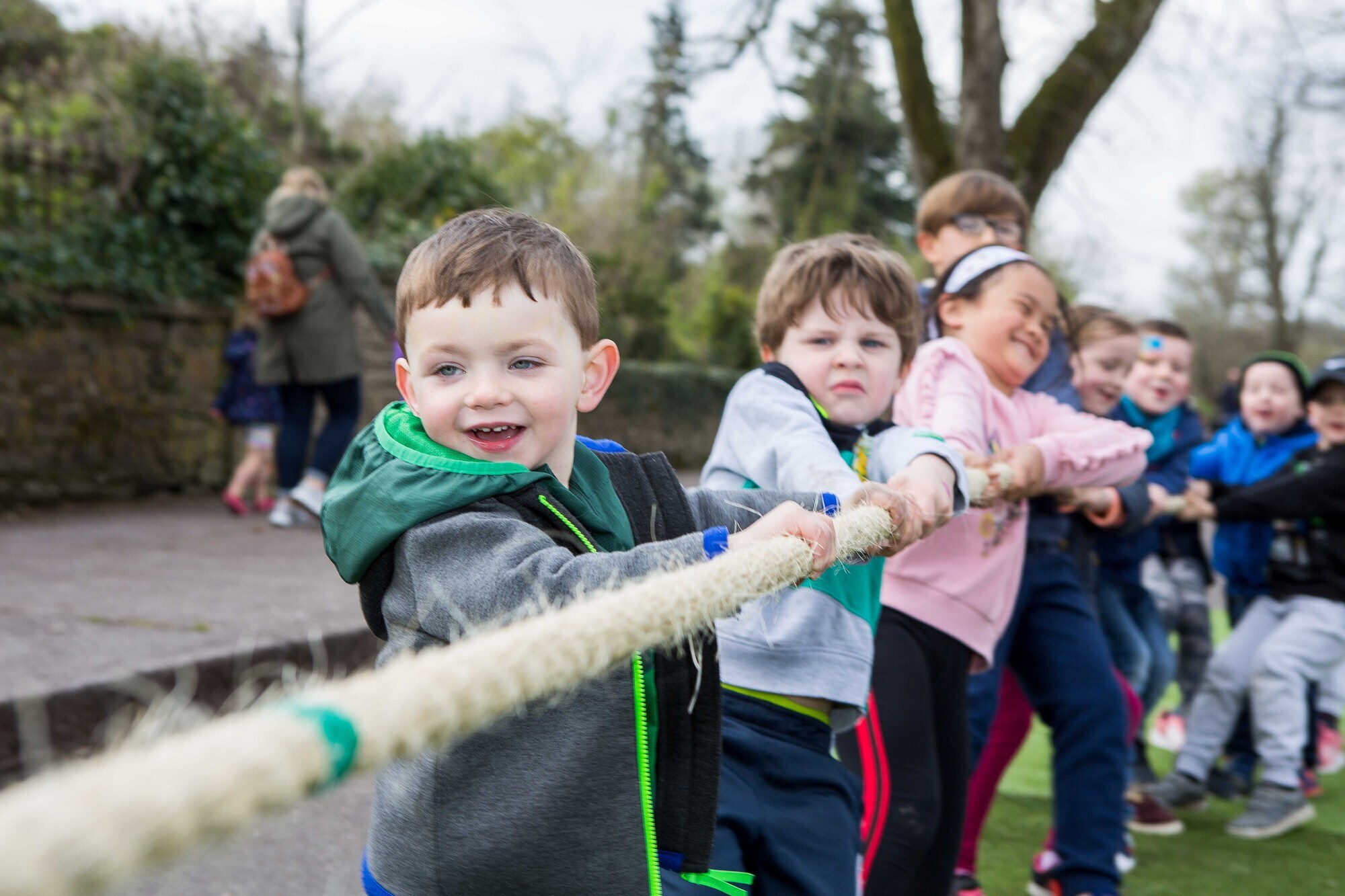
Damien Harrington, Patrick Cronin and Leah Bresnan of Blackrock and Douglas leading the effort at the Tug of War at the Healthy Cities’ “Road Open For Play” initiative at the Marina, Blackrock, in 2019. Picture: Michael O'Sullivan

It’s not often that children get to make a detailed submission that will shape how their city develops over the next decade, or get the chance to take over streets for play in a project which paves the way for the pedestrianisation of an historic riverside promenade.

Or that they’re helping to reclaim underused public spaces for community gardens which have helped to foster strong, resilient communities, and are encouraging older people — some of whom live alone — to work alongside them and share their knowledge.

These are some of the examples of projects which have been backed, supported, or coordinated by the Cork Healthy Cities initiative — a special designation from the World Health Organization (WHO) — which celebrated its 10th anniversary on Leeside this year.

As cities find ways to reinvent themselves in a post-pandemic world and plan for sustainable growth in the context of climate change, those involved in Cork Healthy Cities say the pandemic and the threat posed by the global climate crisis could actually help to accelerate some of their projects.

CLIMATE & SUSTAINABILITY HUB

“It’s not that the pandemic will make our work easier,” says Cork Healthy Cities co-ordinator Denise Cahill. “But the impetus is there now. It’s like 10 years ago, we were trying to make the case for it. 

"Now the case has been made, and the energy and the funding and the effort are there to really do something about it. 

We are armed and ready to run with this — we have the structures and resources to respond.” 

During the pandemic, we’ve all become very familiar with the WHO and with the concept of public health. We’ve also come to see our home places anew and realise that things need to change, and change fast.

The WHO has been working to make cities healthier places for about 30 years, since it established the Healthy Cities designation and network. The global movement has been working since then to put health high on the social, economic, and political agendas of city administrators.

It has been widely accepted for decades that our health is determined more by the context in which we are born, grow, and live than the lifestyle choices we make in our lifetime.

Basically, where we are born, our family circumstances, the community in which we develop, and the educational and employment opportunities available to us influence our health — a concept known as the social determinants of health.

The Healthy Cities idea emerged as health policymakers began to shift their focus from seeing the health service as a crisis response which deals with the fallout of poor health and treats illness, to finding ways of preventing the problem from happening in the first place.

Prevention v Cure

Ms Cahill illustrates the concept by telling the story of a man on a riverbank who sees a person struggling in the water, dives in, and brings the person to safety, only to look back to see another person struggling in the water, and then another, and another, all in difficulty in the water, and triggering a sense of panic when he realises that he cannot help them all.

The man looks upstream and notices that all of the people have fallen through a hole in a wall on a bridge, and is alarmed to see even more people falling in. He calls the gardaí, who close the bridge, he calls the council which puts up warning signs and arranges for engineers to fix the hole, before the local university studies the problem to find out what caused the hole in the wall, and tries to understand why the people using the bridge failed to see it.

“People realised that health services are dealing with the crisis," says Ms Cahill. 

Denise Cahill, co-ordinator of Cork Healthy Cities. Picture: David Keane

"So they started to look beyond treatment and started looking ‘upstream’, and saying: ‘Look, how can we take action to prevent health problems in the first place?', realising that we all have a role to play in better health outcomes, and how can we make cities a healthy place in which to work and live.”

In Europe, the WHO Healthy Cities movement has a network of about 100 flagship cities across 30 countries that work to create healthier urban settings to support the health and wellbeing of the people that use them.

It’s a very big idea, with many players. But Healthy Cities tries to ensure that everyone is essentially singing off the same hymn sheet and working towards the same goal, with projects in cities including Vienna, Brussels, Zagreb, Copenhagen, Dresden, Düsseldorf, Helsinki, Reykjavik, and Jerusalem. In Ireland, Cork and Belfast are currently flying the Healthy Cities flag.

The WHO sets out the priorities for the participating cities every four years, and it provides the expertise, research, and evidence that allows each city to plan in line with their needs.

Cork secured its Health Cities designation in 2012, which provided that framework for the HSE and Cork City Council to work together for better health outcomes, while bringing those in the community and voluntary sector to the decision-making table as equal partners.

Cork’s health status

One of the first big projects was the preparation of a detailed health profile of the city, which used CSO data overlaid with a raft of other statistics to capture Cork’s health status.

Ms Cahill said that at the time, the city council’s social inclusion unit and various community groups were working on something similar, but on a smaller scale.

“Literally, over coffee one day, I said to somebody that this was crazy — we are all doing profiles from the census, we’re all sitting at our own desks doing the same thing — we should work together,” she says.

And they did. They developed an interagency approach to profiling, which led to a groundbreaking piece of work comprising of CSO data, council and garda statistics, and figures from the National Cancer Registry and the National Suicide Research Foundation, all overlaid one on the other, and all viewed through the “health lens”.

It provided the most detailed snapshot ever, right down to local district level, of Cork’s health status, which helped shape the Cork Healthy Cities delivery of specific projects in specific areas.

“It allowed us to see what was going on in terms of education, in terms of unemployment, social inclusion, transport, and when you map onto that what people think about their health, poor health is visible in all of those areas that have low levels of education and high levels of unemployment and social exclusion,” says Ms Cahill.

So what you were starting to see was patterns of inequality, and unless we look at those underlying causes, we’re not going to fix this. So we use the profile as an advocacy tool for better work around the social determinants of health.

“We are always thinking of where is this project most needed, where is the evidence, where can we collaborate, where can we get action.” 

Ella Rea of Douglas at the Healthy Cities’ Road Open For Play initiative at the Marina in April 2019. Funding has been secured to develop a play street in the city centre, to be launched next Spring. Picture: Michael O'Sullivan

The early years of Cork Healthy Cities were about the profile, building strategic alliances, explaining and setting out the potential of Healthy Cities, whereas the second designation in 2016 was about embedding the project strategically and politically.

And that’s where Fianna Fáil councillor Tony Fitzgerald comes in. He has taken a political lead on the project here.

Fianna Fáil councillor Tony Fitzgerald  pictured at Gaelcholaiste Mhic Shuibhne, Terence MacSwiney Community College, Hollyhill, Cork. Picture: Dan Linehan

“The local authorities here traditionally weren’t the lead agency on health matters, but Healthy Cities provided a network to ensure that everyone could work together towards the same goal — better health outcomes for everyone,” he says.

“We needed to ensure that each department in city council had health and wellbeing as a key objective in their plans and actions.

“We needed to get all politicians on board, for them to be proactive in terms of promoting health and wellbeing — in housing, in roads, environment, and planning.

“So we brought the Healthy Cities action plan to each of the council’s strategic policy committees (SPC) and gave them a presentation, urging them to keep this plan in focus when they’re considering their policy areas.

It has helped deliver a lot of small local actions that combine to have a big impact.

“For example, we were pushing for more bike lanes six, seven, 10 years ago, and we’ve seen them being rolled out a lot over the last two years, but that didn’t happen by accident.” 

During his term as lord mayor in 2017-2018, he chaired the European Healthy Cities group and launched the Copenhagen consensus — the new framework under which all European Healthy Cities would work for the next four years.

“That was a real highlight for Cork,” says Ms Cahill.

Green spaces

As the initiative bedded down in Cork, several high-profile projects were supported, including the transformation of a neglected green space in Parkowen, between Douglas St and Quaker Rd, which had been blighted by anti-social behaviour.

“We wanted to show the importance of green space in a city centre, the importance of maintaining it and making it accessible,” said Ms Cahill.

“Maria Young from Green Spaces for Health set up a gardening group which has basically transformed that area.

 Billy Pierce, from 3rd class in Scoil an Spioraid Naoimh Boys, Bishopstown, taking part in the Green Spaces for Health project by planting in raised beds at the new community garden at Murphy's Farm Community Garden, Murphy's Farm, Bishopstown, Cork. Picture: Jim Coughlan
Billy Pierce, from 3rd class in Scoil an Spioraid Naoimh Boys, Bishopstown, taking part in the Green Spaces for Health project by planting in raised beds at the new community garden at Murphy's Farm Community Garden, Murphy's Farm, Bishopstown, Cork. Picture: Jim Coughlan

“They negotiated with the city council that they maintain the area, they meet every week, they’ve implemented a no-spray approach, they have a wildflower section, they hosted workshops during lockdown where people were able to engage with nature, and the anti-social behaviour has virtually stopped. 

We’re building communities through gardening.” 

This project has been used as a template to create more community food-growing gardens and to work on biodiversity-supporting projects across the city, including supporting an upcycling group called Bruscar Crow on Pouladuff Rd.

Playful paradigm

A ‘playful paradigm’ project was also established to use play as a way to foster an appreciation of natural spaces and urban places, and to promote health and social inclusion.

Cork took the lead on the project and developed play packs for kids which were distributed to city libraries.

‘Pop-up play’ events were facilitated at locations across the city, city streets were closed for chalking, play, and performing artists, and play equipment was secured for residents of a direct provision centre. 

Funding has also been secured to develop a play street in the city centre, to be launched next spring.

But this project also included the trial weekend closure of the historic Marina for street play events which proved hugely popular, and helped pave the way for the ultimate pedestrianisation of the popular riverside walkway. The area is now earmarked for massive investment.

Grace and Ruairi O'Flynn were delighted to run around Cork's newest park, Marina Park in Ballintemple, before the park's opening to the public in December. The massive investment in the area is partly thanks to the city's ‘playful paradigm’ project. Picture: Michael O'Sullivan /OSM PHOTO

The work on this play project pre-Covid also led to the creation of a play pack for older adults who were advised to cocoon during lockdown.

Cork Healthy Cities led a joint initiative between the city and county councils, the Cork Sports Partnership and Age Friendly City steering group for the delivery of 6,500 home play packs for older adults in February 2021 and again in May.

Research was conducted to determine what the packs would contain — those in the age cohort said they didn’t want digital engagement, that they missed social interaction, wanted to engage more with nature, and wanted something to look forward to.

Each pack contained a booklet on games, songs, and reading; a pack of playing cards; a bird feeder and seed; and information and resources on support from dedicated agencies.

They were distributed by community organisations, gardaí, and emergency services.

It was a source of enjoyment and fun for many, who felt a real sense of social isolation during the height of the pandemic.

The inclusion of a songs booklet was specifically designed to encourage people to attend and perform those songs at a concert in UCC’s Aula Maxima, once restrictions eased.

Playful Culture Trail

Last summer, Cork Healthy Cities also worked with museums and galleries to create a Playful Culture Trail, featuring 30 fun and playful places where kids were invited to explore the city’s culture, heritage and green spaces through play.

Thanks to the city’s Healthy City status, children were involved in a special creative consultation project earlier this year in partnership with the city council and UCC's Centre For Planning, Education and Research, as part of the drafting of the new city development plan.

Primary-, second- and third-level students were given the opportunity by the Glucksman Gallery at UCC to explore creative approaches to civic life and to express their ideas for a healthier, greener, and more playful city.

Their consistent message was they want a city that prioritises nature, and the health and wellbeing of its citizens.

(Left to right) Caoimhe Kinnerk O’Leary, 5, Castlemore, Naoise Kinnerk O’Leary, 3, Castlemore, Ciara Murphy, 3, Upper Glanmire, Laura Sullivan, 7, Glanmire at the launch in September of Cork City's Playful Culture Trail. Children want a city that prioritises nature, and the health and wellbeing of its citizens. Picture: Clare Keogh

Their responses were examined by the experts at the Centre For Planning Education and Research, and then collated into a formal submission on the city development plan, which is due to be published this year.

An interagency steering group has also been established, chaired by Katherine Harford, which will work with UNICEF Ireland on making Cork a more child-friendly city.

Ms Cahill said children are looking for the simple things.

“Climate change was a big issue for them, but they are looking for simple things: they are looking for a space to play, they want green spaces, they want fun, no litter,” she says. 

"These things shouldn’t be impossible.

Children have gotten lost in the way we are living at the moment. But I think lockdown gave us that opportunity to experience our local communities in a way that was more child-friendly.” 

Laura Sullivan and her cousin Ciara celebrate International Youth Day in August on the Cork City Playful Culture Trail at the Old Cork Waterworks Experience. Picture: Clare Keogh

Those involved in the Healthy Cities movement are now working under a new framework agreed in Copenhagen — the so-called 'Six Ps': people, place, participation, prosperity, peace and planet.

It will mean: 

  • investing in people who make up our cities; 
  • designing urban places that improve health and wellbeing; 
  • ensuring greater participation and partnerships for health and wellbeing; 
  • improving community prosperity and access to common goods and services; 
  • promoting peace and security through inclusive societies; 
  • and protecting the planet from degradation, including through sustainable consumption and production.

“Recent developments in terms of investment in active travel infrastructure and pedestrianisation; the Green Spaces for Health initiative; the playful paradigm project, which uses play and games for promoting social inclusion, healthy lifestyles and placemaking; have been recognised by the WHO as exemplars of good practice,” says Ms Cahill.

(Left to right) Megan Buckley (8), Laura Sullivan (7) and Holly Donnacliffe (7) celebrate International Youth Day on the Cork City Playful Culture Trail at The Crawford Art Gallery. Picture: Clare Keogh

“People's understanding of what public health is is universal now, and as a result of Covid, I think most people really understand now the role that we all have in maintaining public health.” 

The focus over the coming years will be on climate-change mitigation measures and the health co-benefits that flow from that, on improving air quality, on the development of a sustainable food network, and on ensuring that children and others whose voices may not have been heard before are part of the process.

Mr Fitzgerald says the Healthy Cities objectives for the next few years have been embedded in the draft new city development plan. The key will be delivery.

Green shoots

Eoin English

Frank Canty knows a thing or two about sowing seeds and growing spuds. Originally from a farming background in West Cork, and now living in the suburbs, Frank is passing on his expert knowledge to local schoolchildren who are getting involved in one of Cork’s new community gardens.

The Murphy’s Farm project in Bishopstown is one of several such gardens which have sprung up across the city thanks to the work of Maria Young, the Green Spaces for Health co-ordinator who is working under the Cork Healthy Cities umbrella.

As well as the benefits of growing your own food, these gardens played a key role during lockdown, giving people a social outlet, keeping people connected with nature and their neighbours, and giving people a sense of purpose and something to look forward to.

The gardens have also helped foster a sense of pride in their community. They will also lead to the development of nutritional and cooking classes over the coming weeks and months, with sports clubs and third-level institutions set to get involved.

 Leon Rawley Higgins and Jamie O'Brien Murphy, from 3rd class in Scoil an Spioraid Naoimh Boys, Bishopstown, planting the raised beds at Murphy's Farm Community Garden in Bishopstown, one of Cork’s new community gardens that have started thanks to the work of Maria Young, the Green Spaces for Health co-ordinator. Picture: Jim Coughlan
Leon Rawley Higgins and Jamie O'Brien Murphy, from 3rd class in Scoil an Spioraid Naoimh Boys, Bishopstown, planting the raised beds at Murphy's Farm Community Garden in Bishopstown, one of Cork’s new community gardens that have started thanks to the work of Maria Young, the Green Spaces for Health co-ordinator. Picture: Jim Coughlan

Ms Young says the full range of health benefits derived from the community gardens have yet to be quantified, but there is already clear anecdotal evidence.

One of the first such gardens was developed in a housing estate in Deerpark, where two raised beds are tended by a number of local families.

“During lockdown, it became a great place for people to go, especially young mums, who felt quite isolated, and older people as well,” she says. 

"During the lockdown, some local children took over one of the beds and started growing their own vegetables.

“We developed a ‘lockdown garden’ by the Lough Community Centre too, which serves about 10 houses.

It was amazing to watch that one develop, because all those people came out and started planting, and we discovered a Croatian lady — who was living alone — is an incredible gardener, and she got to meet all her neighbours, and now she’s growing chillis near the Lough.

“So this kind of a venture brings a lot of new elements to the community.” 

She says they help bring people together, with the ultimate result being resilient communities.

At Murphy’s Farm, the project has the support of the local Tidy Towns group, students from Scoil an Spioraid Naoimh are getting involved, and three wheelchair-accessible raised beds have been included to facilitate students from nearby St Gabriel’s School.

Catering and tourism students from the Munster Technological University will also use the garden to grow their own herbs, which, it is hoped, will then lead to the running of nutritional and cookery classes for residents of a nearby sheltered housing project, and for older people in Bishopstown, where the city’s health profile shows that a number of older people live alone.

We are not reinventing the wheel here — we are drawing on skills that are already there,” says Maria.

Alex O'Flynn from 3rd class in Scoil an Spioraid Naoimh Boys, Bishopstown, at Murphy's Farm Community Garden in Bishopstown. Picture: Jim Coughlan

Some 80 tonnes of soil were recently delivered for the creation of an 18-bed community garden at Clashduv Park in Togher.

The raised beds were built by members of the Ballyphehane Men’s Shed group, and flyers were distributed locally, inviting people to gather at the park for the soil delivery, and to help fill the beds.

Ms Young was “blown away” by the support when dozens of people, armed with shovels and wheelbarrows, came out to help.

Again, local schools, the Togher Family Centre, and the Cope Foundation, will be involved.

It is also hoped to get St Finbarr’s GAA club involved in healthy eating or nutritional courses that are planned around harvest time.

 Cillian Foley and Zach English from 3rd class in Scoil an Spioraid Naoimh Boys, Bishopstown, planting the raised beds at Murphy's Farm Community Garden in Bishopstown. It’s hoped that produce from the plots will lead to the running of nutritional and cookery classes for residents of a nearby sheltered housing project. Picture: Jim Coughlan
Cillian Foley and Zach English from 3rd class in Scoil an Spioraid Naoimh Boys, Bishopstown, planting the raised beds at Murphy's Farm Community Garden in Bishopstown. It’s hoped that produce from the plots will lead to the running of nutritional and cookery classes for residents of a nearby sheltered housing project. Picture: Jim Coughlan

Not only that, but plans are afoot for an ‘international garden’ for the city’s direct provision community in collaboration with the Migrant Centre at Nano Nagle Place and the Missionary Sisters of the OLA in Ardfoyle. It is hoped to provide a portion of land for about six families to grow food on.

A wildflower meadow has been planted on the grounds of St Fin Barre’s Cathedral, and on the Quakers Graveyard, with members of the Quaker community.

Another meadow was created at Tory Top Park in Ballyphehane, and several native trees were planted around the Lough this spring, which are being cared for by locals.

There are plans to start a seed library at Hollyhill Library and to develop a library garden.

x

More in this section

Lunchtime News

Newsletter

Keep up with stories of the day with our lunchtime news wrap and important breaking news alerts.

Cookie Policy Privacy Policy Brand Safety FAQ Help Contact Us Terms and Conditions

© Examiner Echo Group Limited