Paschal Donohoe: No let up on Russian sanctions even if EU economies suffer
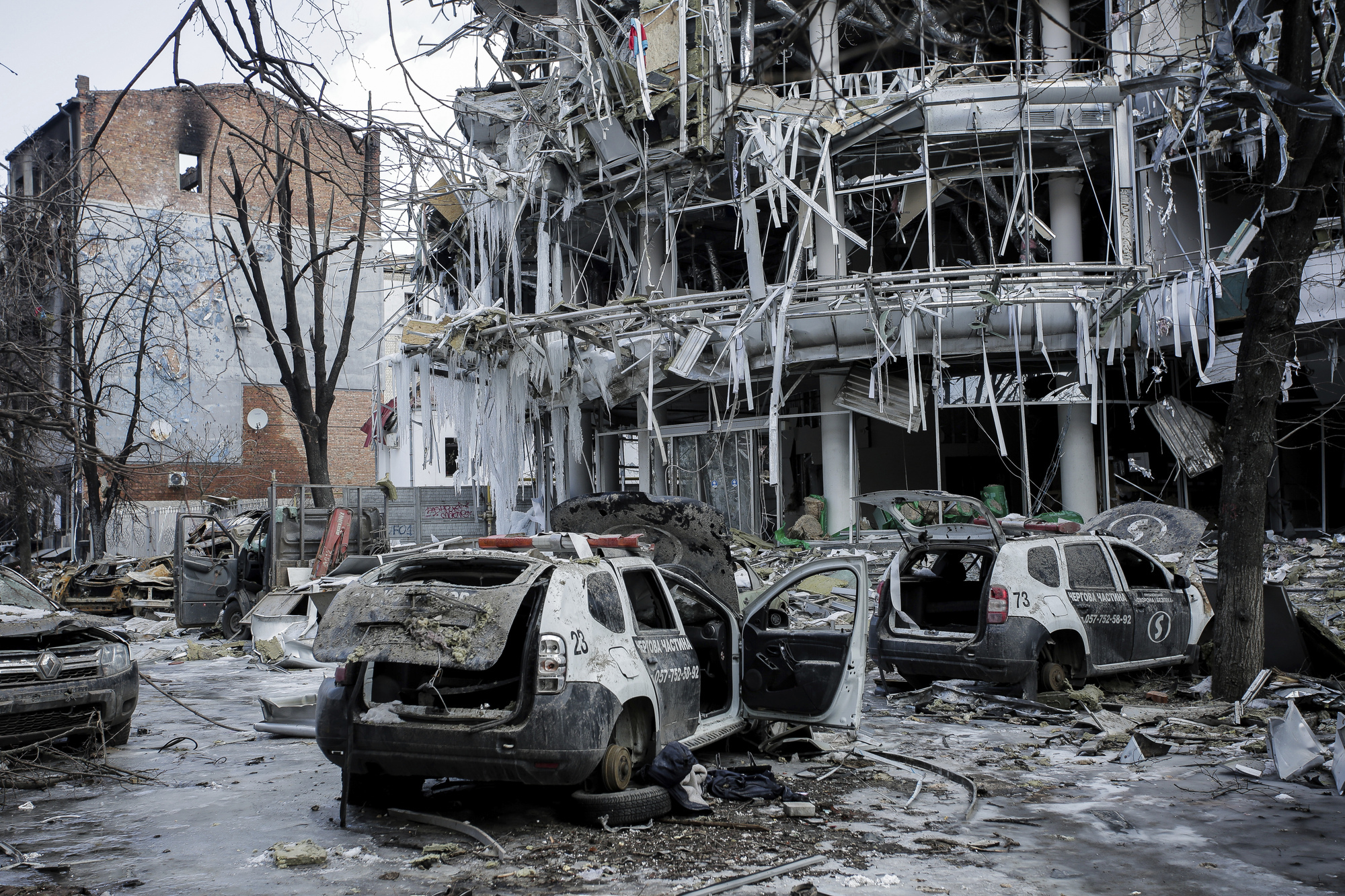
Damaged vehicles sit among debris in Kharkiv city centre in Ukraine on Wednesday. Minister for Finance, Paschal Donohoe, said if the war in Ukraine goes on for months, the EU will not baulk at sanctions. Photo: AP/Pavel Dorogoy
The EU's willingness to impose sanctions on Russia will not dissipate despite European economies suffering, Finance Minister Paschal Donohoe has said.
Mr Donohoe, who is the President of the Eurogroup of Finance Ministers, said EU growth forecasts will be down because of the damage done to economies in the bloc by imposing sanctions on Russia over its invasion of Ukraine.
The Finance Minister, in London for St Patrick's Day, told BBC Radio 4 that the impact on the Russian economy is severe but that the EU has also suffered.
"We've seen the value of their currency plunge, we know the stock markets are closed, they're not functioning. And of course, we have seen a huge change in the level of investment in the Russian economy in turn affecting employment and income.Â
"It is, of course, having an effect on the European economy as well, but the bigger effect is the impact of the war itself. And currently, our forecasts would indicate a reduction in growth for the European economy. But this is something we have to monitor very closely."
However, Mr Donohoe said that the EU will not baulk at sanctions if the war goes on for months.

"Tragically if we find ourselves in that circumstance, we will continue to have the terrible scenes of violence and terror on our screens. I think it would also be the case, though, that if we were in that kind of a situation that governments would do what they can to support their citizens to support businesses in dealing with that cost."
The minister repeated his belief that governments can do little to shield people from rising energy prices and said the war in Ukraine shows the need for energy independence. On finding a solution to the Northern Protocol impasse, he added that Russian aggression has reminded him of "how much we have in common".
"What will happen, as has always been the case from the point of view of the Commission of the European Union, and then the view of the Irish government, we will spare no effort in trying to find an agreement in relation to the implementation of the Northern Ireland protocol," he said.Â
"The protocol is the mechanism that allows us to maintain the balance between the Good Friday Agreement, Ireland's offer of commitment to the European Union and the result of the Brexit referendum, and we will continue to work together to find a resolution.
"What I am reminded of though, as I take a step back, is of how much we have in common between the UK, the European Union and Ireland, as I look at how we are collectively responding back to this war and to Russian aggression.Â
"If I look at the work of your Chancellor, if I look at the work of the government here in the UK, it's an outstanding example to meet. We have more in common than we have in difference."