Gaeltacht academy revives traditional art of skep-making in Cork with free workshops
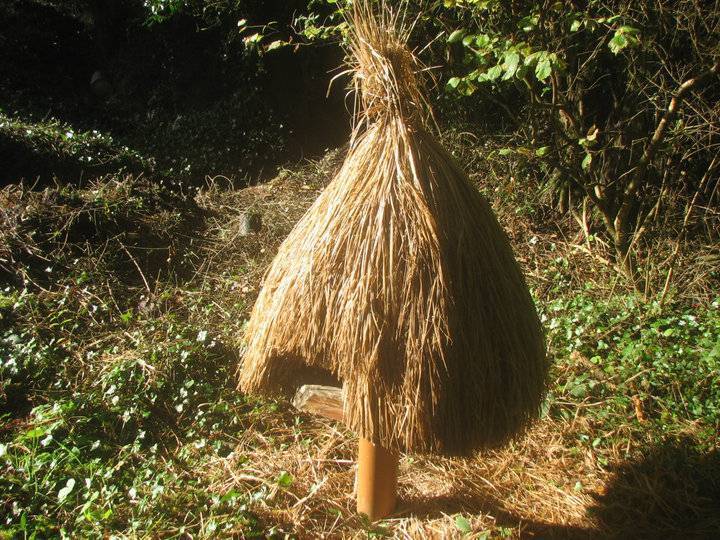

The workshops will take place in Baile Mhúirne, where St Gobnait is reputed to have once lobbed a skep or hive of angry bees at intruders
Gaeltacht academy revives traditional art of skep-making in Cork with free workshops

Composer and broadcaster Peadar Ó Riada described the shape of the skeps as “like a big lampshade”.

In a village synonymous with beekeeping since the 6th century, the traditional art of skep-making is being revived thanks to a series of free workshops.

Baile Mhúirne, where St Gobnait is reputed to have once lobbed a skep or hive of angry bees at intruders, is the location for the weekly workshops, running on Tuesdays until April 12.

Organised by Gaeltacht academy the Acadamh Fódhla, the sessions are led by composer and broadcaster Peadar Ó Riada, who said that while in other areas straw was the material used, the wild grass found in the Cork-Kerry border area was commonly utilised by local skep-makers.

Describing the shape of the skeps as “like a big lampshade”, he said: “Most people are used to seeing them made out of straw but around here they always made them out of fionnán bán, which is the sedge grass which withers and turns white this time of the year.

“It grows on the mountainside and it’s much better than straw. Because it grows on the bog it’s acidic so it doesn’t rot in the same way straw would.”

Mr Ó Riada, who has kept bees at his home in Cúil Aodha for most of his life, also uses timber hives and in recent years has been trialling a top bar hive of African design.

He said the traditional skep compares well with modern timber structures. “I’ve been watching it for years and it’s interesting to see, [the bees] don’t get up and go working at the same time as the bees in the timber hives,” he said.

“With the skep way of keeping bees you don’t get the same amount of honey out of them,” he acknowledged, “but it’s probably a lot healthier”.

“They’re able to control the temperature much easier because it’s so well insulated in the skep, whereas the timber hives wouldn’t be the best for retaining heat and vice versa.

The natural shape of a bees’ nest is oval like a rugby ball and a hive is square so that’s an extra stress. 

"Anything that causes stress affects their immune system and what you’re trying to do is work with them rather than controlling them.”

In contrast to some European systems, where a new skep would be built each year, he added: “The way we used to do it around here is that you have a skep and then you put a second skep on top of it and because bees always put their honey in the furthest part away from the door, they would build a comb and put the honey in the top skep, so you can take that off and leave the bees in the bottom skep again so it’s a much more environmentally-friendly system.”

The Acadamh Fódhla, whose future projects include the building of a traditional boat, aims to ensure workshop participants acquire the skills to build their own skep within weeks and, said Mr Ó Riada, is “always very interested in putting knowledge back into the community”.

The workshops take place in Ionad Cultúrtha an Dochtúir Ó Loingsigh at 8pm, with the first workshop taking place on Tuesday, March 29, and for the next two Tuesdays.

CLIMATE & SUSTAINABILITY HUB

More in this section

Lunchtime News

Newsletter

Keep up with stories of the day with our lunchtime news wrap and important breaking news alerts.

Cookie Policy Privacy Policy Brand Safety FAQ Help Contact Us Terms and Conditions

© Examiner Echo Group Limited