UCC supporting staff involved in Wexford plane crash-landing

Air accident investigators hope to be able to speak to them, and to their pilot whose skills ensured that all four onboard the aircraft survived the mid-air emergency. Picture: Mary Browne
UCC says it's supporting its staff members who survived the miracle crash-landing on a beach after their aircraft suffered suspected double engine failure.
Their pilot has also been hailed a hero for skillfully guiding the crippled aircraft down. Its fuel system and engines are now the focus of the air accident investigation as experts try to establish the cause of the mid-air emergency off the southeast coast on Thursday.
Atlantic Flight Training Academy pilot Captain John Walton, who was flying nearby, who heard the mayday call and who was diverted to the area to help guide rescuers, praised the pilot of the stricken aircraft for getting it down onto the beach near Carnsore Point.
"It could have been a lot worse if they had ditched in the sea, that would have been a different outcome or if the crash landing hadn't been successfully accomplished," he said.
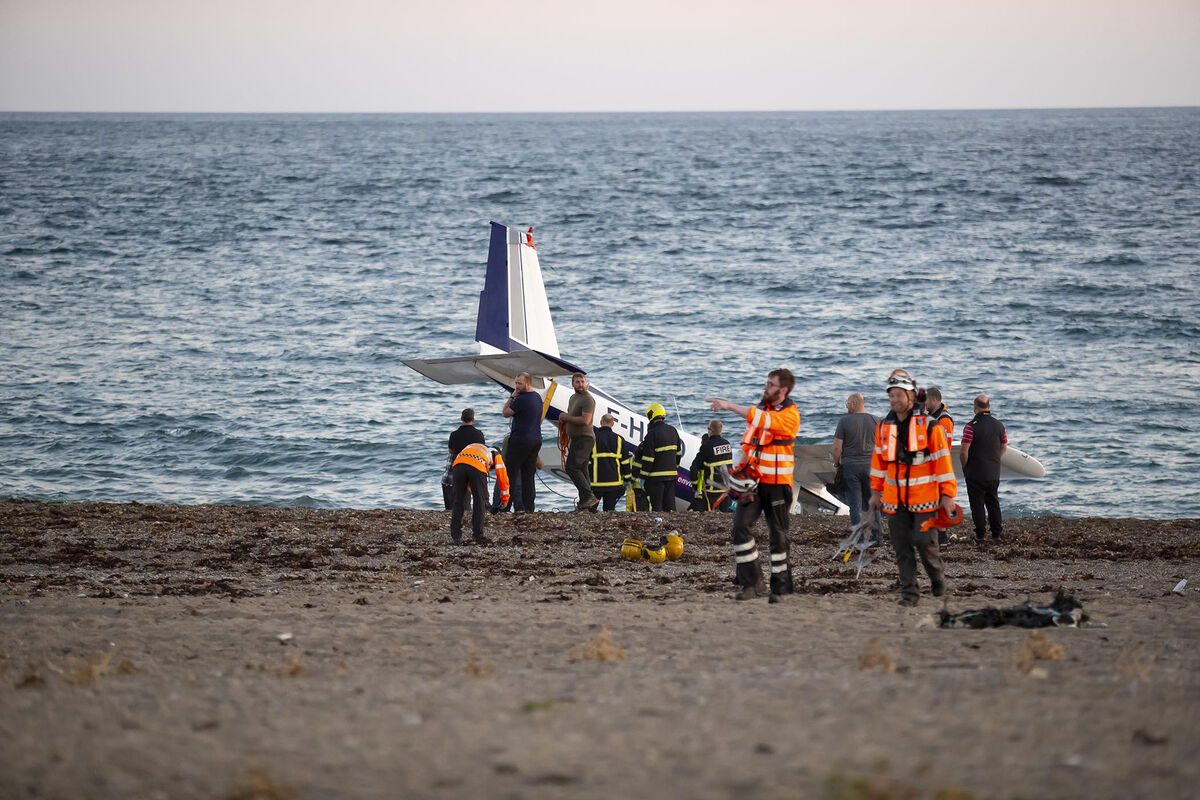
Local councillor and paramedic Ger Carthy, who was involved in the emergency response, praised everyone involved and said the pilot's skill had averted tragedy.
Three researchers from UCC were on board the French-registered Vulcanair P68 twin-engine aircraft with their pilot, a man in his 50s on Thursday afternoon.
The researchers were conducting aerial surveys for marine life, including whales, dolphins and sea birds, in Irish offshore waters, as part of the ObSERVE II project - a major four-year project with researchers from the Netherlands and the US, in association with Action Air Environment, France, to study marine ecology, coastal and marine systems and animal distribution.
The aircraft had spent some time flying a parallel survey pattern over an area of ocean just south of Carnsore Point when the pilot contacted the Coast Guard to declare an emergency just before 5pm.
As the Coast Guard was triggering a full-scale emergency response, the pilot made for land.
The Coast Guard tasked the Dublin and Waterford-based Coast Guard helicopters R117 and R116 to the scene, as well as the Carnsore and Rosslare Coast Guard units and the Dunmore East Lifeboat crew. Gardai and paramedics also rushed to the scene.
Then at around 5.10pm, witnesses saw the crippled aircraft glide down onto a narrow strip of sand between the ocean and a rocky outcrop on the Burrow beach, about two miles west of Carnsore Point.
The pilot had to avoid giant wind turbines at the tip of Carnsore Point.
Shortly after touch-down, the aircraft bogged down in sand and pitched violently forward, crushing the cockpit area.
But all four onboard survived. Two men, one in his 20s and the other in his 50s and believed to be the pilot, and two women in their 30s, were all taken to hospital with non-life-threatening injuries.
A three-person team from the Department of Transport’s Air Accident Investigation Unit hopes to be able to speak to them soon.
The wreckage has been transported to the AAIU’s secure facility in Gormanstown, Co Meath, for a detailed investigation.
The AAIU’s chief inspector, Jurgen Whyte, said as well as a physical exam on the wreckage and chemical analysis of the fuel, statements from those who were on board will be vital.
“Obviously the information from the pilot is going to be crucial to determine what type of technical issue he had and also the examination of the aircraft will tell us what condition the aircraft was in before the emergency took place,” he said.
CONNECT WITH US TODAY



Be the first to know the latest news and updates