Reaction: Robot trees divide Cork commentariat
Picture: Cork City Council
Robot trees might sound dystopian but Cork City Council has managed to get their hands on some, all in the name of tackling air pollution.
Paying €350,000 for the year (including maintenance), the five high-tech robot trees have been installed at St Patrick’s Street and on the Grand Parade near the City Library.
Although the name inspires more futuristic images like the ones below:
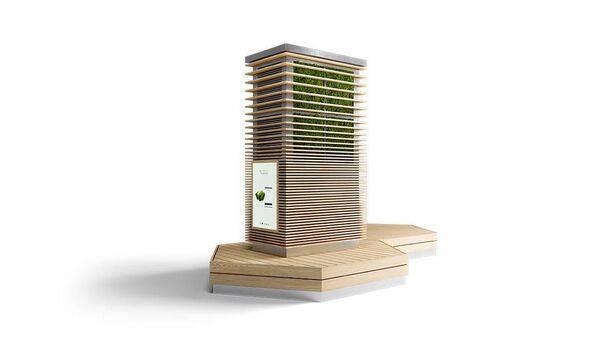
The actual robot trees look like this:

CityTrees are large structures covered in mosses designed to filter harmful pollutants such as fine dust particles and nitrogen oxides (NOx) from the air.
The moss acts as a filter to ‘trap’ and ‘eat’ fine dust, making it a sustainable and regenerative fine dust filter.
Scientific studies by the Leibniz Institute for Tropospheric Research have shown that these 'moss mats' clean about 80% of fine dust from the air.
The CityTrees also have in-built sensors to collate air quality data for analysis and 40-inch TV screens to share information about air quality in the city. They also feature a built-in chair to act as street furniture.
Cork City Council said that they form one part of its strategy to tackle pollution, which also includes the planting of 1,300 trees this year.
Like everything these days, social media users were quick to offer their own takes and reaction to their installation has been mixed, to say the least, and ranged from the humorous:
A city grows great when the council installs trees in whose shade they know they shall never sit.
— Brian Leahy (@cobyhectic) August 9, 2021
- ancient Cork proverb
To the downright outraged:
Is this a joke or are we really in a dystopian film, the world is burning, we have a global pandemic and there are now robot trees!! Read the room @corkcitycouncil , plant real trees and protect the ones that are already there!!
— Shane G (@sg_111) August 10, 2021
And so advanced is this new technology it appears to have attained sentience:
However, their installation has sparked an important conversation online about the urban environment, conservation, and carbon emissions.
Most people questioned the reasoning behind the decision to install the robot trees and asked why real trees were not used instead.
For the same money ye could have planted tens of thousands of actual trees
— Bill (@BilliamMUFC) August 9, 2021
What about actual trees though?
— Áine (@aineg) August 9, 2021
We asked for 🌳🌳🌳in Cork city 🙏
— Frank O'Connor (@frank_oconnor) August 9, 2021
We got these 😳
We must have asked the wrong question 🤔#ClimateEmergency #IPCC #ClimateEmergency pic.twitter.com/hcI3bwOZjX
While others focused on the visual impact of the new trees and the costs to maintain them.
If these are to reduce traffic pollution, try "planting" them in the middle of the road to prevent the problem entering your city. Better yet use some real trees...
— Andy_2000x (@Andy_2000x) August 10, 2021
Anyone running a book on how long until broken, unserviceable and removed?
The city's scientists also made their own contributions.
University College Cork's Dr Eoin Lettice, a lecturer in plant science, said the council should have focused more on reducing traffic congestion rather than installing the city trees.
A point that UCC air quality and atmospheric scientist Dr Dean Venables made when the robot trees were first announced.
Some comments as an atmospheric/AQ scientist on cyber trees & Cork city #airquality:
— Dean Venables (@DeanVenables) October 3, 2020
1ST
It’s a huge positive that AQ is being seriously discussed. @corkcitycouncil is doing innovative monitoring work (incl. with us in @craclabucc) & it’s good to see cllrs engage with the problem pic.twitter.com/D7C6JLz2Ty
For a real look at what the robot trees are able to contribute towards air quality, UCC's John Wenger, an environmental chemist, has published this detailed thread.
The installation of City Trees in Cork has caused quite a stir!
— John Wenger (@johnwenger9) August 10, 2021
This thread contains some commentary & links to recent studies on their ability to remove pollutants from the air.
TLDR: They slightly improve air quality, but only in the immediate area. https://t.co/YGE3MJ4kyW
The huge public interest and response to the new fixtures on Grand Parade and St Patrick's Street prompted local politicians to share their reactions to new robot trees.
Solidarity / People Before Profit Councillor Fiona Ryan was the most scathing in her assessment of the new investment and focused on other expenditure options.
But Green Party Councillor, Dan Boyle, has said in defence of the decision that the robot trees were not a substitute for real trees but instead are meant to have an air quality monitoring role.
Meanwhile, An Rabharta Glas-Green Left Councillor, Lorna Bogue said the response to the robot trees shows "the appetite in Cork City for large-scale urban planting" of trees.
Of course, any spending like this on any new projects attracts many responses from different groups questioning the priorities of their local government and the effectiveness of their decisions.
Irish cities are undergoing great changes as a response to the Covid-19 pandemic especially with reduced traffic volumes and wider pedestrianisation.
And many people ask just how deep-rooted these changes actually are.
It's fitting the installation of the city trees came on the same day the UN published a report from the Intergovernmental Panel on Climate Change (IPCC) on the grave severity of the climate crisis.
Around the world, temperatures might not be "goin' down, down in an earlier round" but if interest like this continues then "sugar, we're goin' down swinging".
There's that Fall Out Boy album reference you were looking for - although these may not have been exactly what the band was thinking of when they called their album From Under the Cork Tree.