Cork boy (12) hailed for highlighting barriers facing deaf people
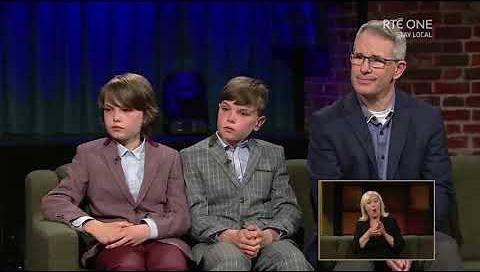
Calum Geary and twin brother Donnacha and dad Andrew, tell Ryan Tubridy about some of the challenges deaf people face in Ireland.
Advocates for Ireland’s deaf community have hailed 12-year-old Cork boy Calum Geary’s appearance on the Late Late Show, and say it should only be the first step toward greater visibility and improved services for deaf people.
Calum, who is deaf, appeared on RTÉ’s flagship programme with his twin brother, Donnacha, and his dad Andrew, and signed to Ryan Tubridy his concerns about the difficulties he faces, not least those caused by the lack of qualified interpreters in the classroom.
“In life, I’ll always face challenges and barriers,” Calum said, noting that deaf students are at an immediate disadvantage in class, as pupils who have full hearing can read a book while their teacher is speaking.
“In sign language, you’ve to really stare at your teacher to try to get what they’re saying and it can be exhausting.”
Calum’s dad, Andrew, who is a garda sergeant living in Ballyhooly, Co Cork, said Irish Sign Language (ISL) should be included in the school curriculum, noting that it is possible to sit the Leaving Certificate in Japanese, Mandarin or Russian, but not in ISL.
“We’ve got brilliant deaf people as brilliant role models on this island. We could put a curriculum together in the morning," he said.
Graham O’Shea, the chairperson of the Cork Deaf Club, praised Calum and Donnacha, saying: “The two boys are fantastic, and gave great expression to their experience of education.
“Many deaf people experience low motivation due to attitudinal and structural barriers which is why their voices need be heard in the media.”
Lorraine Leeson, professor in Deaf Studies at Trinity College Dublin, noted that the Late Late only provided in-screen ISL interpretation for the section featuring Calum and his family, meaning deaf people could not access the whole programme.
“It is very rare to see a deaf child represented on our TV screens, and it is very rare for deaf children to see sign language content on our TV screens.
“Linguistic access cannot be partial, and determined by those who don't know what it is to be excluded.”
Mr O’Shea said the deaf community needs to be consulted more, and media should highlight discrimination against deaf people, which he says is rife in Irish society, and the various social barriers facing deaf people, including unemployment, economic disadvantage, and literacy problems.
Mr O’Shea also highlighted the lack of deaf teachers in Ireland, partially due, he felt, to the requirement that primary teachers speak Irish.
Professor Leeson said ISL needs greater public visibility and noted that RTÉ’s subtitling is often “hit-and-miss” in quality.
“A commitment to have interpretation of the Late Late Show would be a powerful and important step in the right direction for the Irish deaf community.”
Seán Sherlock, Labour TD for Cork East, said ISL should be part of the school curriculum.
“Minister Norma Foley should engage with the National Council for Curriculum and Assessment to inculcate some new thinking around ensuring that deaf people be given an equal footing.”

CONNECT WITH US TODAY



Be the first to know the latest news and updates