Boy, 2, on 'borrowed time' settles action against hospital over missed heart defect
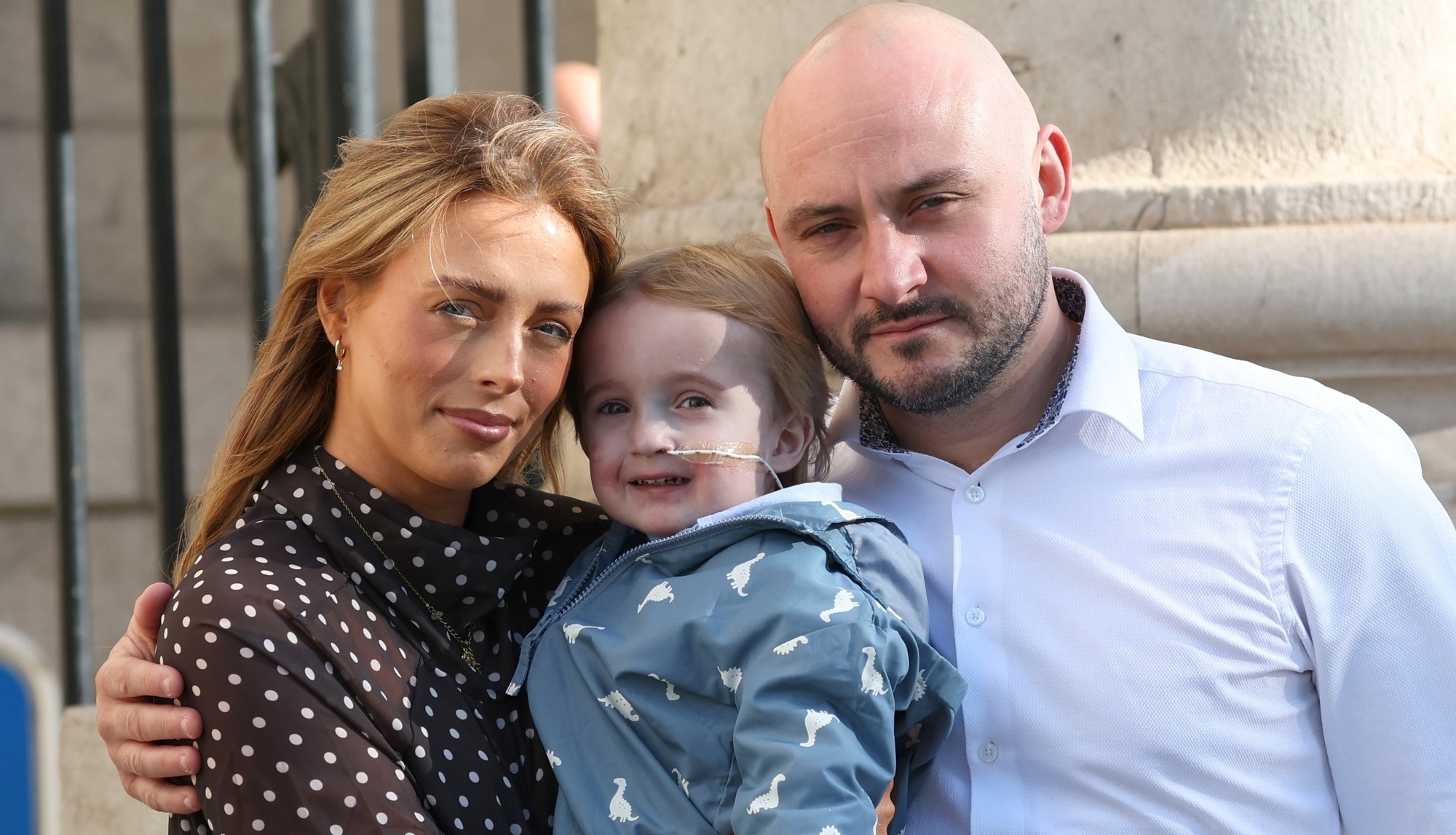
Parents Leonie Kinch (left) and Sean Roche (right) with their son Ollie (centre) outside the Four Courts in Dublin this morning. Picture: Collins Courts
A two-year old boy, who is now on “borrowed time” after it was claimed a serious heart abnormality was not detected in a hospital ultrasound scan before he was born, has settled a High Court action against the HSE.
Little Ollie Roche when he was six weeks old was diagnosed with complex congenital heart disease and his parents thought he could have life-saving surgery. However, within 24 hours they were told that it was too late for surgery and palliative care should be considered.
His counsel, Oonah McCrann instructed by Cantillons Solicitors, told the High Court that Ollie has already defied medical expectations and he is a remarkable little boy. “He is living his best life on what is borrowed time," counsel told Ms Justice Leonie Reynolds.
The little boy along with his mum Leonie Kinch and father Sean Roche from Gorey, Co Wexford, and Ollie’s grandparents were in court for the ruling of an interim settlement of over €1m in the case against the HSE over his and his mother’s care at Wexford General Hospital before and after his birth in November 2023.
It was their case, counsel said, that the heart defect should have been picked up in an ultrasound scan of June 2023 and if identified Ollie would have had to have three surgeries. However, the baby became ill and when at six weeks the condition was diagnosed at a Dublin hospital, Ollie’s parents were told it was now too late.
In a statement outside court, Ollie’s mother Leonie Kinch said in a matter of six weeks they went from the elation following Ollie’s arrival to learning Ollie had a serious heart condition, but believed it could be fixed with surgery to then learning that it was now too late to even do that life-saving surgery.
She added: “The shock and heartbreak of that moment have never left us. The heartbreak was compounded, when following our solicitor’s investigations we learned that Ollie’s heart condition could and should have been diagnosed before he was born.”
Ms Kinch said her son has defied all the odds and keeps fighting but “our family lives with the uncertainty of not knowing what the next day or even the next few hours may bring”.
She said they “live in fear and trepidation that we may see the signs in Ollie of deterioration that we have been advised to be vigilant for. Our days are shaped by caring for Ollie and doing everything we can to give him the best quality of life.”
She added: “It is heartbreaking to live with the fear of what the future may bring. We try to make the most of our time together and take life day by day. Nothing can take away what Ollie and our family have been through, and what we have lost but it means so much that Ollie has finally got justice.
"Hopefully lessons will have been learned that the mistakes in my pregnancy with Ollie won’t be repeated.”
In the proceedings, it was contended that as a result of an alleged failure to identify the baby’s cardiac abnormalities in an ultrasound scan in June 2023, there was a delay in diagnosis until he as six weeks old.
It was further claimed that Ollie’s family were denied the opportunity to receive the best treatment option for his cardiac disease.
Following Ollie’s delivery, it was claimed that there was also a failure to perform accurately or at all a pulse oximetry screening which detects critical congenital heart disease in newborns.
The HSE has admitted that by failing to obtain a clear four chamber view of the baby’s heart and not identifying sub-optimal ambiguous images for follow up, the assessment conducted by a June 27, 2023, scan in Wexford General Hospital was incomplete and fell below the standard of care expected.
It further admitted the failure to identify the baby’s cardiac condition antenatally had adversely affected his survival rate into early childhood years.
The HSE contended that Ollie’s diagnosis of complex congenital heart disease would have adversely affected his life expectancy beyond mid-childhood notwithstanding the failure to identify this diagnosis antenatally.
Approving the interim settlement, Mrs Justice Reynolds wished Ollie well and hoped he continued to thrive. The case will come back before the court in 2029.


CONNECT WITH US TODAY



Be the first to know the latest news and updates