Special garden planted at Dublin's Iveagh House to remember child victims of the Holocaust
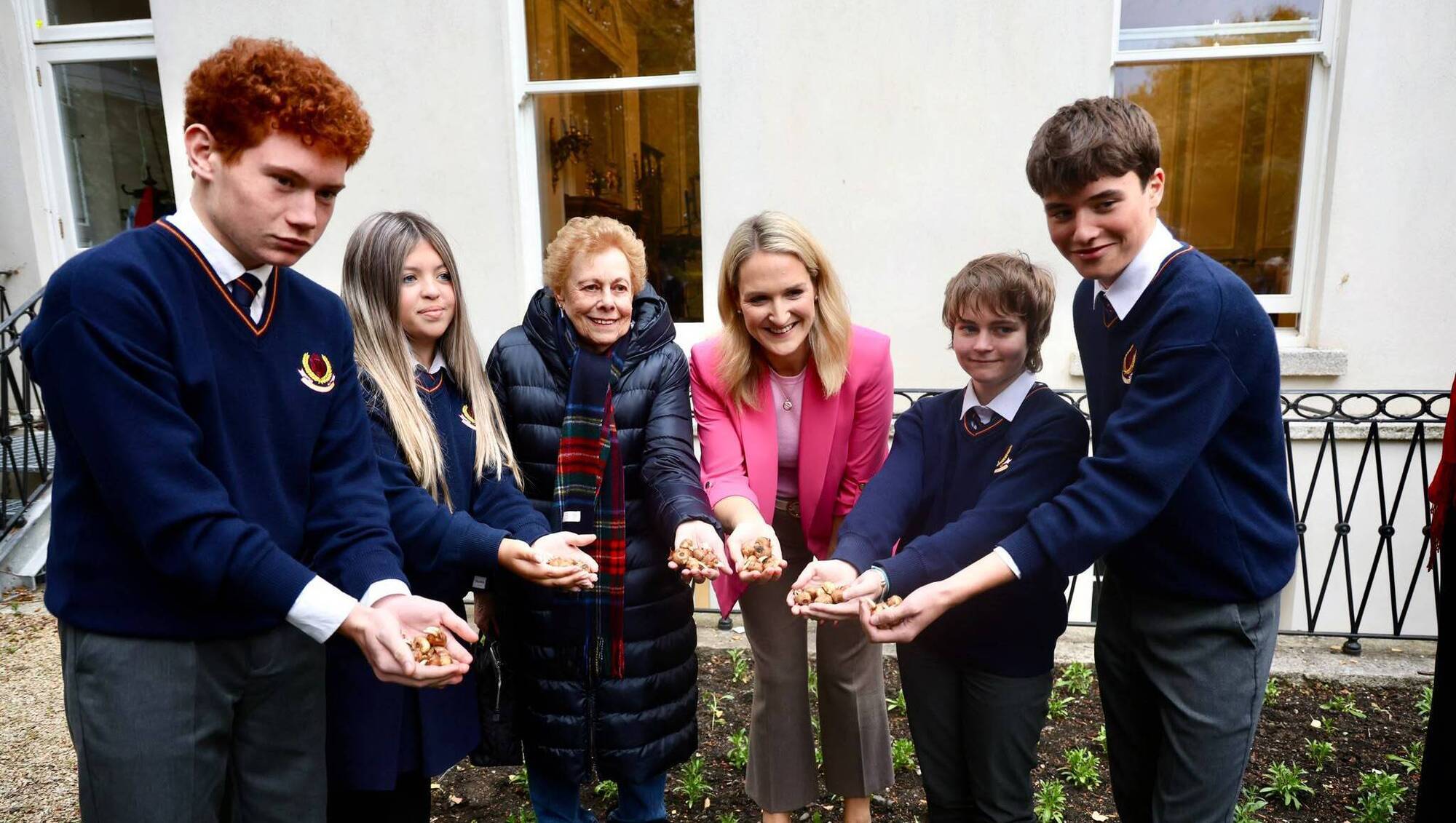
Foreign affairs minister Helen McEntee was joined at Iveagh House in Dublin by Holocaust survivor Suzi Diamond and students from Stratford College, south Dublin, in planting a special garden in memory of the 1.5m Jewish children murdered in the Holocaust and thousands of other children murdered by the Nazis.
A special garden has been planted at Iveagh House in memory of the 1.5m Jewish children murdered in the Holocaust and thousands of other children murdered by the Nazis.
Foreign affairs minister Helen McEntee was joined at Iveagh House in Dublin by Holocaust survivor Suzi Diamond and students from Stratford College, south Dublin.
The Crocus Garden is an initiative of Holocaust Education Ireland (HEI), in conjunction with the Department of Foreign Affairs.
HEI runs The Crocus Project, a programme in schools which invites students to plant yellow crocus bulbs in memory of the genocide of Jewish children by the Nazi regime during the Second World War.
Read More
Speaking at Tuesday's event, Ms McEntee said: “As these flowers bloom and fill the garden here at Iveagh House, they will serve as a reminder of the devastating consequences of hatred, prejudice and antisemitism, and of the one and a half million Jewish children murdered in the Holocaust, and of the millions of other victims of Nazi persecution.”
The minister added: “At a time when antisemitism continues to rise internationally, programmes such as The Crocus Project help ensure that the memory of those who were murdered is preserved and that the lessons of the Holocaust continue to inform younger generations.
“Ireland remains firmly committed to Holocaust remembrance, education and combatting antisemitism."
The minister also remembered Holocaust survivor Tomi Reichental, who died last May, age 90.
A child survivor of Bergen-Belsen concentration camp, Mr Reichental spent much of his life talking in schools about the Holocaust and the need to learn lessons from it.
Ms Diamond, from Debrecin, near Budapest, in Hungary, was found, aged two, along with her brother, Tibor (Terry), aged five, in Bergen-Belsen camp in April 1945.
Bergen-Belsen, located in northern Germany, was characterised by diseases, poor sanitation, limited water access, and limited rations.
By 1945 the conditions, along with forced labour and brutality had murdered around 52,000 people.
It was liberated on April 15, 1944 by British troops.
Of the 1.5m Jewish children killed in the Holocaust, an estimated 200,000 were murdered in the Auschwitz-Birkenau camp, mainly in gas chambers.
An unknown number of Roma children were killed by the Nazis and their allies during the Second World War, with the total number of Roma adults and children who perished estimated at between 250,000-500,000.

CONNECT WITH US TODAY



Be the first to know the latest news and updates