French and history pose 'challenging' papers for Leaving Cert students
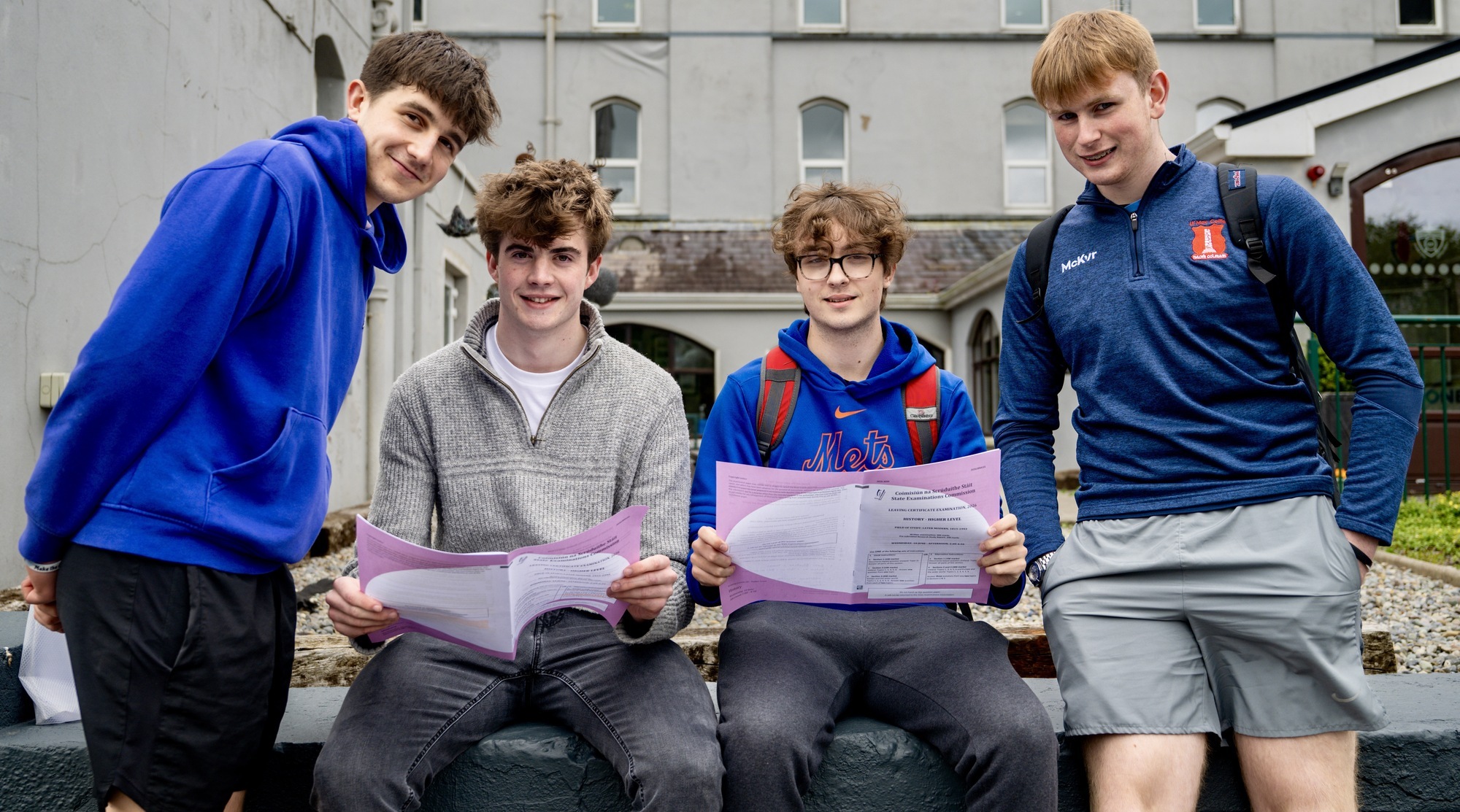
(Left to right) Daniel Garcia, Tony Geraghty, Eoin Kehoe and Darragh Breen outside Rochestown College following their Leaving Certificate History exam. Picture: Chani Anderson
Leaving Cert students faced a day of "tough" exams midweek, with "challenging" exam papers and difficult question phrasing requiring students to think rather than recite.
The second week of the State exams continued on Wednesday with Leaving Cert French, and history, as well as Junior Cycle Spanish and home economics.
Students have now sat all papers in Leaving Cert English, Irish and Maths. Elective subjects will now be examined until the exams conclude on June 23.
Ann Brudell, a teacher at Scoil Mhuire, Convent of Mercy, Co Roscommon, and the Association of Secondary Teachers in Ireland (ASTI) subject spokesperson, said this year's higher-level French exam was "very challenging".
Ms Brudell is also the chairperson of the French Teachers' Association of Ireland (FTA Irelande). “We felt the ordinary level paper was overall very fair," she said.
The vocabulary needed to understand the paper’s reading comprehension questions would have been “accessible” to students.
Read More
However, the use of ‘sabbatique’, sabbatical, would have been difficult for some. “It's not a term they would use in English either, at 17 or 18 [years old].”
However, for the most part, the reading comprehension was fair and used vocabulary students would have prepared in class, she said. Likewise, the paper’s written production tasks were also predictable and followed the types of tasks set in previous papers.
“Overall, we would endorse that paper.” However, the higher-level paper was a “very challenging” paper, she believed.
The paper included “predictable” questions on topics such as holidays and learning a language, which would have been welcome to the students.
“However, some of the topics in both sections, reading and writing, would have been outside of the lived experience of many 17- or 18-year-olds.”
This included tackling the housing crisis, and driving schools. “They were asked to describe their first day taking a lesson in a driving school."
Even questions on familiar topics, such as fast fashion, were “very demanding” in terms of the required grammatical skills and vocabulary base.

“We also felt there was a lot of manipulation needed, due to the difficult phrasing of some questions. At times, the students' understanding of the question was based on their understanding of a specific word or ambiguous word.”
“We were very happy with the ordinary-level paper, in general we were happy with that for the most part. The higher level paper, however, we did feel it was very much a challenging paper for students.”
Meanwhile, the higher-level history paper was a "tough exam", according to history teacher Patrick Hickey, who posts online as @lchistorytutor.
"It rewarded the student with genuine breadth of understanding rather than the one who banked on predicted questions and rehearsed answers."
The paper required students to think rather than recite, he believed. An example of this could be seen in the paper's documents-based question on the GAA to 1891, which set a critical contemporary report against a far more positive account of the association’s growth.
This was a "fair pairing", but the question's mini-essay also required precise knowledge of the political problems of the period rather than a general overview.
"The same pattern ran through the rest of the paper," Mr Hickey said.
The paper's question on American foreign policy avoided "obvious signposts", he believed, with no "clear steer" towards Cuba or Vietnam.
The paper's dictatorship and democracy question on Britain also extended right through to 1945, leaving students who prepared as far as 1939 needing to "dig deep".
"Several of the Northern Ireland questions were pitched narrowly, including a very specific question on Gerry Adams, which gave students fewer easy choices than they might have hoped."
Mr Hickey said: "Well-prepared, adaptable students will have done well, and they deserve great credit, but there is no doubt this was a challenging examination."
- Jess Casey is education correspondent for the


CONNECT WITH US TODAY



Be the first to know the latest news and updates