More than 400 charges issued under Coco’s Law as intimate image abuse rises
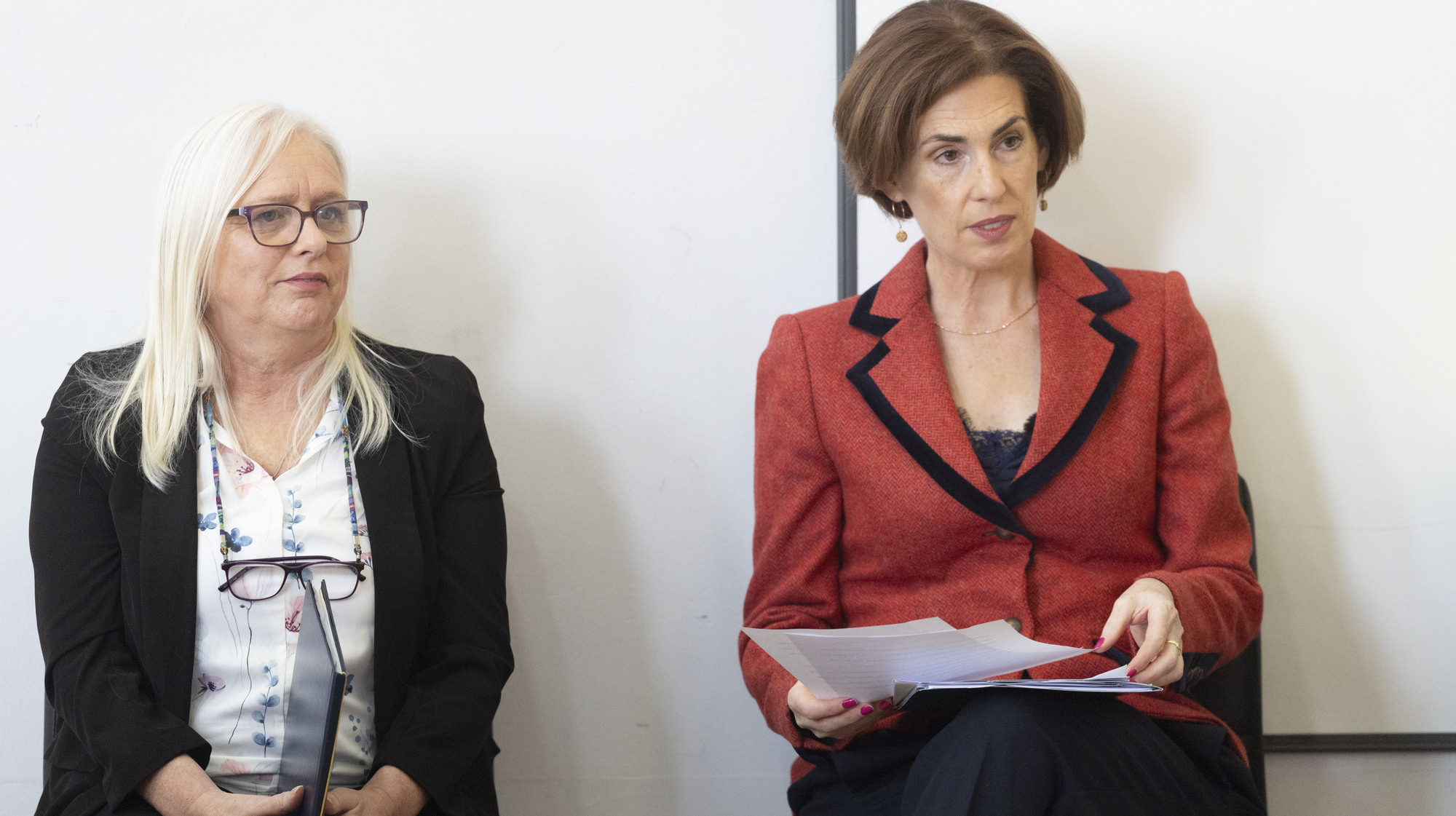
Jackie Fox (left) and minister for education and youth Hildegarde Naughton at Friday's launch marking the addition of a new lesson on Coco’s Law to An Garda Síochána’s Schools Programme. Photo: Sam Boal/Collins Photos
More than 400 charges and summonses have been issued under Coco’s Law, as human rights organisations raise concerns about the surge in the non-consensual sharing of intimate images.
Figures released by An Garda Síochána have shown there were 1,860 "harmful communication" incidents recorded by gardaí since 2023.
The Children's Rights Alliance has warned that the true picture is not reflected in the figures as the garda statistics do not include young people, under the age of 18 years, who have been processed through the Juvenile Diversion Programme.
The garda figures show that between January 1, 2023, and February 28 this year, they received:
- 552 reported incidents of distributing grossly offensive communication to cause harm
- 1,140 reported incidents of distributing, publishing, recording intimate images
- 175 reported incidents of recording intimate images causing interference or alarm
Read More
Gardaí released the figures to mark the launch of a new Garda Schools Programme on Coco’s Law, which will be rolled out in secondary schools.
It was officially launched by minister for education Hildegarde Naughton and Jackie Fox, whose daughter Nicole, also known as Coco, died by suicide in 2018 after she was bullied online.
Jackie had campaigned for the introduction of Coco’s Law, which criminalises the non-consensual sharing of intimate images and the sending of threatening or offensive communications.
Ms Fox said: “Nicole’s legacy is now written into the law of this land, but its true power lies in education.
"Seeing this lesson enter schools means that other families might be spared the heartbreak we endured. This is about teaching our children that their online actions have real-world weight."
Noeline Blackwell, online safety co-ordinator with the Children’s Rights Alliance, said that while the figures provided by the gardaí do not accurately reflect the sheer number of incidents, they do prove that further action is needed to combat the rising level of threats.
“It shows how necessary the legislation was that the gardaí have that level of actual investigations and charges going on relating to adults," said Ms Blackwell.
"It says that the gardaí are aware of the seriousness of this offence and taking it seriously. And that should give people the confidence to report.
"It also shows that people are beginning to understand that they don’t have to be ashamed if their image is shared non-consensually. The shame is with the person who shares it and people can report it and should and can get help for themselves.”
The chief executive of Women’s Aid, Sarah Benson, said the sharing of intimate images is becoming “increasingly prevalent”.
The normalising of this sharing, particularly among young people, is “very connected to the negative impact of ubiquitous levels of pornography,” she added.
Ms Benson said that when the sharing of intimate images occurs, it is “utterly devastating” for the victim.

CONNECT WITH US TODAY



Be the first to know the latest news and updates