Travellers 'have to hide their identity in order to survive'
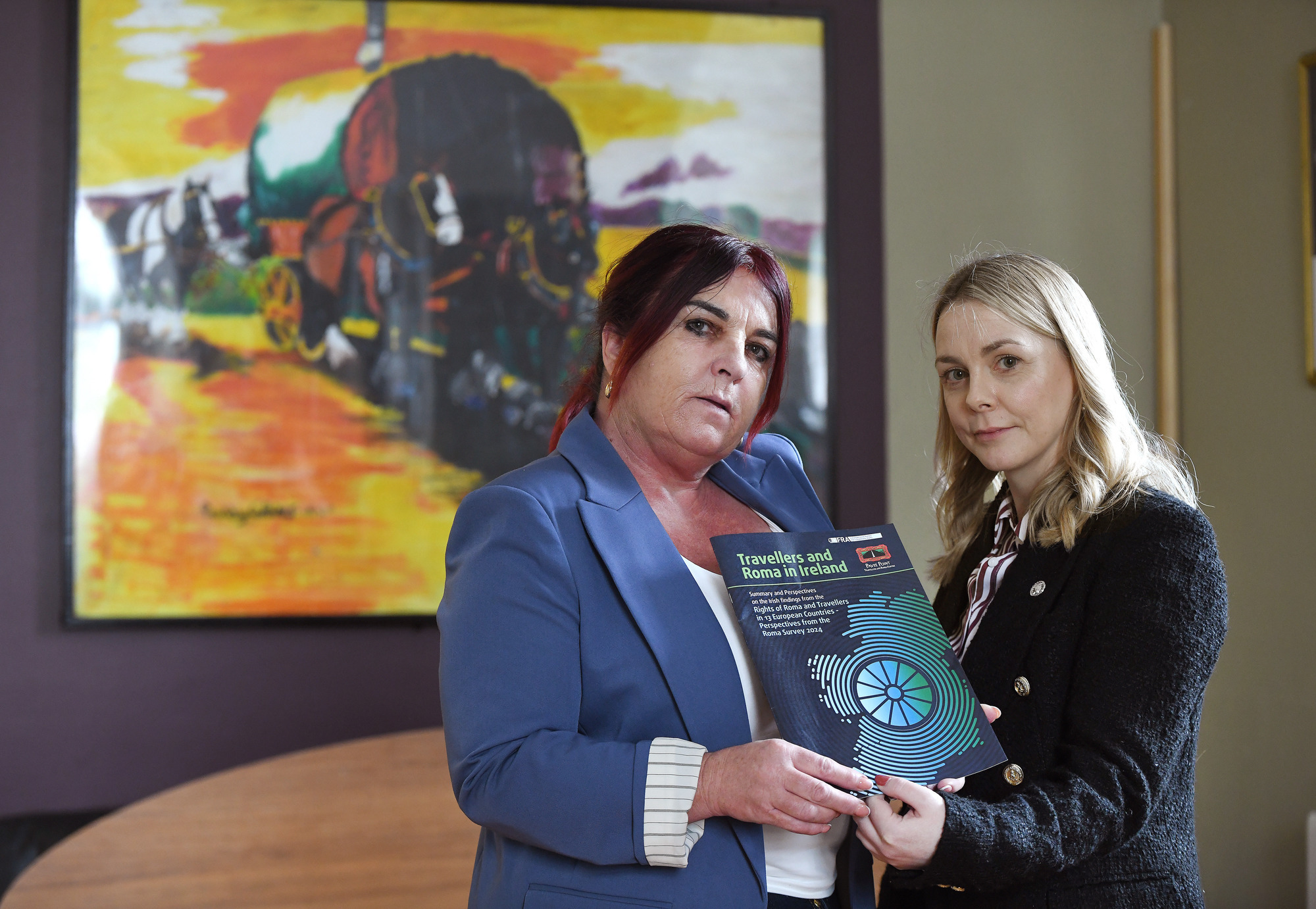
Dr Lyndsey Kavanagh co-director, right, and Mary Brigid Collins, primary healthcare co-ordinator of Pavee Point at the launch of a report 'Rights and Living Condition of Travellers and Roma in Ireland 2024'. Pictures: Moya Nolan
Travellers “have to hide their identity in order to survive”, attendees heard at the launch of a survey on Traveller and Roma rights on Wednesday.
The survey found:
- Traveller and Roma women live almost eight years less than women generally in Ireland;
- Traveller and Roma men live almost 11 years less than their peers — suggesting an EU-target of halving this gap by 2030 is “not likely to be achieved”;
- Over one in three Travellers felt discriminated against when they tried to get healthcare;
- 22% of adult Travellers are now in paid work, a 7% increase on the 2019 survey;
- There is“a slight increase” to 68% of Traveller children in early years education;
- 27% of Travellers aged 20-24 have completed at least upper secondary school, up from 22% in 2019.
Martin Collins, co-director of the non-governmental organisation Pavee Point, highlighted concerns about “having to hide one’s identity in order to survive, whether that’s in the schoolyard, in a classroom, in the workplace... And it’s really sad.”
He warned: “Some Travellers feel compelled to hide their identity in order to avoid discrimination.
The survey of 415 Travellers and 106 Roma was part of an EU Agency for Fundamental Rights (FRA) survey across 13 countries.
Researcher and primary healthcare co-ordinator Kathleen Ward said: “People felt truly heard.
“It was a positive experience for all of us and what made it work so well was it was Travellers talking to Travellers, Travellers interviewing Travellers.”
The survey found three out of four Travellers and two out of three Roma experienced discrimination in the year before the survey was done.
Researcher Gabi Muntean said: “Racism and discrimination, harassment and hate crime are daily realities for many people.
“As a Roma women we face this every day, and it becomes annoying. Today, we have to teach our young people we are equal and we need to fight for our rights.”
She said families "don’t want to say they are from the Roma community because our children have issues in school, they are being called names or we won’t get a good job if we say we are from the Roma community"
Pavee Point co-director Lynsey Kavanagh told the : “The findings are not shocking to people working in this area. They need to be contextualised in the broader world in terms of the rise of hate speech and general homelessness issues.
“For us, it’s about ensuring the hard-fought for polices are implemented and they’re resourced and delivered on.”
Ms Kavanagh added: “We need more ambition and we need to be able to deliver on this, and work together [with Government] to make sure there is effective change.”

CONNECT WITH US TODAY



Be the first to know the latest news and updates