First dictionary of ancient Celtic spoken 2,000 years ago to be compiled by linguists
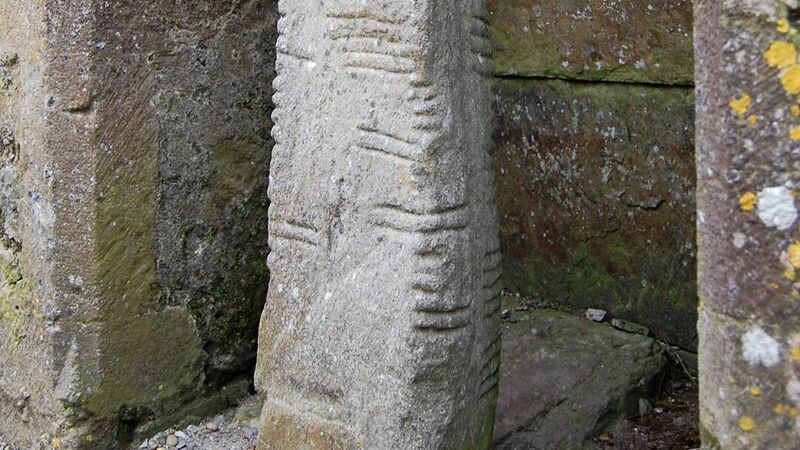
Inscriptions on stones using the Ogham alphabet will provide source material for the new Celtic dictionary.
It is not likely to be a hefty volume because the vast majority of the material has been lost in the mists of time.
But the remnants of a language spoken in parts of the UK and Ireland 2,000 years ago are being collected for what is being billed as the first complete dictionary of ancient Celtic.
The dictionary will not be huge because relatively few words survive, but experts from Aberystwyth University say they expect they will end up with more than 1,000 words.
Sources for the dictionary will range from Julius Caesar’s account of his conquest of parts of northern Europe to ancient memorial stones. It will include words from about 325BC up to AD500.
Dr Simon Rodway, a senior lecturer in the department of Welsh and Celtic studies at Aberystwyth, said it was exciting to be involved in compiling the first dictionary of its kind.
“The picture of the linguistic landscape of Britain and Ireland will be of interest not only to linguists but to historians, archaeologists and archaeogeneticists.”
Elements of modern languages such as Welsh, Irish, Scottish Gaelic, Breton and Cornish have some roots in their ancient Celtic counterparts.
The team compiling the dictionary say while modern Celtic languages are often different from each other, similarities can be seen between words.
For example, the words for sea in Welsh and Old Irish — môr and muir — correspond to “Mori” in Celtic names such as Moridunum, which means “sea fort” and is an ancient name for Carmarthen in south-west Wales.
Rodway said: “With the exception of a very small number of inscriptions from Roman Britain in Celtic languages, we’re dependent on documents that are written either in Latin or Greek, but which contain names of places, ethnic groups or individuals that we can say are Celtic.
“People have studied placenames before and a few inscriptions, but we’re going to try and get everything together and see what patterns emerge.”
As well as Caesar’s writing, there are fragments of Celtic to be found in administrative records made by the Romans when they arrived in Britain.
“We’ve got quite a lot of material from Roman Britain, including letters from soldiers stationed here. It’s almost all in Latin but you get the odd Celtic word in there,” Rodway said.
He said the bulk of the material would come from the Roman period in Britain, from the first to the fourth centuries AD, and from the middle of the second century onwards in Ireland.
He said: “There’s much less from Ireland from that period, because it was never part of the Roman empire.”
Another source is inscriptions on stones in places such as Cornwall and Ireland that use the Ogham alphabet, a system of straight lines designed to be carved on to stone, metal, bone or wood.
“In north-west Europe, in the early period, we don’t have very much written history. If you’re in the Mediterranean, you’ve got Greeks and Phoenicians and Romans and Etruscans writing stuff all the time.
“Once you get to the north of France and Britain you don’t have much at all. We’ve got placenames and the personal names and you can start to try and reconstruct some sort of a narrative out of that.”
The plan is to produce online and printed versions of the dictionary.
CONNECT WITH US TODAY



Be the first to know the latest news and updates