Ireland’s cleanest bathing waters revealed in new EPA water quality report

Children ride the waves in the crystal-clear waters off Inchydoney, West Cork, during a fun-filled session with the local surf school. Picture: Dan Linehan
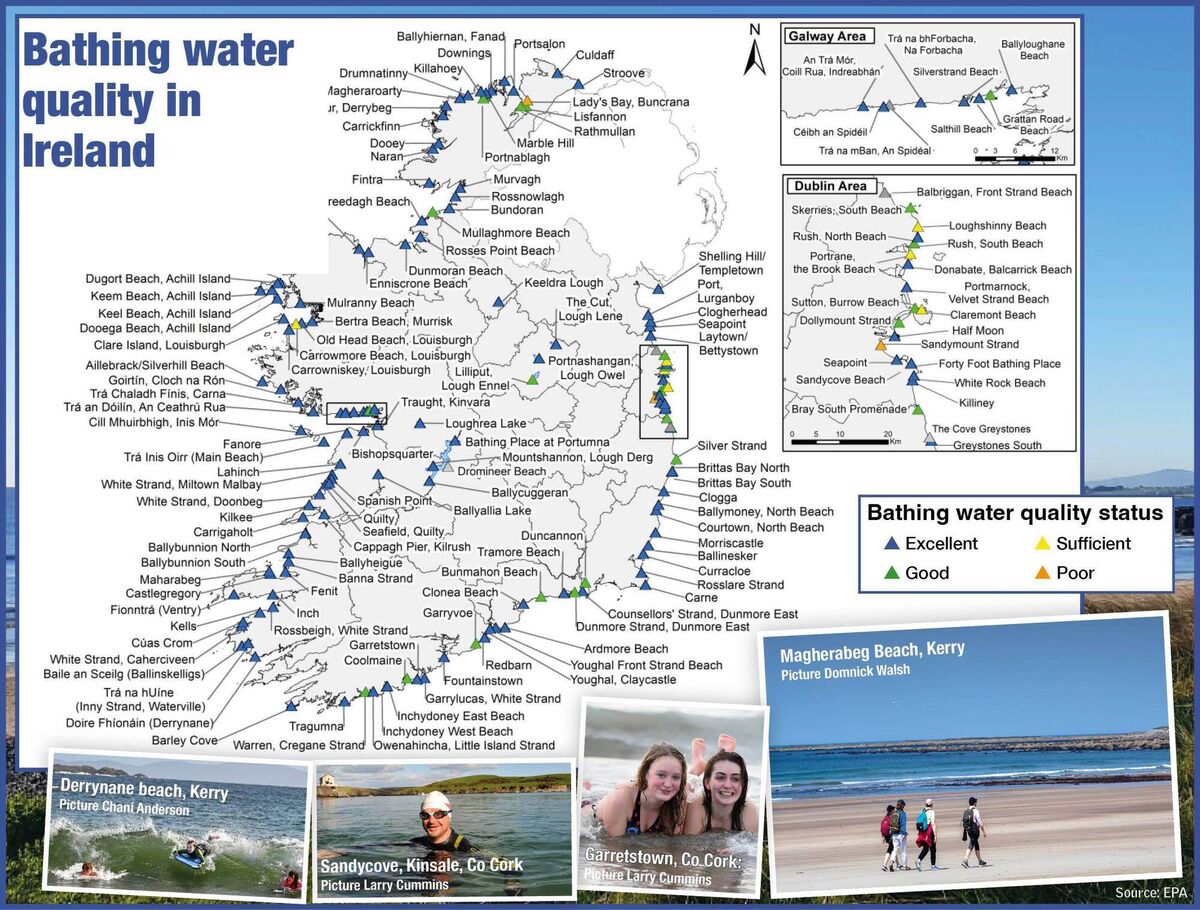
Ireland’s bathing waters have been given a near-perfect clean bill of health.
According to the Environment Protection Agency (EPA)’s the quality of the majority of our bathing waters is rated either “excellent” or “good”.
Some 96% of the 151 identified bathing waters met or exceeded the minimum required standard of “sufficient”.
A total of 122 bathing waters were rated as “excellent quality”, the highest number since 2014 — when the “excellent” classification was introduced — which is an increase of eight since 2023.
Just two bathing waters were classed as “poor”, down from five in 2023. These were Lady’s Bay, Buncrana, and Sandymount Strand, Dublin. As a result, they will have swimming restrictions for this year’s season.
The director of the agency’s office of evidence and assessment, Eimear Cotter, said: “We are happy to bring a positive news story on our bathing water quality for 2024, which is overall very good.
However, she said heavy rainfall during another bathing season “emphasised the need to build climate resilience into the management of bathing waters”.
“Heavy rainfall in the West and North-West last August resulted in many beaches being closed to protect swimmers’ health.
“Local authorities must step up their efforts to improve their understanding of causes of pollution from heavy rainfall and how this impacts beaches.”
In 2024, the EPA was notified of 34 pollution incidents which resulted in the closure of bathing waters — down from 45 in 2023.
The majority (18) were due to the presence of pollution in sample results and, in one case, due to algal blooms. Bathing waters were also closed as a precaution after overflows in the sewer network 15 times.
In 2024, there were 79 “prior warning” notices by local authorities when there were potential pollution events that could affect swimmers’ health. The number given in 2024 was 149 less than 2023, and 81% of them were reported during August.
The annual report on bathing water quality in Ireland during 2024 is based on data supplied by local authorities who monitor and manage bathing waters in their area.
Each year, local authorities take samples of bathing waters just before and during the bathing season.
The EPA classifies water quality at beaches and lakes in four ways: “Excellent”, “good”, “sufficient”, or “poor”.
The minimum mandatory requirement is for “sufficient” quality.
That any bathing water is classified as “poor” means there is a risk of microbiological pollution present, which could cause illness such as skin rashes or gastric upset.
Overall, there was less rainfall in summer 2024, compared to 2023, the report noted. However, there were periods of heavy rain in August — resulting in increased incident reporting along the West coast.
This, the EPA said, highlights the need to build “climate resilience” into the management of pollution from pressures driven by heavy rainfall — including overflows from urban wastewater systems and run-off from agricultural land.
CONNECT WITH US TODAY



Be the first to know the latest news and updates