Taoiseach hits out at 'extortionate' €350k cost for Leinster House bike shed
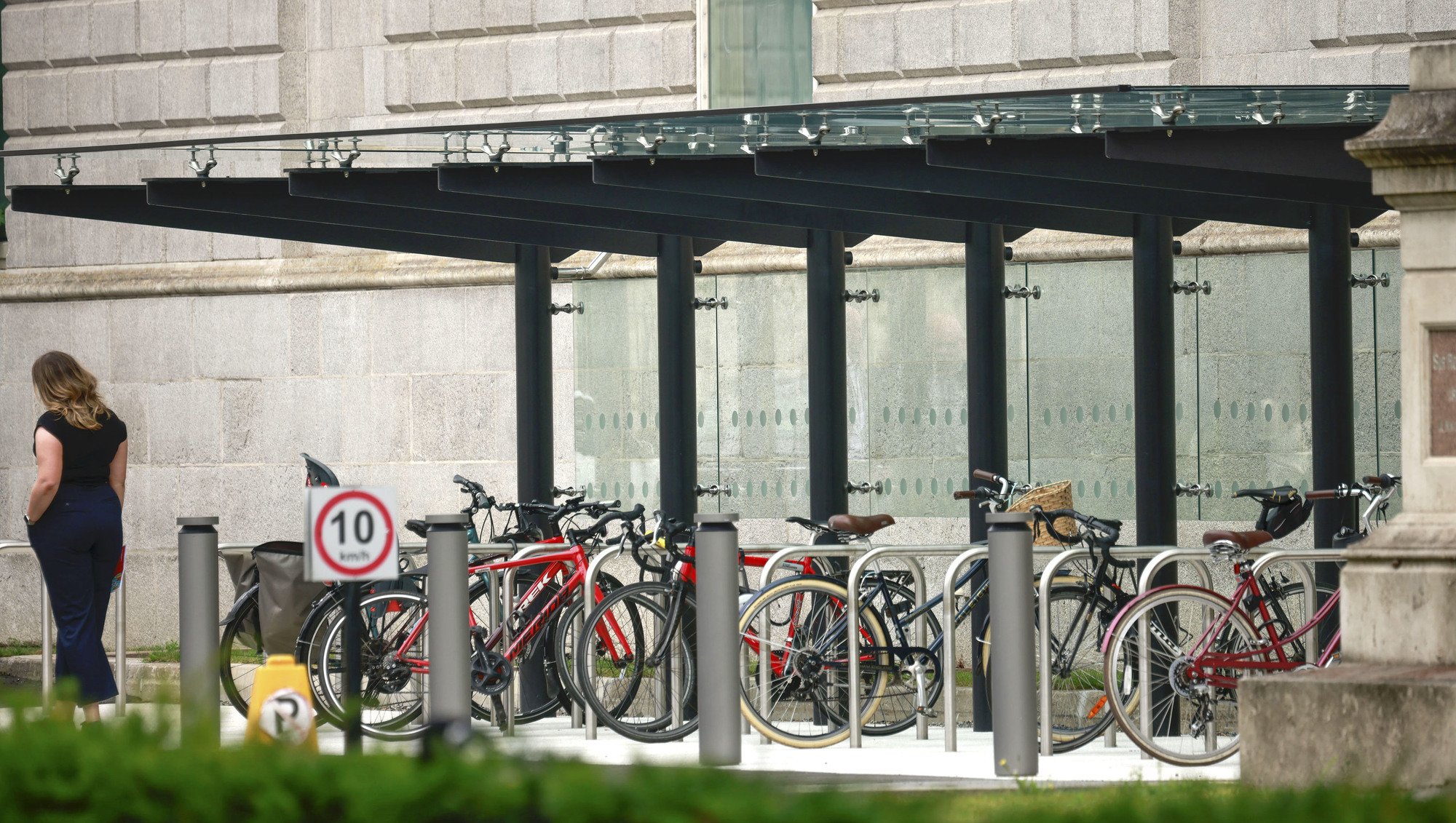
The Leinster House bike shed. Picture: Arthur Carron/Collins
Taoiseach Simon Harris has described the €335,000 bike shelter on the grounds of Leinster House as being “extortionate”
It comes as Kieran O'Donnell, Minister with Responsibility for the Office of Public Works (OPW) has requested an immediate full review around the construction of the shelter.

“I think everybody can see the benefit of having somewhere to park a bike in the workplace, people get that. What they don’t get is the extraordinary sum of money that this has cost and I don’t either, quite frankly,” Mr Harris said.
“I think it is inexcusable and inexplicable.
"This is the sort of thing that rightly angers and annoys people and it angers and annoys me as well because yes, workplaces should provide somewhere to park the bike, grand.
“But they shouldn’t do it in a manner that is lavish or extortionate in relation to the public purse.”
Mr Harris said he welcomed the investigation that was now being launched by the minister.
The shelter, which holds 18 bikes, cost €322,282 for construction and installation, according to the breakdown of costs from the OPW.

A further €2,952 was spent on archaeological services while €10,816 was paid for quantity surveying services and “contract administration services”.
In a statement, the OPW said the project was procured via a framework agreement and complies with public procurement and planning guidelines.
It also said: "We recognise the importance of ensuring that public money is spent transparently."
The bike shed involved "several unique challenges" and it was stipulated in the planning application, it was to have no material impact on "the historic fabric of Leinster House".
The structure consists of a steel-framed, glazed canopy to ensure long-term durability, the OPW said.
"The materials used, including Irish granite, glass and steel, were carefully selected not only for their durability, but also for their compatibility with the historic setting of our national parliament."
Tánaiste Micheál Martin said that it was an “incredible cost for a mere bike shelter”, while Justice Minister Helen McEntee said that she believe it was an “astronomical” amount of money to pay.
On Monday, Minister for Transport Eamon Ryan has said the €335,000 price tag on was an "incredibly expensive" figure.
The shelter had previously been hailed by Mr Ryan as a good example of public sector climate action but when asked on Monday about the costs involved, he said the Office of Public Works (OPW) has questions to answer.

"I think we have to show that we spend the public money wisely and that cost, to me, seems very, very high," he said.
Mr Ryan said he looks forward to speaking to the OPW to see why it was so expensive but acknowledged that it is "sensitive" and they may have legitimate reasons.
Asked about the costs involved, a spokeswoman for the OPW said: “The bicycle shelter is a new structure located within the setting of Leinster House, a protected structure of national importance.
“In response to the character of the historic setting, a well-designed structure with an appropriate use of high-quality materials and finish was required.”
Asked for a copy of the scoping documents involved in the work, the Office of Public Works refused to provide them.
They claimed these had been prepared as part of a planning application and could not be released for “security reasons”.
The stand was built with a special cantilevered canopy that is designed to protect from the prevailing northerly winds. It has not been fully enclosed however, with some believing it leaves their bikes too exposed to the elements.
Mr Ryan shared concerns that if such climate action measures cost large amounts then it will reduce the amount of projects that can be undertaken.
He gave the example of the need for more bus shelters as increasing numbers are using public transport, saying: "If they are all that expensive then we won't deliver them".
"This could be a useful lesson to say 'hold on a second, how can we deliver good architecture, good street furniture, good support for what the people want but not make it so expensive?'" Mr Ryan said.
"Maybe in some ways, this case, might make the case for us doing things cheaper and standardising so it won't be as expensive."