Lack of funding and government support forces Oiled Wildlife Response Network to close
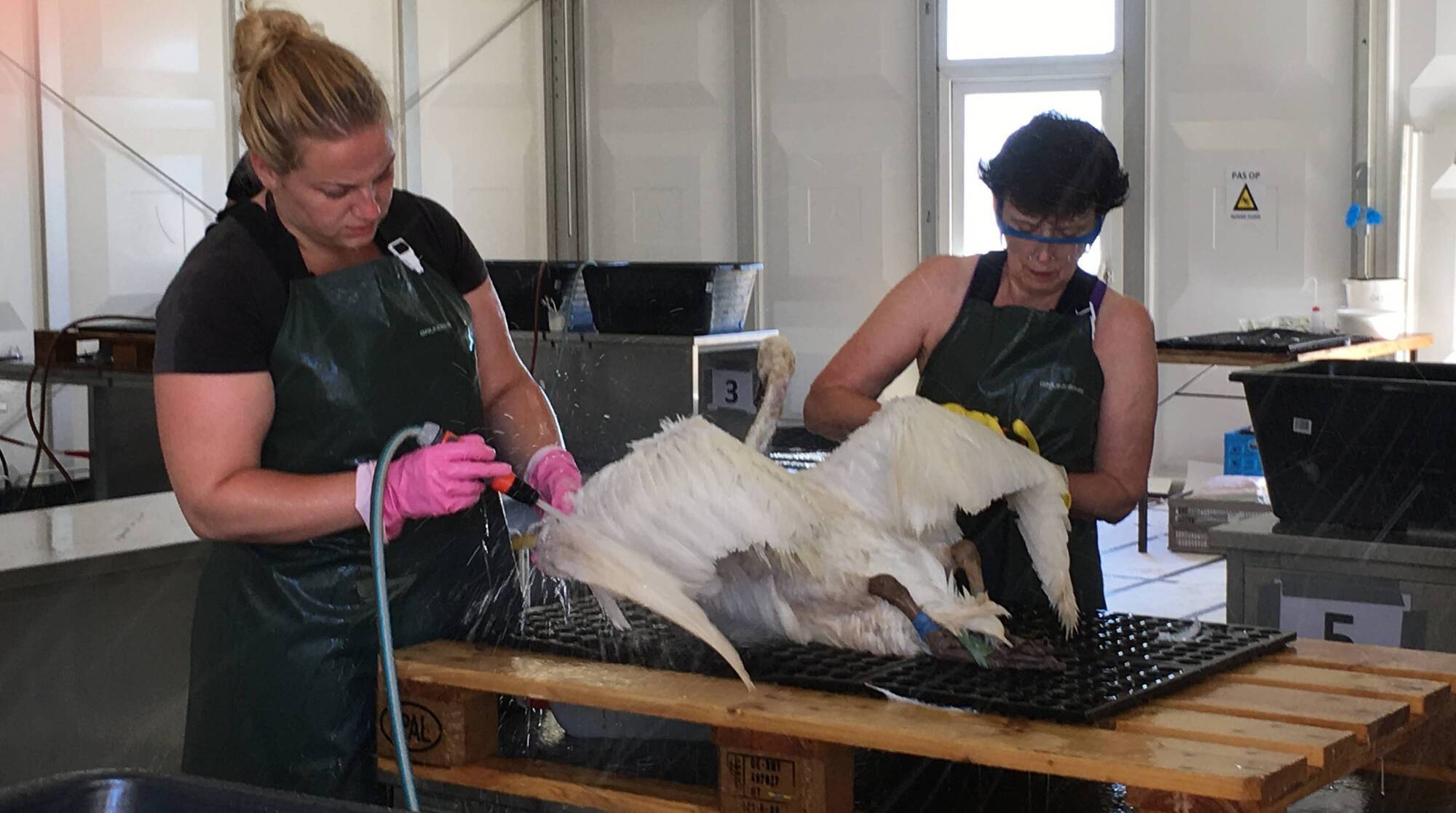
Pauline Beades (right) of the Oiled Wildlife Response Network training with Sophie Ward in Holland. 'We have tried desperately over the years to come up with some sort of funding framework.'
The Oiled Wildlife Response Network (OWRN) has announced the “heartbreaking decision” that it is winding down its operation, after 20 years, blaming a lack of government support and funding.
The move comes despite the network playing a key role in overseeing the rescue of 150 oiled birds off the east coast recently. OWRN is a group of specialist conservation and animal welfare organisations who train volunteers to act as ‘first responders’ in the event of an oil spill.

Pauline Beades, founder of the organisation, told the the group can “no longer cope with a lack of funding and resources”. “It’s heartbreaking” she said. “We have tried desperately over the years to come up with some sort of funding framework.
“We presented at the national forum for the coastguard, and we suggested a very simple way of funding us. We weren’t looking for a huge amount of money.
“We wanted to pay two staff members and we wanted a plan for wildlife written in the legislation — that’s all we asked for and we got nowhere. Ms Beades said it would have cost in the region of €150,000 per year to fund an office and two staff. "It beggars’ belief — we are not looking for millions”.
CLIMATE & SUSTAINABILITY HUB
“So unfortunately, at the end of March we made the very sad decision to close up shop and wind down the organisation. We are only making the announcement now."
Former Harbour Master at Shannon Foynes Port, Hugh Conlon, of Shannon Estuary Anti-Pollution (SEA-PT) said “it’s very disappointing" that OWRN is closing. "They are an important service."

“They don’t come to light until a disaster happens, people tend to forget until it is too late.
Ms Beades said they had made the decision to close when their services were urgently needed. "Ironically, we had made the decision to wind down and then we heard that oiled birds were reported all along the east coast.
“We got involved of course with several groups including the National Parks and Wildlife Service (NPWS), Kildare Wildlife Rescue and BirdWatch Ireland.
“We did whatever we could."
In May, 150 birds were lifted by wildlife volunteers from an area that stretched from Skerries in north Dublin to as far as Rosslare in Co Wexford.
Several organisations received reports of a possible oil or tar substance on a number of beaches and seabirds with oil on them at the time.

Images of Guillemots and Razorbills covered in a black substance later hit the headlines as hundreds of wildlife rescuers combed the coasts, to try and save them.
Minister of State with responsibility for nature, Malcom Noonan promised a total of €50,000 to help with the incident which he said was "shocking and extremely concerning".
However, many wildlife volunteers have hit out at the investigation carried out in the aftermath which claimed there was “no evidence of pollution”.
While Wicklow County Council said: “The presence of oiled birds was confirmed on the beaches at Greystones North and Brittas Bay North." In a statement to the , Wexford County Council said they carried out “extensive investigations” but found “no evidence of pollution”.

The Department of Transport told the : “The Coast Guard carried out aerial monitoring flights of the area and no spill was detected.” The EPA said while it was not directly involved in the investigation, "it had offered our assistance and support as required”.
However, both Bird Watch Ireland and Kildare Wildlife Rescue insist there was a serious oil incident and it "should be a wake-up call”.
Ms Beades said she is “deeply frustrated” at the response from the investigation.
“I’ve never seen anything of this scale. Birds were coming in for breeding season and then they hit the oil and got very distressed.
“Up to 150 birds were picked up, including the corpses of some. Several had to be euthanised because of their poor condition.
“Those who survived had to be cleaned in a specialised way. It can take up to two weeks for the entire process.

“It’s deeply frustrating when you hear that there was no contamination and no pollution. I know the coastguard sent a helicopter up, but we don’t know how far it went out.
“We need a plan to deal with an oil spill like this and to have a proper response."
And of the decision to wind down OWRN, she says: “Finally admitting that Irish authorities don’t care enough to give that little bit of extra support is heartbreaking."
“For me personally that is heartbreaking because I started this process and I’ve dedicated my life to it in many ways and it has been gut-wrenching from time to time and really stressful from time to time."