Facebook groups based in the UK are offering to arrange private adoptions and forged birth certificates for a fee of ÂŁ1,900 (âŹ2,240) to Irish families, the Irish Examiner has learned.
The groups are claiming they can act as a facilitator between prospective adopters and single women who are not in a position to look after their babies.

The proposed âadoptionâ would mimic some of the private adoptions illegally carried out in Ireland up until at least the 1970s.
Up to 20,000 false registrations of Irish babies here left them with no trace of their biological history and in some cases, no idea they were ever even âadoptedâ.
Illegal adoptions or illegal birth registrations take place when a child is falsely registered as the biological baby of the adoptive parents.
Under Section 2(2) of the Criminal Law (Human Trafficking) Act 2008, these private adoptions carry a maximum penalty of life imprisonment.
Domestic and international adoptions into Ireland are overseen by Tusla, which assesses prospective parents while the regulator, the Adoption Authority of Ireland, certifies the placement and provides legal certificates under the Adoption Act 2010.
A leading expert in child law here said: âIn short, no one should go anywhere near this.â
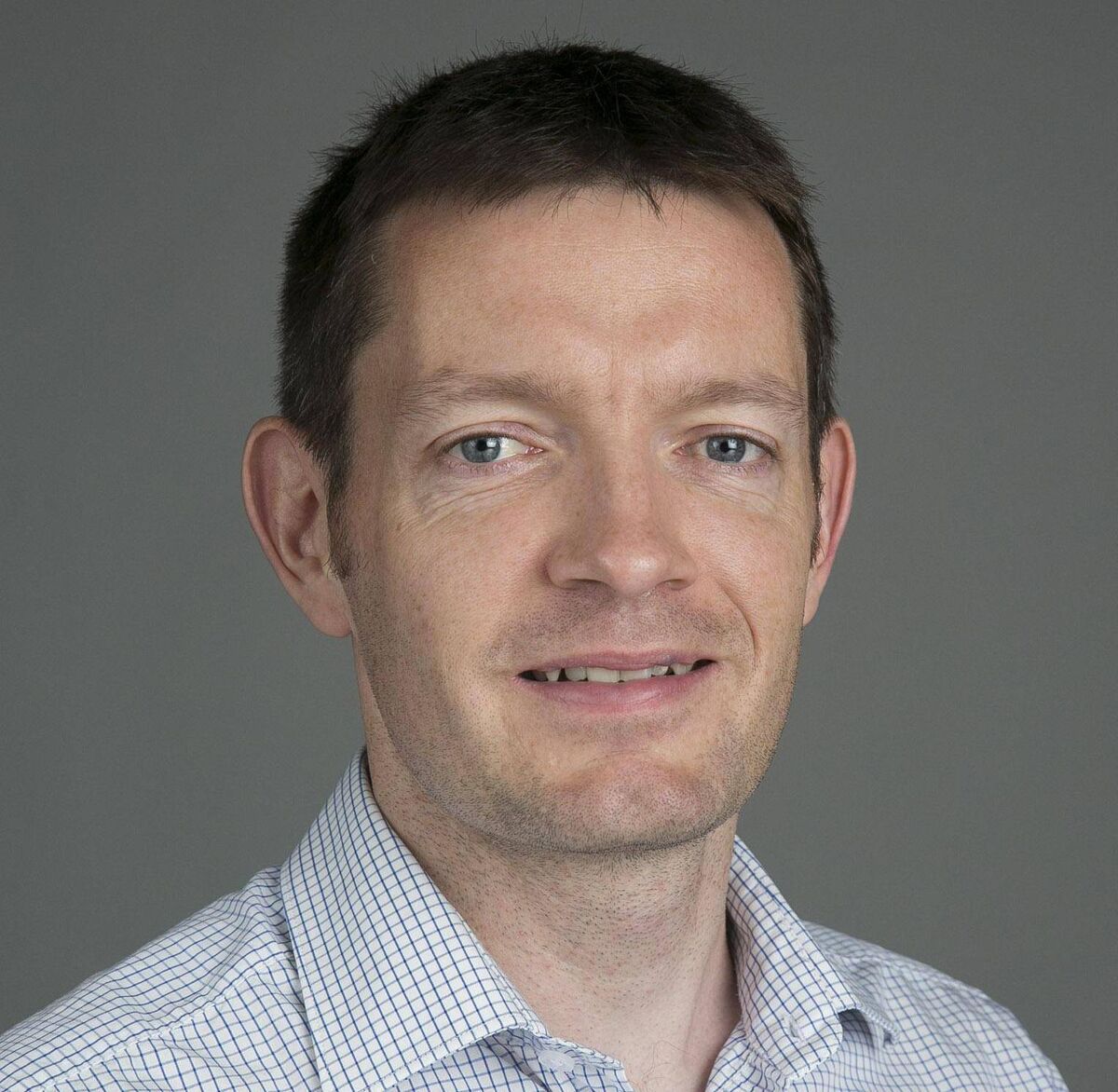
Dr Conor OâMahony, director of UCCâs Child Care Law Clinic, said there is no such thing as a âprivate adoptionâ in Ireland and all adoptions must be approved by the AAI.
âAnyone engaging in a transaction of this nature [whether as the purchaser or the seller] would be at risk of prosecution under the legislation prohibiting the sale of children.â

The Irish Examiner became aware of several social media pages offering âbabies for adoptionâ online.
We engaged with several people who claimed they had children as young as two days old available for adoption.
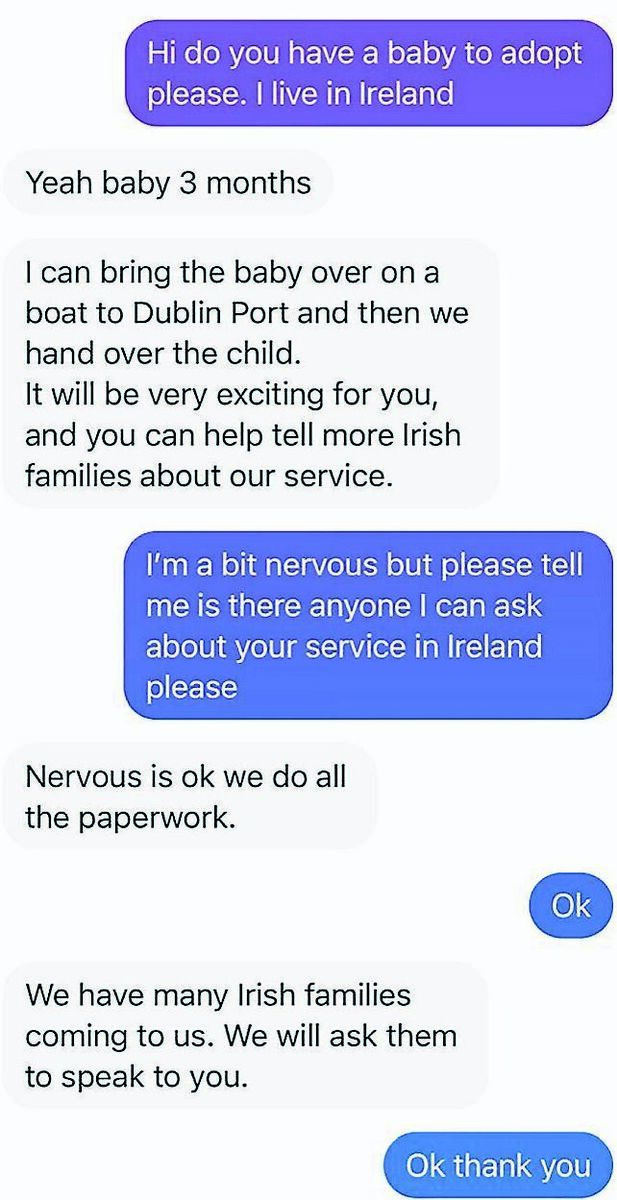
One person told us they had a six-month-old African baby girl and that he was going to âbring the baby over on a boat to Dublin Portâ from the UK, where he would âhand over the childâ.
âIt will be very exciting for you, and you can help tell more Irish families about our service,â he said.
We engaged with a number of people and asked if they arranged âprivate adoptionsâ.
One person sent a reply minutes later, saying: âYes I do, you are looking for a male or female?â
The person went on to say they are based in the UK but had been âin contact with Irish familiesâ.
âIf we want to follow all legal procedures, itâll cost you about ÂŁ1,900. But I always like using the other way to make it easier for you.â
When we enquired about âthe other wayâ to adopt the baby, the contact said: âJust make arrangements and you come pick them up or I deliver her after Iâm done with all the adoption papers. I have a private lawyer for that.â
At no point, despite asking repeatedly, did the contact give us details of the âlawyerâ they referred to. âNot sure itâs safeâ [to say] was the response.
âItâll take about a week [to adopt the baby]â they continued. âHer mom is on board but donât want to be involved in the process.
âFirst, Iâll need to start with adoption papers. Will work with the lawyer which will cost ÂŁ250 (âŹ294) to ÂŁ300 (âŹ353).â
When this newspaper asked if we should employ our own lawyer, the person said: âItâs needless getting a lawyer, when everything will be handled.
âBut you can get your lawyer if you would love to, it just costs you more.â
The proposed arrangement included bringing the baby to Dublin Port, where we would meet, and collect the child.
It is easier if we come by boat. We will make a birth certificate and you can say the baby is yours.
However, when we pressed the contact about the law, and if this was illegal, they stopped correspondence and later blocked us on Messenger.
A second engagement with another person led to a conversation about the woman not being able to mind her two-month-old twin girls, and that she would bring them to Dublin.
âIâm the birth mother of them,â the person claimed before sending a photo of two babies.
âIâm a student and I got pregnant, and the person refused to be responsible of my pregnancy, so I was afraid of abortion, and IÂ decided to give birth and put them up for adoption.
I canât take care of this alone beside I am a student so I canât handle this. I am the only child so how will I got out and work to feed them. This is better to adopt them.
The person later said it would cost $2,500 (âŹ2,297) to adopt the two babies.
The illegal advertising of babies for private adoption online comes amid growing concern, as the number of babies for adoption has declined all over the world in recent years.
Research by the Adoption Authority of Ireland shows there were 4,989 intercountry adoptions from abroad approved in Ireland between January 1991 and September 2019.
The vast majority of the overall figure took place in the years to October 2010.
Of those figures, 83% of these children came from just five countries: Russia, Romania, Vietnam, China, and Ethiopia.
Intercountry adoptions
From November 2010 to September 2019, there were 707 intercountry adoptions from 23 countries.
The decline in inter-country adoptions since 2010 was a direct result of Irelandâs ratification of the 1993 Hague Convention on November 1 that year.
New figures also show there were just 102 domestic adoption orders granted in 2022. That includes step parents, long-term foster carers, and infant adoptions, while the authority received 110 applications.
Adoptions between Ireland and a large number of countries, including Russia, Ethiopia, and China have all ceased in the past decade due to growing concerns all over the world about baby trafficking.
In May, the Netherlands said it will no longer allow its citizens to adopt from foreign countries.
Dutch parents adopted around 40,000 children from 80 countries in the previous half-century.
There are dozens of similar Facebook pages advertising private adoptions and a quick trawl through them shows some could possibly be a scamming mechanism to lure vulnerable, hopeful parents into the trap of an âadoptionâ for money.
However, one woman, who was illegally adopted in Ireland in 1972 when she was handed to her adoptive parents at three days old through a car window in a car park in Co Louth, said: âEven one baby being trafficked is too much.â
Margaret Norton lifted the lid on the criminal behaviour of Dr Irene Creedon in Co Monaghan who was trafficking scores of children all over the country for more than 20 years.
She knowingly broke the law by arranging private adoptions and was linked to a number of mother and baby homes, including Bessborough, Temple Hill, and Sorento House in Dublin.
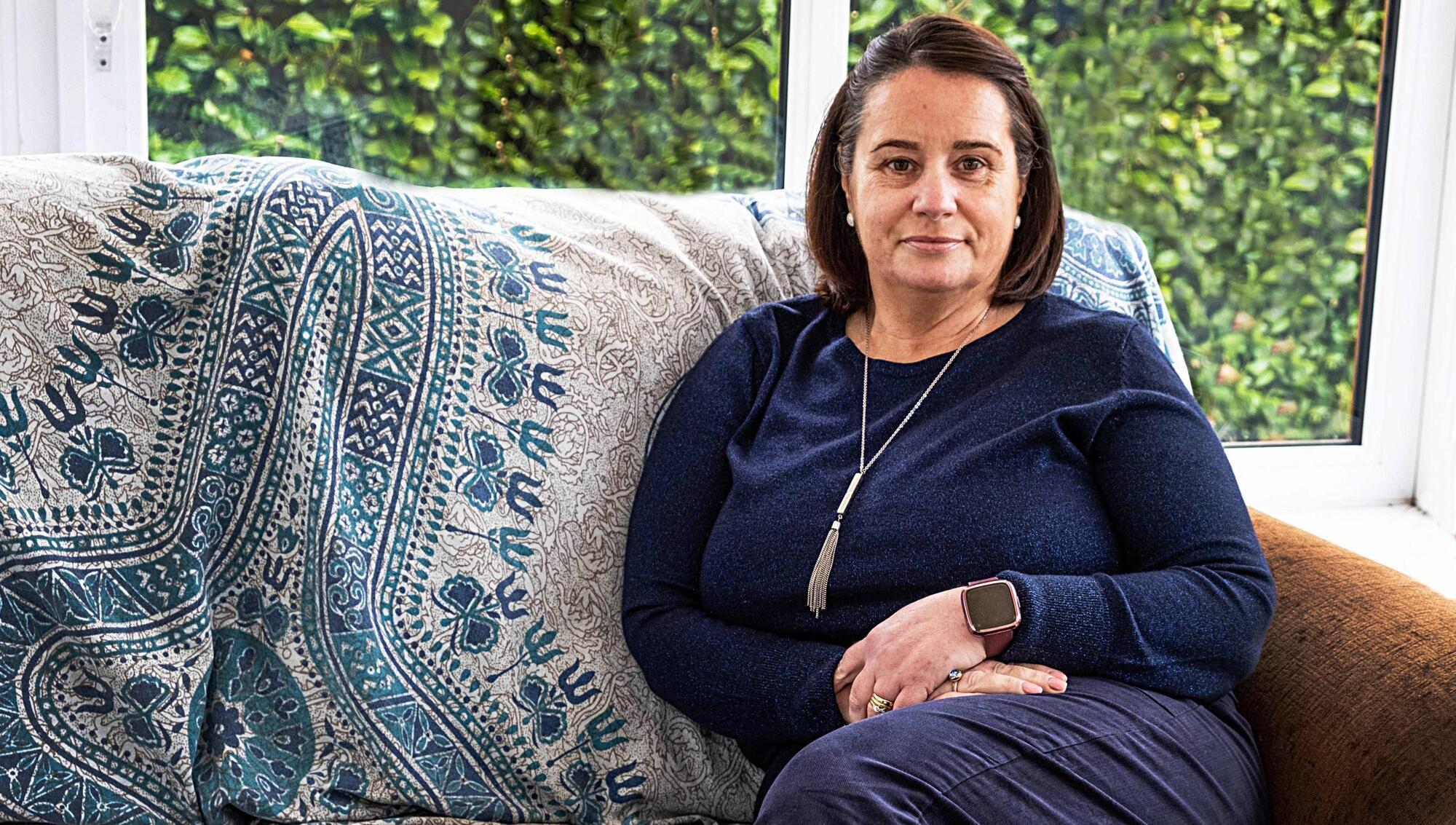
Ms Norton, from Co Longford, said: âAs an illegally-adopted, illegally- registered, trafficked child of the 1970s I would be horrified to think that in 2024 this alleged trafficking is still ongoing.
I was assured by authorities that this would never happen again. Being a product of the above has significant implications on a childâs life, not knowing who you are being the most traumatic.
âNot having any paperwork, or in my case falsified paperwork, is so disturbing because even if you are lucky enough to go to a great family like I did, as the years pass you naturally get curious about your birth parents. This illegal practice of moving vulnerable small babies from country to country or within Ireland leaves you with almost no place to start looking for information because essentially you donât exist.
âThis is a trauma in a childâs and or adultâs life and can leave people with very profound emotions and feelings. I would urge the relevant authorities such as gardaĂ to investigate this alleged practice as we certainly do not want history repeating itself for these little babies.â
In his report to Government in 2022, the former special rapporteur for children Conor OâMahony said the State was aware of illegal adoptions in Ireland which happened following the implementation of the Adoption Act in 1952 â a law that was meant to prevent child trafficking.
In 2018, Tusla told the Department of Children that at least 126 children adopted through the St Patrickâs Guild Adoption Society had been the subject of an illegal birth registration. That number has since risen to 151.
These cases were found when a suspicious marker âadopted at birthâ was found on the files in question and investigated.
Irene Creedon was not the only high-profile doctor trafficking babies. Consultant Ăamon de Valera, the son of the former president, was also involved in the illegal practice.
No official figure has ever been determined for the number of illegal adoptions in Ireland, because not all of them have been uncovered.
However, an independent review sampled records held by Tusla and the AAI and said there were around 20,000 illegal birth registrations.
In a statement, Tusla said it âis not aware of any such adoption practices active in Irelandâ.
âIn the instance such practice comes to light we would report it as a matter of urgency to An Garda SĂochĂĄna to investigate and the Adoption Authority of Ireland as the regulator of adoption and the central authority under Hague convention, in line with child protection legislation. Anyone with a child protection concern should contact their local duty social work office.â
Illegal practice
The Department of Children and the Adoption Authority of Ireland said: âPrivate placements and adoption in Ireland is illegal.
âPayment for adoption in Ireland is illegal. Part 15 of the Adoption Act 2010 details the offences and penalties under the legislation for accredited bodies or individuals breaching or failing to abide by the provisions of the Act.
âSpecifically, Section 144 of the Act prohibits the advertising of adoptions, and Section 145 prohibits the receipt of payments by adopters, parents, or guardians in consideration for the adoption of a child, as well as payments to those who make arrangements for adoptions.
âFurthermore, Section 125 prohibits private placements or individuals making such arrangements for the placement and adoption of a child. These restrictions were included in the original Adoption Act 1952.â
It added: "Tusla, the Child and Family Agency is the body designated with statutory power to make arrangements for the placement of a child for adoption. The Adoption Authority of Ireland is responsible for regulating and supervising domestic and intercountry adoptions. As both the Competent Authority and Central Authority in Ireland in relation to adoption matters, the authority is the only agency in Ireland that has power under the law to grant or refuse to grant adoption orders.
"Adoption can only occur through bodies accredited by the authority. Any prospective parents seeking to or are interested in adopting a child should seek further information from the authority.
"The authority is not aware of any Irish families involved in the illegal adoption practices highlighted by the journalist. Furthermore, anyone approached with an offer to arrange an adoption or to arrange an adoption for compensation should immediately report the incident to the gardaĂ."
CONNECT WITH US TODAY
Be the first to know the latest news and updates