Irish environmental experts welcome 'huge boost' from Swiss climate change case ruling
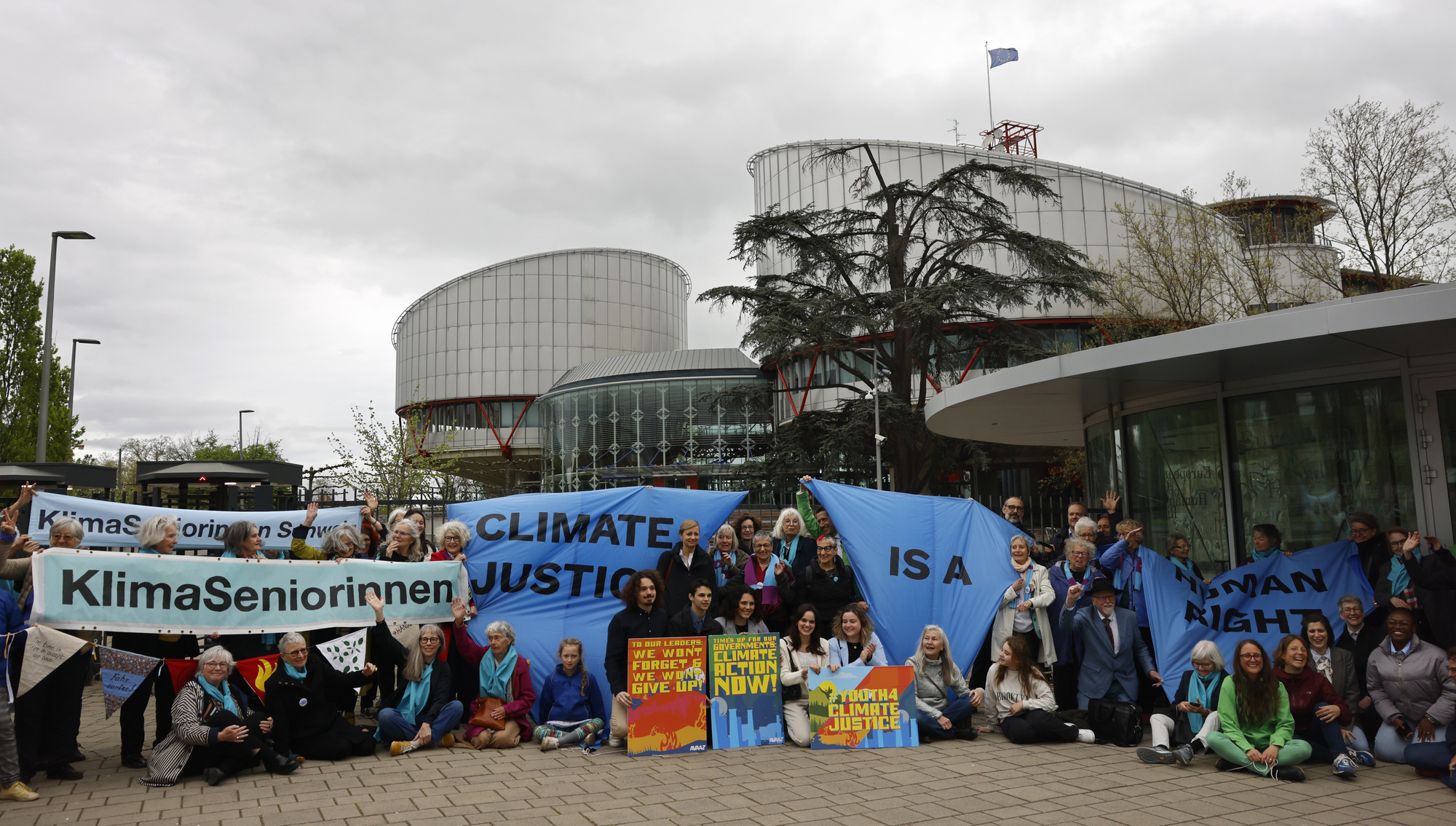
People demonstrate outside the European Court of Human Rights on Tuesday where a ruling in a landmark climate change case was handed down. The case sets a precedent that climate change represents a fundamental issue of human rights, as opposed to merely an environmental problem. Photo: AP/Jean-Francois Badias
Irish environmental experts say a new "landmark” ruling by the European Court of Human Rights is a “huge boost” for climate activists, one which “couldn’t have come at a more important time”.
The ECHR has ruled in favour of a case taken by a group of older Swiss women in asserting that their government had an obligation to act on its own climate change commitments in order to uphold the women’s fundamental human rights.
The case, taken by the 2,400 Swiss women and predicated on the assertion that older women are more likely to die in climate change-induced heatwaves, is broadly seen as setting a precedent that climate change represents a fundamental issue of human rights, as opposed to merely an environmental problem.
“At the heart of today’s ruling is that climate action is a legal duty, and Governments must live up to its promises,” said Clodagh Daly, manager of the Centre for Environmental Justice.
“It is a huge boost for communities who have turned to the courts and are demanding greater action on the climate crisis,” she said, adding that the ruling “couldn’t have come at a more important time” given that all EU countries are expected to publish their updated 2030 climate plans this coming June.
CLIMATE & SUSTAINABILITY HUB
Ms Daly said:
She said that people are “entitled to have an expectation that climate change won’t impact on their personal private lives”.
Dr Diarmuid Torney, the co-director of DCU’s Centre for Climate and Society, said that the ECHR’s ruling “sets a precedent” for Ireland’s own courts to potentially follow, and would likely “present challenges” for both the current Government and its successor.
“It could present a headache for the Government, though it hasn’t been alone in terms of dragging its feet on climate action, lots of Governments have been similarly slow to act,” Dr Torney said.
The ECHR ruling has opened the door for similar cases to be taken by citizens of the other 45 member countries of the European Council in their own national courts.
While the Irish courts could potentially rule in opposition to the ECHR’s findings, should a case progress to the European level, the ruling of the human rights court cannot be appealed.
The Swiss women's case was one of three climate-themed actions decided upon by the ECHR on Tuesday, with the other two — involving complaints made by a grouping of Portuguese young people and another taken by French MEP Damien Careme — were dismissed as inadmissible.
“It means that where a person can show that climate change will harm them, they have a right to recourse in the courts,” Oisin Coghlan, chief executive of Friends of the Earth Ireland, said, citing the potential example of farmers suffering heightened stress as a knock-on effect of the impact of extreme weather on their livelihoods.
“It is definitely a landmark ruling, an international court showing itself as willing to protect people from the harms inflicted by climate change,” he said.


CONNECT WITH US TODAY



Be the first to know the latest news and updates