Medicine-resistant infections the biggest risk facing Ireland, experts warn
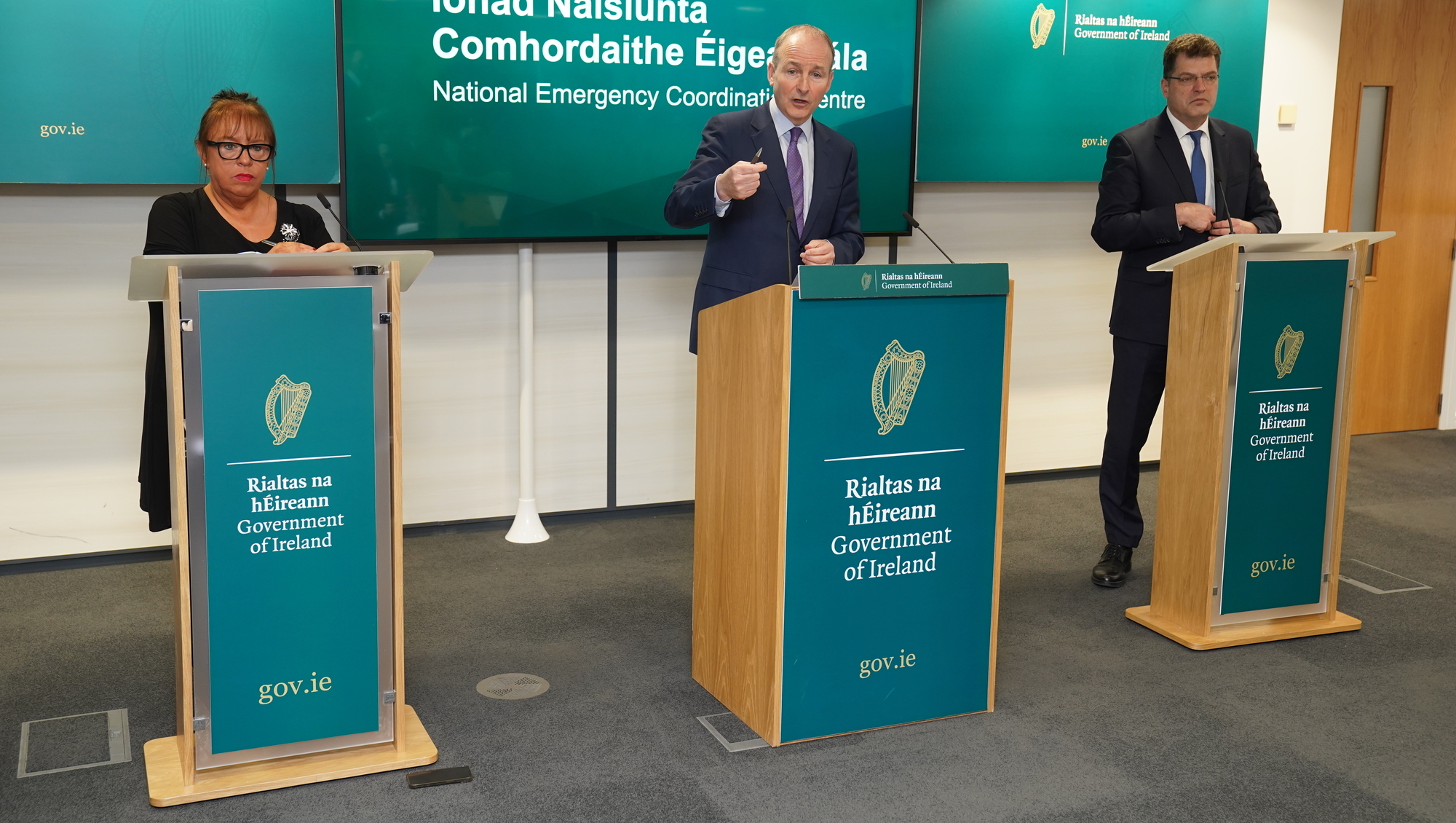
From left, Professor Caroline McMullan of Dublin City University, Tanaiste Micheal Martin and European Commissioner for Humanitarian Aid and Crisis Management, Janez Lenarcic (Brian Lawless/PA)
Infections that are resistant to medicines are the biggest risk facing Ireland, according to an expert assessment.
The next biggest threats are a pandemic, cyber attacks and disruption to critical supply chains, according to Ireland’s National Risk Assessment.
The report aims to give direction to Government on how to prepare for possible threats over the next three years.
Professor Caroline McMullan, the lead researcher of the academic project Futureproof.ie which helped with the assessment, said the report provides an evidence base for creating policy around emergency planning.

She said the top risks facing Ireland, analysed by experts based on likelihood and impact, are antimicrobial resistance, followed by another pandemic, attacks on key computer systems, and disruption to critical supply chains.
An over- or inappropriate use of antibiotics has led to a wider range of bacteria that do not respond to traditional treatments, she added.
This risk is part of a global trend and is not unique to Ireland, but it is the first time antimicrobial resistance has been named as the top threats to the country.
A report will be prepared for Government on each risk in order of priority.
Tánaiste Micheál Martin said he views cybersecurity as “a key risk” and also highlighted the need for adaptation to climate change.
“Since the war in Ukraine, cyber attacks have increased exponentially, this has been documented by quite a number of sources,” he said.
“We experienced our own cyber attack on our health service, which basically paralysed our health service for a number of weeks and (caused) extraordinary human costs and financial cost.”
“We need to adapt more quickly to climate because climate is happening right now, and we have witnessed that in terms of the flooding, our water levels are very high – will that affect our food production system this year in terms of tillage?
“On the subsea cables, again, the issue there is more collaboration across like-minded countries across the European Union, which we do. It’s also an investment in intelligence – everyone has an idea that it’s all about ships.
“Yes, we need ships on the oceans and we have an issue with recruitment and retention but the more fundamental issue actually is is around collaborating with others.”

Professor McMullan said members of the public were asked to rank the same risks as the experts and there was “quite a number of overlap” but added that the public rated cybersecurity as the top risk.
“The war in Ukraine was to the forefront in the minds of both the expert focus groups that assessed the risks and the public,” she said.
“We did see a greater awareness of the fragility of our supply chains, whether that’s food, medicines, energy, oil.
“Also, they were more aware of perhaps the changing nature of warfare. So the use of drones or the use of cyber attacks.
“Last time, when we undertook the National Assessment in 2020, antimicrobial-resistant infections had been the subject of study because they were emerging risks rather than a fully mature risk.
“But this time, the expert focus groups have rated antimicrobial-resistant infections as the top risk facing us at the moment, and so that’s quite a shift.”
“It’s important not to chase things that get more, if I’m honest, coverage and stick to the research-informed processes that we have in place.
“So we do need to use those priorities and not be side-tracked by, if I’m honest, media coverage.
“So we should be tackling the top risks in order.”
She added: “Central government came out with a 90% rating in terms of trust that the public would follow what advice was given during an emergency.
“It’s an incredible score for central government to achieve and it was only topped by the emergency services and the national weather service.”

CONNECT WITH US TODAY



Be the first to know the latest news and updates