'Critical' Irish security strategy still awaited four years on
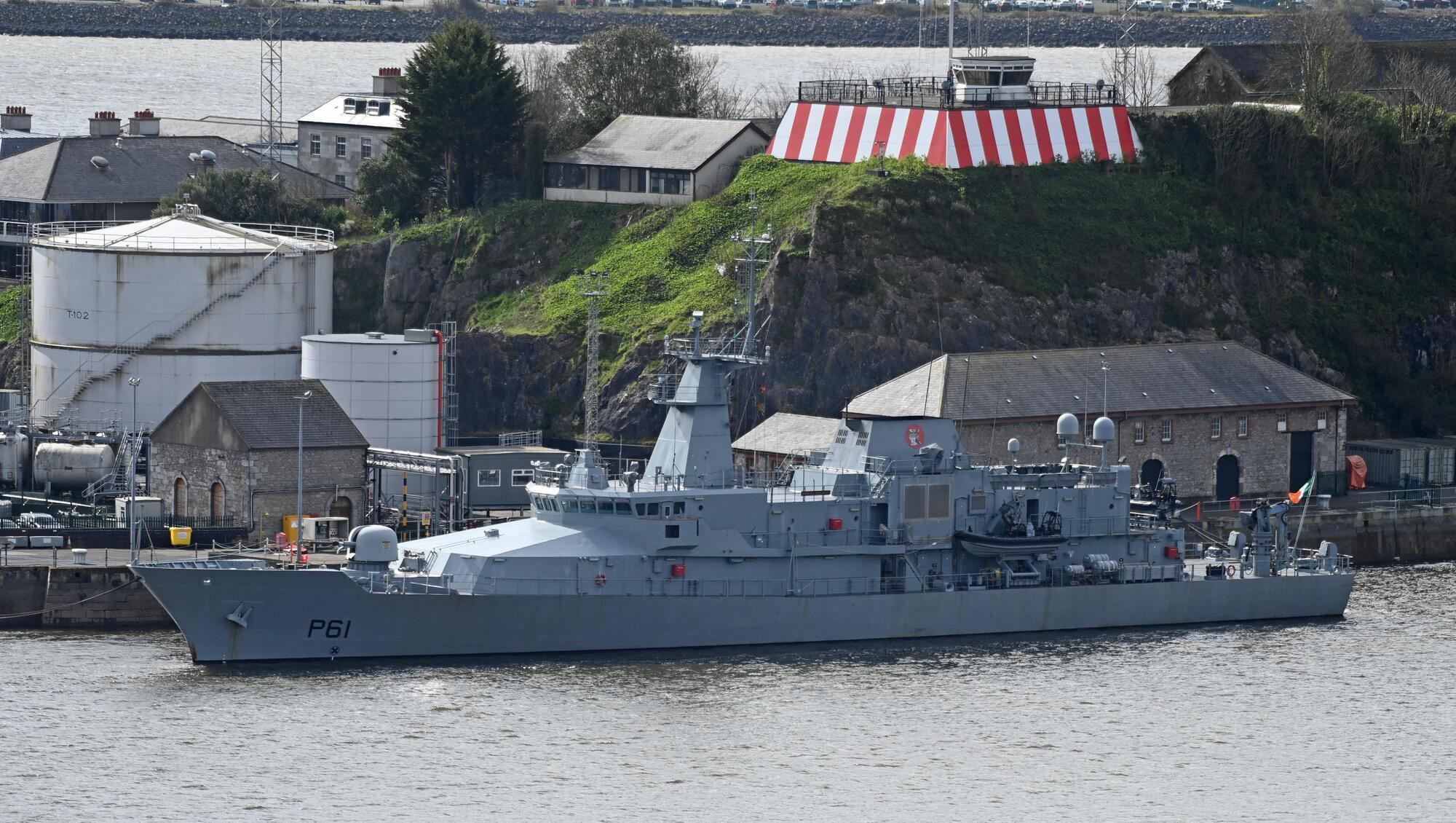
Irish naval vessel The Samuel Beckett docked at te naval base in Haulbowline, Cork.
A National Security Strategy is “critical” for Ireland, but one has still not been developed four years after the Government signalled its intention to devise it, a serving senior naval officer has said.
Lieutenant Commander Mike Brunicardi said that, in that time, the country’s health service has been hit by a cyber-attack and Russia has conducted naval exercises in Irish waters.
In addition, he said the Defence Forces is “languishing” in a staff crisis and that this is resulting in military operations being curtained across the organisation.
Writing in the annual Defence Forces Review 2023, Lt-Com Brunicardi said: “Ireland currently lacks a National Security Strategy, despite the Irish Government’s decision in 2019 to develop one."
The strategy, supposed to cover the period 2020-2025, is being developed by the National Security Analysis Centre (NSAC), located in the Department of the Taoiseach.
Lt-Com Brunicardi said Ireland is facing a range of security risks, including cyber threats, organised crime and terrorism, espionage and threats to critical national infrastructure, such as subsea cables.
The NSS would also protect Ireland’s economic stability, energy security, diplomacy, technological security and cohesion, including from disinformation and misinformation.
He said the planned Russian naval exercises in February 2022 — just before its full-scale invasion of Ukraine — was an example of the threats to Ireland’s maritime security.
“These exercises were not planned in the United Kingdom or French waters but in Irish waters, more likely because of the lack of comprehensive deterrence as a response,” he said.
“Ireland struggled to provide surveillance platforms to deter and monitor these planned exercises.”
Lt-Com Brunicardi added: “Currently, the Defence Forces are languishing in a human resource crisis, resulting in operations being curtailed across the organisation. This poses a strategic risk to Ireland in that both state and non-state actors can utilise Irish geostrategic space unchallenged.”
He cites former Chief of State Mark Mellett who said Ireland’s lack of military capabilities created a “paradox” where Ireland is reliant on other countries to protect its sovereignty.
“The rise of hybrid threats, cyber espionage, and the potential spillover effects of conflicts from neighbouring regions underscore the vulnerability of Ireland, even with its neutrality,” Lt-Com Brunicardi said.
“If Ireland truly wants the freedom to act, it needs to be capable of defending itself.”
The naval commander said a comprehensive NSS would send “a powerful message” to potential aggressors, bad actors or potential adversaries and operate as a deterrent to them.
He said an NSS is “critical” to implement Ireland’s national strategic objectives and said this should also include partnerships with other countries, while maintaining our neutrality.
“Four years after the Government outlined its intent, we remain without an NSS,” Lt-Com Brunicardi concluded. “In that time, Ireland has suffered a cyber-attack on its Health Service Executive and has seen its maritime domain increasingly exploited by state actors to loiter in the vicinity of maritime CNI [Critical National Infrastructure].”
The has repeatedly tried in recent months to get some information on the funding for the NSAC and details on when the NSS would be published but to no avail.
The Defence Forces Review 2023, published in collaboration with Maynooth University, focused on the theme of the organisation as a ‘Joint Force’, as opposed to siloed branches of the army, air corps and naval service.
This followed a key recommendation of the Commission on the Defence Forces, which was accepted by the Government.
In another paper, doctoral student in Maynooth University Giovanni Parente examined the potential benefits for the Defence Forces if it joined, even as an associate participant, in the UK-led Joint Expeditionary Force.
The aim of the JEF is to quickly deploy armed forces for various land, air, naval and cyber operations. Its main area of operations has, to date, been the Baltic Sea.
Eight other countries are involved, namely the Nordic and Baltic States.
The paper said the JEF could be considered as a “framework for rapidly responding to crises” rather than a military alliance.
Mr Parente pointed out that Ireland has participated three times in seven EU Battlegroups and last year committed to participation in a new German-led EU Battlegroup.
He said initiatives like the JEF are “highly beneficial for small states”, by strengthening their military and strategic capabilities by operating with larger armed forces under NATO standards.

CONNECT WITH US TODAY



Be the first to know the latest news and updates