Plans to impose time limit on State accommodation for Ukrainians arriving in Ireland
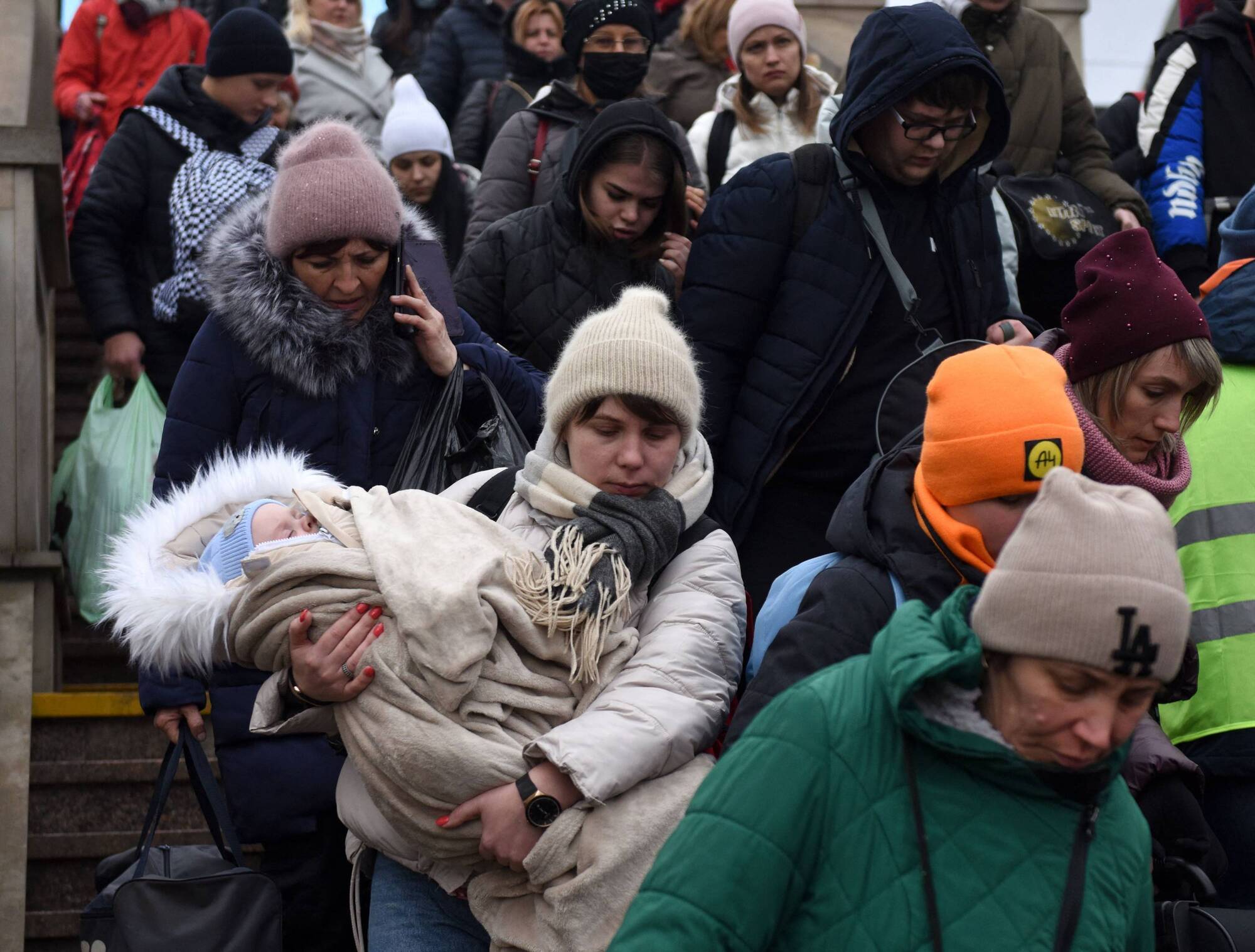
A new policy is being drawn up regarding those fleeing war. Picture: Yuriy Dyachyshyn/AFP
Ukrainians newly arrived in Ireland could be offered State accommodation for just three months before having to find their own place to live.
The understands that the Department of the Taoiseach and the Department of Integration are working on a new policy for those fleeing war, with a memo due to go before Cabinet soon.
In what will be a major shift in Government policy, Ukrainians will have to either find accommodation in the private rental sector or take a pledged property through the offer-a-home scheme after three months in State-provided accommodation.
Officials are working on when the changes will kick in. They will apply only to new arrivals to the country.
A Government source said the move to put a time limit on accommodation was to bring Ireland’s offering in line with other EU countries.
In Czechia, Ukrainian refugees are entitled to a maximum of 150 days in state accommodation.
In Poland, those who have spent more than 120 days in provided accommodation have to pay 50% of the cost, with this rising to 75% after 180 days.

It is understood that the Government is also to consider reductions in social welfare paid to Ukrainians, but a senior source said they do not envisage this happening for some time.
As of October 5, there were 40,995 adults in receipt of income support payments and the majority of new applications from Ukrainians were jobseeker’s claims.
Child benefit was being paid in respect of 20,414 children, while 197 rent supplement applications have been awarded.
Documentation prepared for the recent Cabinet committee on Ukraine said Ireland’s approach was “significantly” different to that of other EU countries, with “high State involvement and wide support, including income and accommodation”.
Officials said the current approach was “unsustainable and unsuitable” and that a new model was required. There are also “equity concerns” with regard to Irish and EU citizens and other migrant cohorts.
They said that the level of people seeking international protection here has shown no sign of abating and is “simply not sustainable into the future”.
Almost 97,000 Ukrainians have arrived in Ireland, with more than 73,000 provided with State accommodation at a cost of €1.5bn a year. It comes as the State is seeing an increase in the number of people fleeing Ukraine, with up to 200 arriving per day.
Recent changes in policy have also seen restrictions on the length of time Ukrainians can be absent from accommodation. Those who leave hotels for prolonged periods risk losing their space, barring “exceptional circumstances”. The right to an absence of seven days over a six-month period has been suspended.
As of October 5, 96,151 personal public service numbers had been issued to Ukrainians, of whom 62,994 are of working age, 27,278 are children, and 5,879 are aged 66 or over.
Sources said Revenue records indicate that 15,171 Ukrainians are in active employment here, with the highest concentration in the hospitality sector.
At the end of September, 30,431 Ukrainians of working age had availed of Intreo Centre employment services.
In total, 73,800 medical cards have been issued to Ukrainians but as of October 6, 59,400 medical cards are live in the system. Officials believe the fall in active cards can be attributed to a number of factors including that after 12 months of holding a card, Ukrainians are deemed to be resident here and lose the card; financial assessment; or individuals are not contactable.