'There is enough room for everybody': Activist says Israelis and Palestinians can peacefully co-exist
'There is enough room for everybody': Activist says Israelis and Palestinians can peacefully co-exist

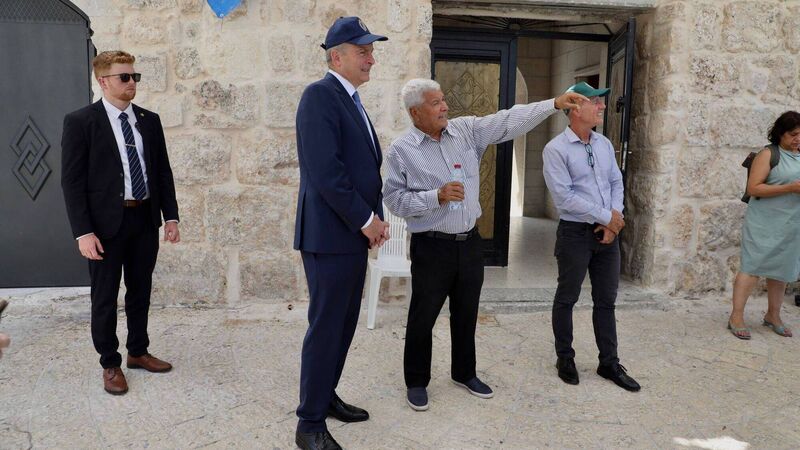
Tánaiste Micheál Martin with Dr Thabat Abu Rass in Lod in September. Picture: Hannah McCarthy

At the beginning of September, Dr Thabet Abu Rass gave a tour of his home city of Lod to Tánaiste Micheál Martin while he was on an official visit to Israel. 

Lod is a mixed city where Jewish and Arab/Palestinian Israeli citizens live side-by-side but not always in harmony.


In theory, the two groups have equal rights in Israel but in practice, Arab/Palestinian citizens are discriminated against in many sectors of society, including housing and jobs. 

Abu Rass showed Mr Martin the poor state of Lod’s Arab neighbourhoods compared with the Jewish areas and how few signs in Arabic there were. “Even in our own neighbourhoods we don’t have sovereignty,” he said.

Through his role as co-director of the Abraham Initiatives, an NGO supported by Ireland, Abu Rass advocates for equality between Arab/Palestinian and Jewish citizens, as well as the peaceful co-existence of an Israeli state alongside a future Palestinian state. 

Like many Palestinians living in Israel, Abu Rass has relatives in Gaza that were displaced in 1948 when the state of Israel was formed and hundreds of thousands of Palestinians were expelled from their homes.

Last week, he tragically learnt that eight members of his family were killed during the unrelenting campaign of aerial strikes on Gaza that Israel launched following the devastating attack orchestrated against it by the militant group Hamas on October 7. 

Even before the total siege imposed on Gaza by Israel following the Hamas attack, Abu Rass said it had been easier to visit his son in the US than his relatives in Gaza, who live just a few kilometres from him due to travel restrictions. “I cannot visit them but I talk with them every day and even more now,” he said.

As well as reckoning with the loss of eight members, part of his family has been displaced from their homes in Gaza after moving to the southern part of the coastal enclave following an Israeli order that said they would be safer there. 

In defiance of the order, the other half of his family remains at home in the Jabalaya refugee camp north of Gaza City, where 40 children and grandchildren who have known only refugeehood are crowded into one home. Abu Rass’s family told him: “Why should we leave?” 

Abu Rass said: “Gaza City is a symbol for the Palestinians but from the Israeli point of view, it's a symbol of the Hamas regime.” 

His family expects there to be a bloody war “but they're really hoping that the international community will prevent it”. 

We can’t think that killing civilians — neither here in Israel nor now in Gaza — is the right thing to do. 

“It's a violation of international law; it’s a war crime; it’s unacceptable.” 

Abu Rass believes the civilian hostages Hamas has taken to Gaza should be freed immediately — “especially kids and elderly people; they have to free all civilians and then go for a prisoner exchange for the Israeli soldiers.” 

Then the Israelis need to stop the bombings and transfer of Palestinians from north to south: “I believe there is a plan to push Palestinians out of the Gaza Strip [into Egypt],” he explained.

“I don't know what will happen, there is a lot of revenge; a lot of bombing. We see attacks on civilians not only in Gaza but also in the West Bank.” 

Dr Thabet Abu Rass: 'I don't see the Americans rushing to try to help the occupied people in Palestine. Why is there this hypocritical policy? We don't trust the American administration right now because of this policy. Picture: Hannah McCarthy

Since October 7, 75 Palestinians have been killed in the West Bank and 545 displaced, according to UN and Palestinian sources.

Abu Rass is critical of the unwillingness of Israeli governments to promote peace since the Oslo Accords in the 90s. 

“I see Israel doing the opposite: more expansion of settlements; a more aggressive policy against the Palestinians, as well as trying to label the Palestinian struggle for freedom and independence and sovereignty as terrorism. 

The whole policy needs to be changed. The occupation and the aggression against civilians create a fertile land for more extremism among Palestinians. What we need is to give hope to the Palestinians that things can be changed in their life. 

“We are sharing this land and there is enough room for everybody. Israel cannot always think about Jewish supremacy and claim the land for itself. This land should be shared between Jews and Palestinians.” 

Many Palestinians are critical of what they view as a double standard in how the West has approached the Russian invasion of Ukraine and the Israeli occupation of Palestinian territory. “What's the difference between the occupation of Ukraine and the occupation of Palestine? All occupation is bad,” said Abu Rass. 

“I don't see the Americans rushing to try to help the occupied people in Palestine. Why is there this hypocritical policy? We don't trust the American administration right now because of this policy.

“We would like to see the international community led by the United States and Western countries promoting peace between Israel and the Palestinians — we need that and for them not to be one-sided. 

The way we see it right now they’re not helping either Palestinians or the Israelis. We need solidarity to protect civilians on both sides and to stop more wars in the Middle East.”

More in this section

Lunchtime News

Newsletter

Keep up with stories of the day with our lunchtime news wrap and important breaking news alerts.

Cookie Policy Privacy Policy Brand Safety FAQ Help Contact Us Terms and Conditions

© Examiner Echo Group Limited