Farming challenges and Mandarin Chinese for Leaving students as Junior Cycle exams finish
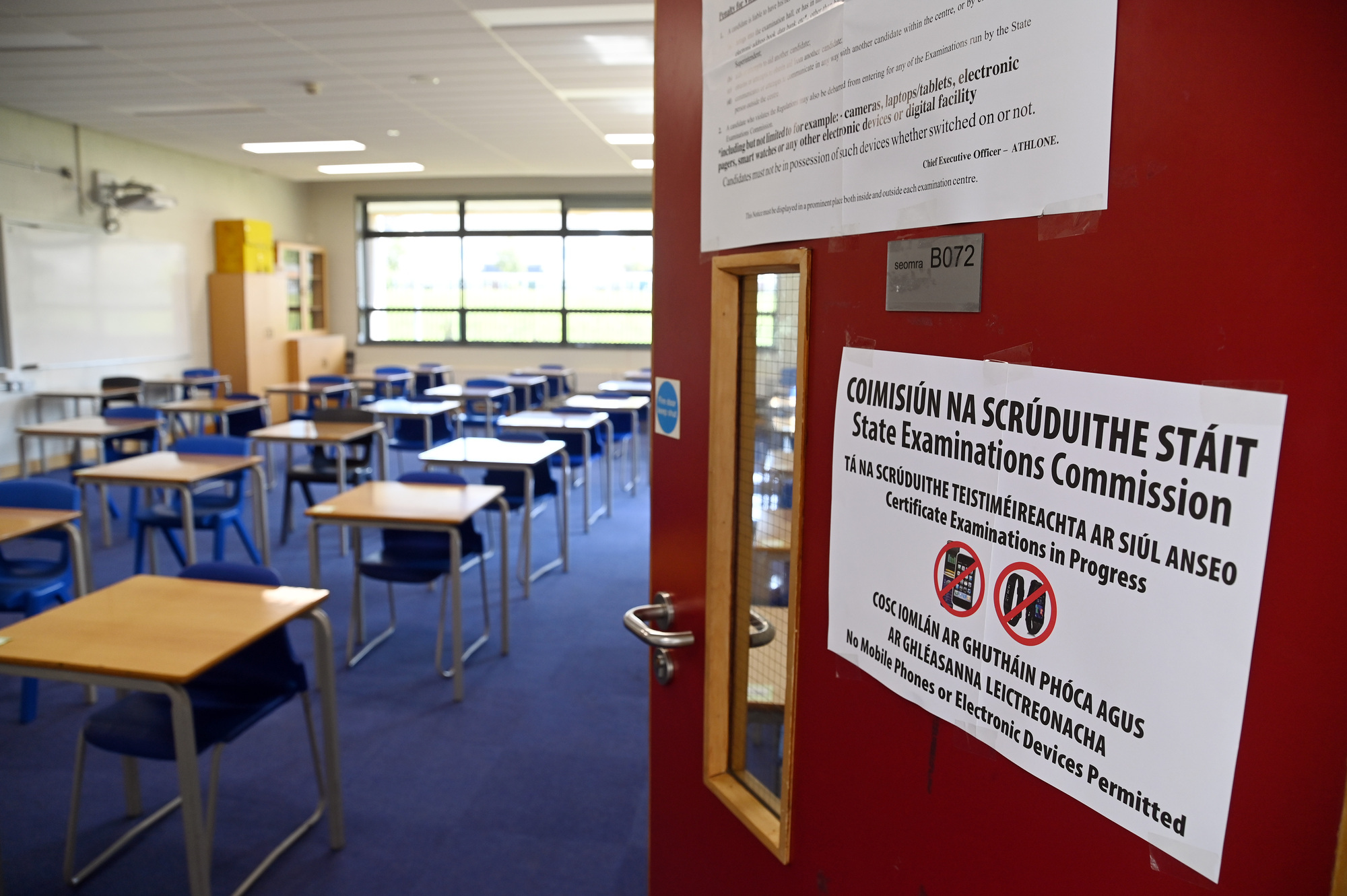
This Monday also saw the conclusion of the 2023 Junior Cycle exams, with students sitting the last exam of the year in applied technology. File picture: Denis Minihane.
Leaving Cert agricultural science offered students good choice on a paper that reflected everyday farming challenges, while Mandarin Chinese was a “well-structured” exam, although a little bit tougher than last year.
The Leaving Cert exams continued Monday with agricultural science on Monday afternoon, and the non-curricular languages, as well as Polish, Portuguese, Lithuanian, and Mandarin Chinese.
Non-curricular languages do not appear as part of the normal school curriculum, but students can opt to take the State exam in these subjects.
Polish, Portuguese, Lithuanian and Mandarin Chinese are curricular languages and designed for non-native speakers.
The first exams in these four subjects took place in 2022.
This Monday also saw the conclusion of the 2023 Junior Cycle exams, with students sitting the last exam of the year in applied technology.
There was good choice in both of this year’s agricultural science papers, according to Peter Keaney, subject spokesperson with the Association of Secondary Teachers Ireland (ASTI).
“It was a nice innovative paper, and it also reflects where agriculture is going now. It's an active science, very much in line with sustainability and climate change, and reflects the challenges faced by farmers every day.
“It’s great to see a modern course, keeping up to date with what’s happening with the technologies.”
On the higher-level paper, students had ten out of 12 questions to tackle in Section A.
“In that, you had internal choice as well so it gave them a good selection. Section B had four out of six questions to answer, so really and truly they had plenty of choice.
“There are always difficulties in papers but it was an easy read. It was a student-friendly paper.
"Naturally, there was always going to be tricky questions on the higher-level paper but there were also a few nice little things.
The long questions in Section B on this year’s higher-level paper focused on crops and soils over animal science. Questions were instead based on topics like soils, cereals, carbon emissions and grasslands.
“You’ll get people who say ‘Oh there was no beef and no sheep in the longer questions’ which I thought there might have been. There was a lack of animal science in this year’s longer questions.”
“But in saying that, they were quite good. There was one question on dairy. All questions were doable, and there were parts of all questions that students would be able to attempt.”
The ordinary level paper also offered students good choice, albeit with a few trickier questions, Mr Keaney believed.
“Section A was nice. It was again a reader-friendly paper, with plenty of diagrams in it.
This year’s long questions on the ordinary level paper focused on crops, soil and included more animal science than the higher-level paper.
However, question 16, part a, was a question on checking the quality of a milk sample.
“It would have been nice if the students here were given a diagram to help them out.
“The equivalent question was given on the higher-level paper with a diagram, while the ordinary level was based on their own experiment. I thought that was difficult for ordinary level.”
He also found question 18, a question on DNA and genetics, was quite challenging for ordinary level, and possibly more suited to higher-level.
The 2023 Junior Cycle applied technology written examination was “approachable and well thought out”, according to Eoin Hayes, subject representative with the ASTI.
“A very positive aspect to the paper was that while the questions were focused, they were broad enough so that a student could rely on her or his practical experience combined with their subject knowledge to answer them.”
This is very much so in keeping with the new Junior Cycle philosophy of affective learning or learning by doing, he added.
“So, instead of route learning stats and figures, the student can reflect on how they practically handled a variety of scenarios in the applied technology workshop or classroom and reflect on a combination of hands-on experience and learned knowledge to answer the questions.”
However, it must also be remembered that this cohort of students were impacted by Covid as their workshop and classroom experience, hence practical and hands-on experience, was very limited in first year.
The new Applied Technology course is made up of three strands.
The strands ‘principles and practices’ and ‘energy and control’ were well covered throughout the paper but especially so in an interesting set of questions regarding a camera dolly for a mobile phone, Mr Hayes said.
While a little bit tougher than last year, most students should be happy with this year’s Leaving Cert Mandarin Chinese exam paper, according to Yun Wu, a teacher with the Insitute of Education.
“The examiner was very thoughtful in the choice of themes and in providing clarification on some key terms.
“The vocabulary drew on the usual topics that a student would have prepared when learning any language and so there was nothing out of the blue or shocking to be found.
“Students who took their time, read the instructions carefully, and covered the key points of the question will score well.”
The exam paper was “very thoughtful” about clarifying certain terms that students might not know in a question based on a flyer for a zoo in Section A, the reading section, Ms. Wu said.
“For example giving the characters for ‘treasure’. However, students should read the questions very carefully, as unlike the others, [answer] B (iii) required an answer in Chinese, not English.
“The poetry question was accessible, without the need for advanced metaphor,” she added.
Meanwhile, Section B, the writing section, had lots of options for students.
“More advanced students would need to be cautious about word count in this section.
“The longer 100-character pieces had a useful overlap with the previous sections such that a student writing about their favourite food could use some of the vocabulary from Section A’s hot pot piece.
“The questions were accessible enough to allow students to use the vocabulary that they knew in order to describe a person that they know or a dream holiday.”
The listening test, the aural, was spoken clearly and drew on common vocabulary such as travel, family, and descriptions, Ms. Wu believed.
However, students would still need to take the time to read the questions carefully in order to know what to look for, such as numbers and locations, she added.
“While students with a heritage of speaking Chinese will find this paper very easy, it was very accessible and fair to those who only started learning the language in fifth year.
“This paper was manageable and shows the study of Mandarin Chinese to be an appealing option for those looking to take it up for the Leaving Certificate.”
The Leaving Cert exams continue on Tuesday with Spanish and Chemistry.
CONNECT WITH US TODAY



Be the first to know the latest news and updates