'How is this fair?' Cork farming family risks losing everything
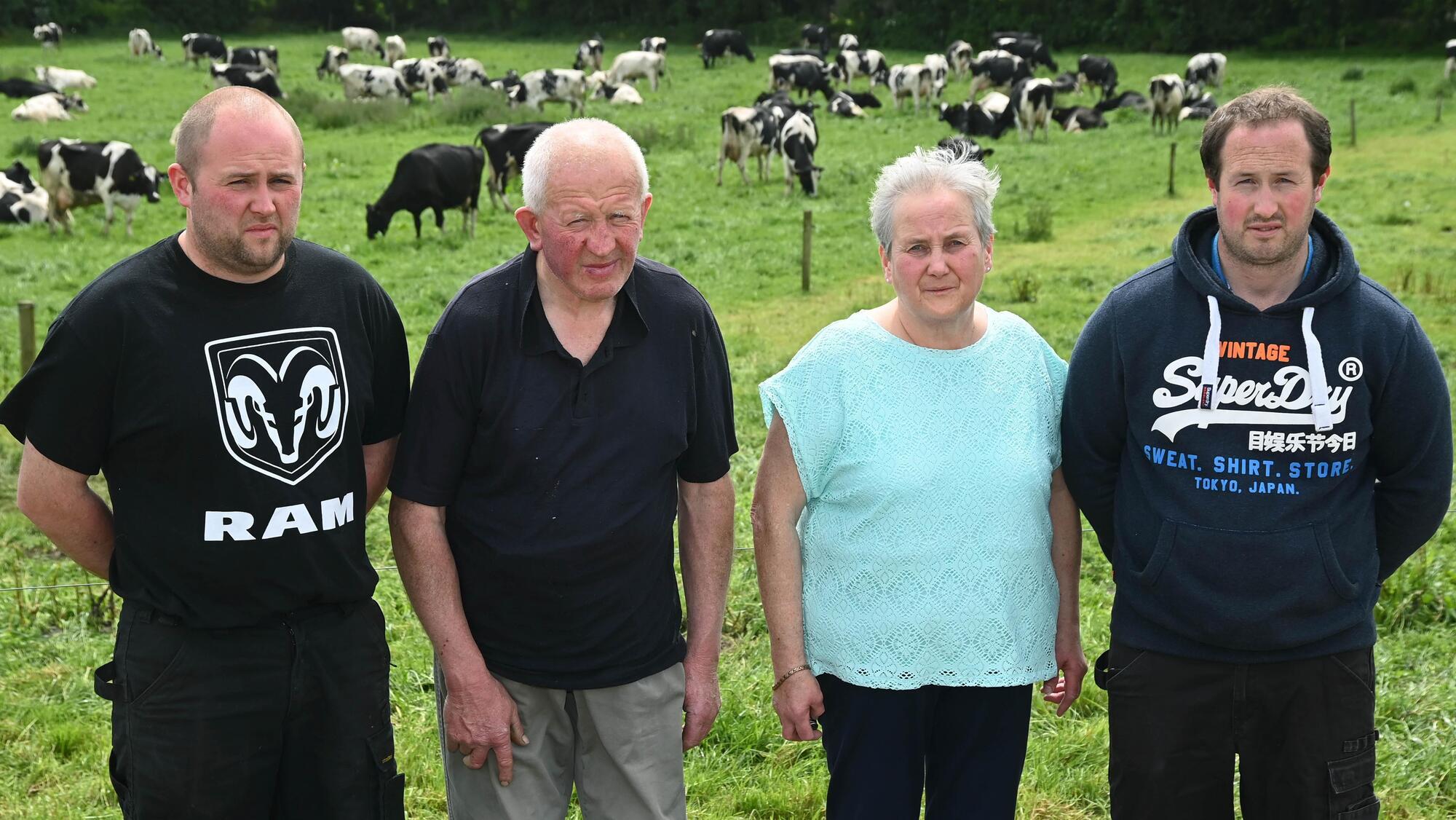
Jerry and Ita Murphy and their sons Diarmuid and Conor on their farm in Co Cork. The family’s solicitor says Everyday Finance is not engaging with them on the basis of a downsizing plan.
The Murphys are one of thousands of farming families who have found themselves in hock to an alien, largely faceless entity — the vulture fund. Their story resonates across rural Ireland. They had loans, they ran into some trouble along the road, but managed to come out the other side, and then they found themselves no longer owing money to a bank, but at the mercy of a vulture fund.
Now the fund is moving to sell off Gerry and Ita Murphy’s livelihood, which they had intended to pass on to their farming sons. Forty five acres of the family’s 113 acre farm was offered to a neighbour by the receiver and he bought it.
“Another neighbour told us about it,” Ita Murphy says. “It happened last December but I didn’t know until after Christmas, which is just as well because if would have been ruined. I couldn’t believe it. Our lives are wrecked from this whole thing. We want to pay our way, we just want to get the whole thing sorted so we can get back to our normal happy, family life again.”
Gerry and Ita Murphy farm their holding in Crossbarry with their two sons, Diarmuid and Conor, who are in their 30s. The parents would happily pack in and enjoy their retirement if, as originally planned, they could simply pass the business on to the next generation. Now their great fear is that there will be no farm to pass on. Since Everyday Finance bought their loans from AIB, the main thrust of the fund’s efforts has been to liquidate the family’s assets, the livelihood that has been in the family for five generations.
The Irish Farmers Association estimates that between 2,500 and 3,000 farming families are in the same precarious situation as the Murphys. Earlier this year the Rural Independent Group of TDs, with the assistance of former High Court master Edward Honohan, introduced a bill to prevent vulture funds getting access to family farms.
The Impaired Farm Credit Bill 2022 was rejected by the Government on the basis that it would jeopardise farmers’ access to finance. Yet the problem continues and may well intensify if funds follow through on threats to repossess.
A cold economic reading of the issue suggests it is one in which businesses borrow, fail to maintain repayments, and must therefore forfeit assets. In reality, businesses borrowed in a particular context, one in which banks were throwing money around like confetti. They often did get into trouble and, after some lean times, many got back on track. Having done so, and made new arrangements with their bank, they then found that their loans were sold — for a fraction of their value — to a vulture fund, which in turn had no interest in maintaining a long-term schedule of repayments. In the farming sector, the business is, and always has been, much more than just a means to a livelihood.
The Murphys’ woes can be traced back to a healthy ambition to extend and make provision for the next generation. In 2000, the opportunity arose to buy another farm in Ballymacoda in East Cork. The Murphys went for it.
They weathered the 2007 economic crash but, with the price of milk dropping in 2009, tougher times were ahead.
Then they ran into trouble with milk quotas. The system of milk quotas pertained within the EU from the 1980s up until 2015. Each farmer had a quota based on various criteria. If the farmer produced above that quota they were liable to fines.
Some farmers gambled that they could overproduce on the basis that others would not reach their quota and the national figures would be in line. This didn’t always work out. For instance, in 2014/15 Irish farmers were caught for a total fine of €75m, which was the biggest that had to be paid over the 31 years that the system was in existence.
By June 2016, Cork dairy farmers still owed almost €8.5m in fines. Among them was the Murphy family.
“We produced too much milk and the country was over quota,” Ita Murphy says. “It was a risk we took and the risk went wrong but at that stage we were, like a lot of people, getting by on the bare minimum.”
Problems arose with repayments. An arrangement was made with Bandon Co-Op for a schedule of payments to take care of the fines and levies accumulated over the quotas. For a while, they were unable to meet the bank repayments. They went into their local branch as always in Bandon and engaged. Then in 2017, they got fully back on their feet and began making the repayments again. It looked as if the storm had been weathered.
There were negotiations with AIB on how best to address the loan going into the future. The family retained a financial adviser. “The last time me met the bank it was in our home,” Ita says. “We wanted them to restructure the loan and put it over 30 years. They said they would come back to us.”
That was in August 2018. Months later, they were informed that their loan had been sold to Everyday Finance.
This has been standard procedure for thousands of individuals, families and business with “non-performing” loans over the last 10 years.
These loans are deemed to be a blight on the balance sheets of the main banks at a time when strict rules are in place about ratios of funds available to loans in the banks. The banks are allowed — and in some instances encouraged by the Central Bank — to sell on these loans to the vulture funds.
The funds buy these loans at a rate hugely reduced from their value. An Oireachtas committee was told earlier this year that the discount can be up to 50%. Thereafter, the funds are interested in either reaching a settlement to pay off immediately or sending in a receiver to sell — or at least threaten to sell — assets on which the loan was secured.
There has been much criticism from politicians and some financial advisers about this system of dealing with “non-performing” loans. As previously reported in the , a non-performing loan is not necessarily a loan which has no prospect of being fully repaid. Once a loan has not met the original terms of its contract, it can be classified as non-performing and sold as part of a bundle to the vulture funds, such as Everyday Finance.
That was what befell Gerry and Ita Murphy. They then went from dealing with a bank with whom they had a relationship going back decades, to the “wild west” of vulture fund regulation, as described to the Oireachtas finance committee last February.
The family engaged with the fund at first but were advised that their best option was to seek a loan elsewhere and sell off some assets to ensure that they held on to their family farm. This went on for a while through the early straits of the pandemic. There followed a period of inaction.
The Murphys, on advice, stopped making repayments. This is a strategy advocated by some financial advisers on the basis that a final settlement with the vulture funds will be for a sum that takes no account of the repayments made since the loan came into the fund’s hands. Other advisers in the sector disagree, pointing out that when conflict arises, one excellent plank of defence is that the borrower continued to make the repayments to the fund, as they had to the bank prior to sale.
In all of this, the fund has the upper hand. The lack of regulation allows for all sorts of conduct on behalf of the fund to collect on the loans.
At the Oireachtas finance committee hearing to investigate the “wild west” of regulation, committee vice chair and Fine Gael TD Bernard Durkan said the funds were selling people’s homes and properties online “in a kind of Ebay operation”. He said:
The Murphys would have no argument with that analysis. “After we tried to engage through different advisers we then got a letter in the post late last year to say that they were appointing receivers to the farms but not the dwelling houses,” Ita Murphy says.
The family retained Bandon solicitor Ted Hallissey to represent them but, whenever progress is made, it would appear that further issues arise to prevent a solution.
“This family is in a serious situation,” Hallissey says. “They accept that they will have to sell off some land. They are prepared to do it.
The has attempted on numerous occasions to make contact with representatives of Everyday Finance in connection with a number of cases where receivers have been appointed yet no acknowledgement or response has been received.
The family have animals on the land in both the Ballymacoda lands and the portion of the family farm that is being offered to a neighbour. Should the sale advance, there will a requirement for vacant possession, meaning the animals will have to be taken away. Gerry Murphy is noncommittal on whether he would obstruct such a move but there is plenty of precedent in this country of resistance to that kind of sale.
There is an offer on the table. Through intermediaries in the agriculture sector, the family have been able to secure assistance that would allow them to pay off the fund, and make a standard repayment arrangement for the loan. So far, Everyday Finance isn’t playing ball. In recent months the has reported on a number of cases of businesses in the Munster region where Everyday Finance have sent in receivers but, certainly as of now, have not completed the sell-off of assets.
Some observers believe this is a heavy-handed tactic by the fund to extract the maximum possible from borrowers in the shortest time. The toll it takes on borrowers, however, can be extremely taxing.
For the Murphy family, what is at stake is more than just a business.
“People overstretch and run into difficulty but they still have their livelihood,” Ita Murphy says.
“This is our livelihood, it is our way of life, one we want to pass onto two of our adult children. We never lived a high life or spent big sums of money, we just worked. And now this is what we are being faced with. In what world is that fair?”