State papers: Robinson's gift to Irish centre was already on sale in their own shop at discount price
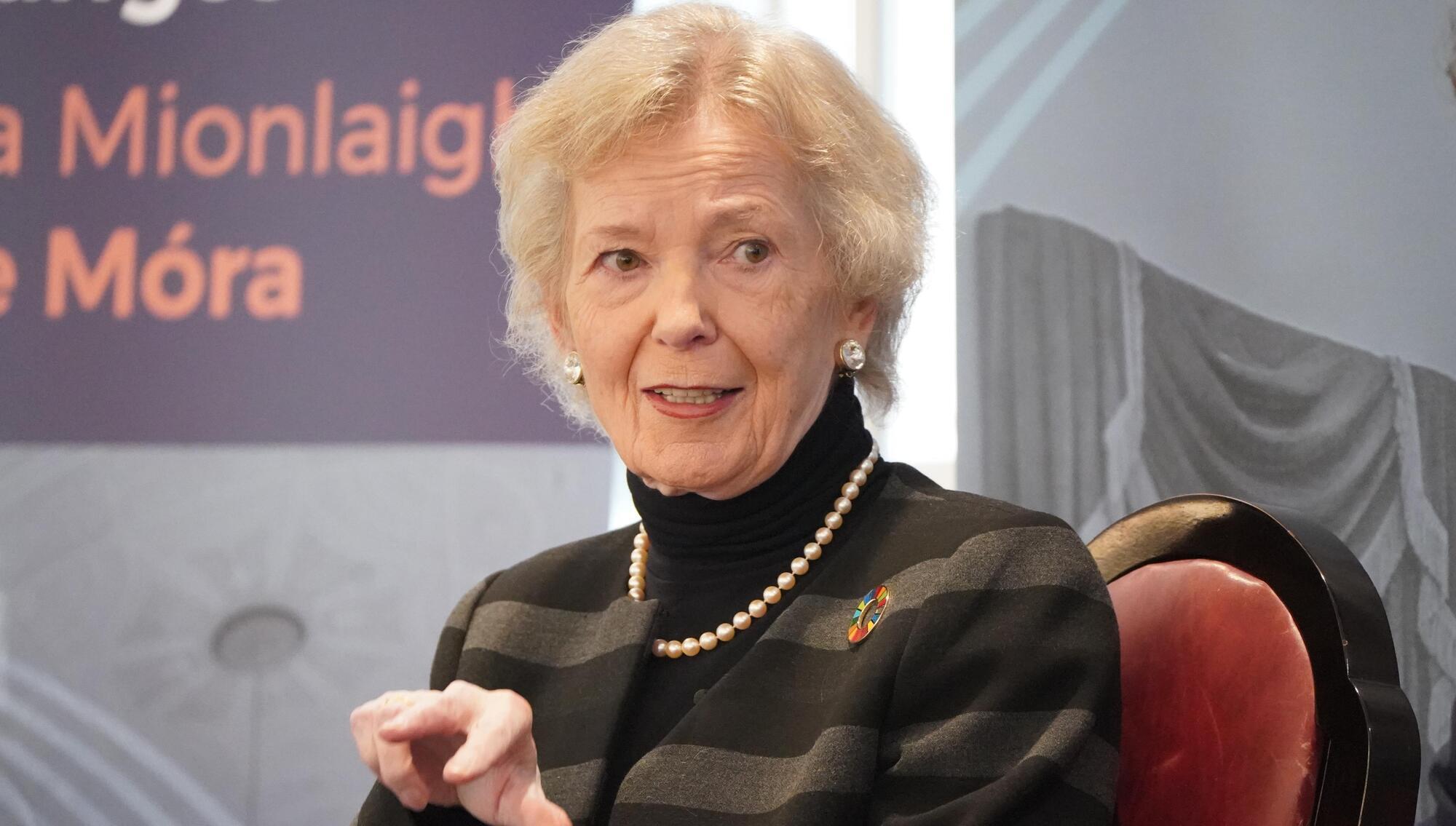
Former President of Ireland Mary Robinson.
President Mary Robinson expressed annoyance about research on suitable gifts by embassy officials after she presented a gift to an Irish centre in Britain that she discovered was available on special offer in the centreâs shop.
Files released under the 30-year rule show the Presidentâs secretary, Peter Ryan, and special adviser, Bride Rosney, raised several issues that concerned Ms Robinson at a meeting with Government officials in Ăras an UachtarĂĄin in January 1992.
The documents highlight how Ms Robinson sought to make changes to elements of traditional protocol associated with the presidency after her historic election as the first female president of Ireland in 1990, as she believed the military ceremonies on her departure and arrival from official visits were âexcessive.âÂ
They reveal the Presidentâs annoyance that she noticed that a copy of the , which she had presented to the Liverpool Irish Centre as a gift, was available for sale at a reduced price in the centreâs craft shop.
HISTORY HUB
If you are interested in this article then no doubt you will enjoy exploring the various history collections and content in our history hub. Check it out HERE and happy reading
Her representatives suggested at the meeting that local embassy staff should provide âgreater thought and more researchâ about gifts to be given by the President as Ms Robinson felt copies of the were no longer suitable.
They also made an oblique comment that the President had been embarrassed by an encounter in Liverpool with a British lord over her âovernight arrangementsâ, and that similar arrangements should be avoided in future.
The officials raised the issue of catering for meals hosted by the President and noted that the caterers for a recent State dinner for the Icelandic president had been âvery poorâ.
The files revealed that the Presidentâs husband, Nick Robinson, a member of the Church of Ireland, requested that a chaplain from a local Protestant church should accompany him to any services in a Catholic church which he would attend when on an official visit abroad with his wife.
Ms Robinsonâs officials also informed the Department of Foreign Affairs that she would prefer to have long rest periods in the afternoon rather than several short rest periods during the day when on official visits.
The President also had a preference for conducting her official business in the morning or by 3pm at the latest and liked luncheons better than dinners.
Documents show the President almost inevitably always made a last-minute decision to bring an extra suitcase on overseas trips.
Her officials also called for occasions where Ms Robinson could be âexploited for commercial reasonsâ to be avoided as Ms Rosney pointed out that the President had visited an Irish-owned shopping centre in San Francisco during a visit to the US, although there was no particular emphasis on Irish products.
Ma Robinson also requested that any receptions hosted by a local Irish or other organisation attended by her should not charge guests.
In addition, she asked for luggage of accompanying press reporters to be treated as if it was part of the official party to facilitate coverage of departure and arrival ceremonies.
In relation to the military element of ceremonies, Ms Rosney said the arrival of army personnel and trucks used to cause disruption at the Ăras on days when new ambassadors would be presenting their credentials and expressed concern about the associated costs.
Civil servants were informed that the President would prefer if such events could be âa more social occasion".
In an assessment of topics discussed at the meeting, the secretary general of the Department of Foreign Affairs, Noel Dorr, said he agreed that it would be desirable to look critically at various protocol and ceremonial arrangements and âto adapt and update them somewhat".Â
Mr Dorr said he would personally favour some reduction in the âmilitarisationâ of the Presidency but at the same time he advised there was a danger of draining functions of the Office âentirely of symbolism".Â
He admitted that he privately often believed that the military aspects of such ceremonies were ârather overdone for a small country with an elected civilian president.â Mr Dorr noted that the President is also commander-in-chief of the Defence Forces and there is a team of aides-de-camp in Ăras an UachtarĂĄin.
âThis gives the Defence Forces an established position which they might be reluctant to diminish to too great an extent,â he observed.
Mr Dorr remarked that several new ambassadors who had presented their credentials had commented on how they were surprised that the ceremonies were so formal for âa country like ours.âÂ
 He expressed support for doing away with military ceremonies for when the President either left or arrived back in the country apart from occasions of formal state visits.
However, he said⯠the military ceremony marked the importance of the occasion rather than the President herself.
Mr Dorr also supported a reduction in the number of people who made up a âfarewell partyâ for the President on non-formal occasions.
At the time, such parties consisted of the Taoiseach or another Government minister, protocol officers, the chief of staff of the Defence Forces, the Garda Commissioner, the Government secretary, and the secretary of the Department of Foreign Affairs, as well as top officials from Aer Rianta and Aer Lingus.
Mr Dorr questioned if it was really necessary for the Chief of Staff or the Garda Commissioner to turn up for such occasions if there was no military ceremony.
However, he observed that most officials would probably still show up âout of a sense of dutyâ unless there was a clear directive on the issue.
Mr Dorr joked that the most âefficientâ way for ambassadors to present their credentials would be to get embassy drivers âto deliver an envelope to the Ăras.âÂ
Another senior official also remarked that there was a great deal to be said for adapting such ceremonies so that they were âless anachronistic and more in keeping with the image of a modern democracy.â