Last month was the fourth warmest September on record
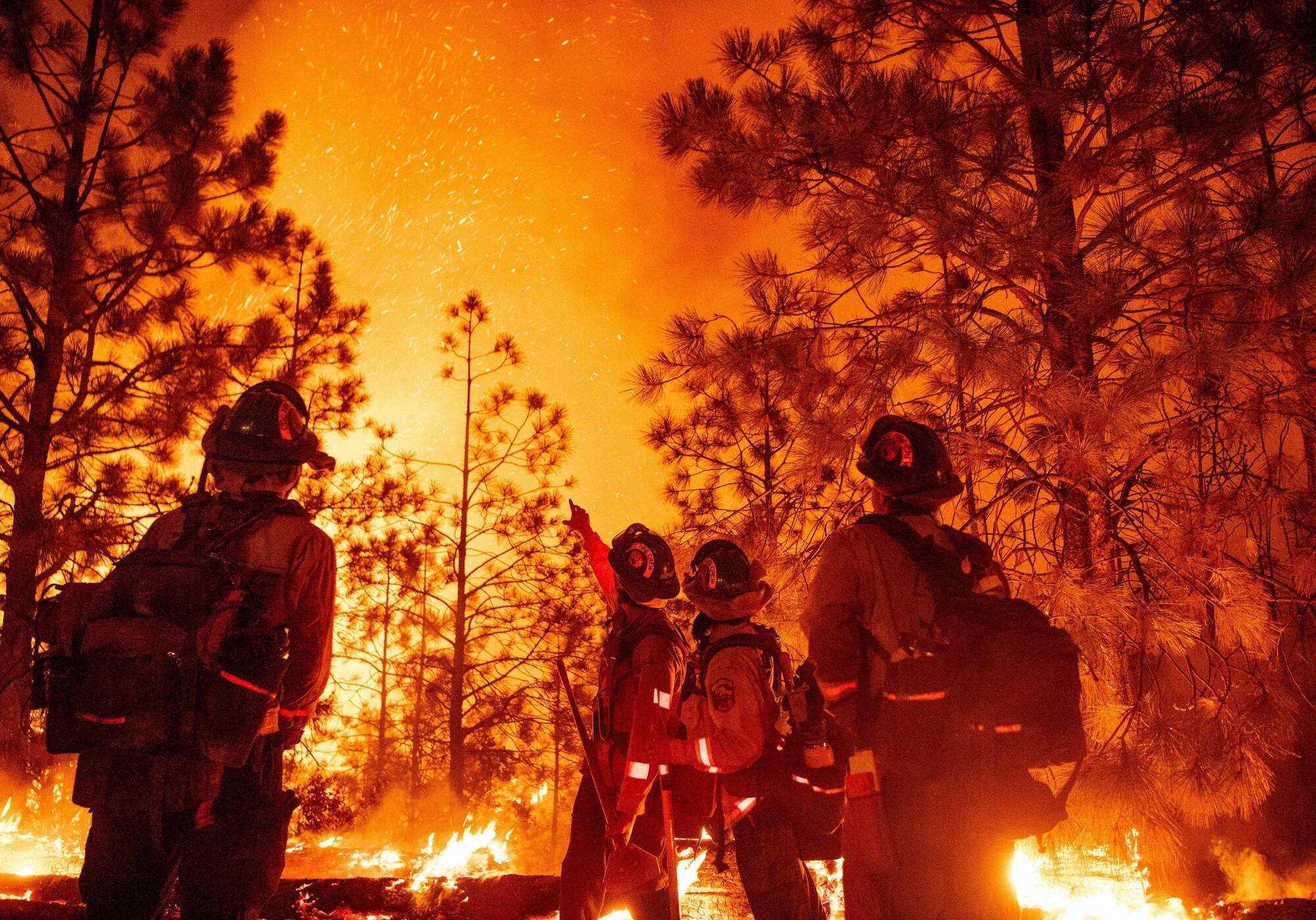
Firefighters monitor the Mosquito Fire, California's current largest blaze, which swept through nearly 50,000 acres in the Sierra Nevada Mountains in September. Globally, according to Copernicus data, it was one of the warmest Septembers. Photo: Joash Edelson / AFP
Last month was the fourth warmest September on record, with Greenland in particular showing ominous signs of the stark reality of climate change, data show.
According to analysis from the EU's Copernicus Climate Change Service (C3S), while Europe had a month that was cooler than recent norms, conversely the rest of the planet was warmer than average, equalling 2016 as the fourth warmest on record.

Greenland, the world's largest island, saw worrying temperature outliers, the data show. Copernicus said Greenland had exceptional temperatures that reached more than 8C above the monthly average in places, the warmest temperatures for September in the record.
Senior scientist with Copernicus, Freja Vamborg, said: “After a summer of extremes with record temperatures, drought and fire activity in most of Europe, the month of September has shown below average temperatures in Europe.
"Globally, according to Copernicus data, it was still one of the warmest Septembers. Greenland was unusually warm, with most of the territory experiencing the warmest September in the record dating back to 1979.”
The findings are based on computer-generated analyses using billions of measurements from satellites, ships, aircraft and weather stations around the world.
The newest data coincides with the World Meteorological Organisation (WMO) warning that the gathering and assessment of data had to improve as the world continues to warm, causing more and more extreme weather events.
“All successful actions to adapt to or mitigate climate change must be based on sound accurate information that can only be provided by a global climate observing system. Planning for and mitigating the impacts of climate change, predicting and understanding future risks, and protecting vulnerable populations and infrastructures all require global information on the changing climate,” said WMO Secretary-General, Prof Petteri Taalas.
A report by the Global Climate Observing System (GCOS), which informs WMO policy, found that the development of long-term records are "extremely vulnerable".
There are big gaps for observations over parts of Africa, South America, Southeast Asia, in the deep ocean and polar regions, while there has been no improvement since the last report seven years ago, GCOS said.
Chair of the GCOS Atmospheric Observation Panel for Climate, Maynooth University professor Peter Thorne, said: "There is an ongoing need to understand the changing climate system.
"At a fundamental level what we do not observe we cannot understand, and what we cannot understand we cannot predict, adapt to and mitigate."
CLIMATE & SUSTAINABILITY HUB