Ukrainian refugee influx could be on a 'different scale'
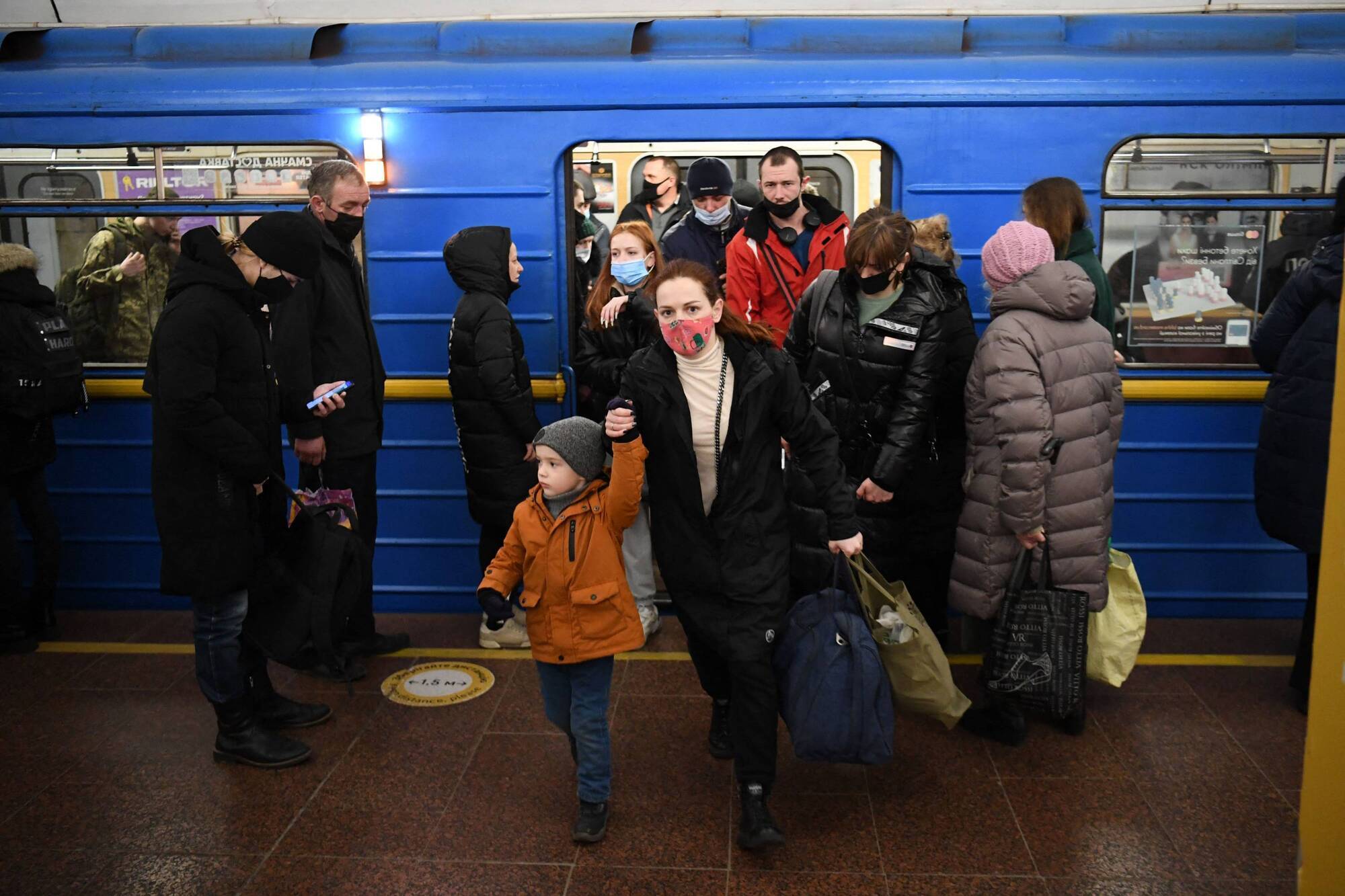
People disembark a train at a metro station in Kyiv. Millions of refugees have left Ukraine in the past few weeks.
The influx of Ukrainian refugees into Poland and other border countries could soon be on a “different scale”, aid agencies have said, as the western city of Lviv faces escalating Russian attacks.
David Burns, from Irish aid agency Goal, said with each attack near the border region, there is a “big surge” in terms of numbers heading to cross the border.
“There’s no doubt that if this escalates and continues, the needs are only going to increase,” he said. “An awful lot of people haven’t yet crossed the border. They are displaced and still in Ukraine. It’s all about trying to prepare and plan to get supports to the people who can’t get away.”
An early Friday morning barrage of missiles on the outskirts of Lviv, less than 100km from the Polish border, were the closest strike yet to the centre of the city which has become a crossroads for people fleeing from other parts of Ukraine.
Black smoke billowed for hours after the explosions, which hit a facility for repairing military aircraft near the city's international airport, only four miles from the centre. One person was wounded, the regional governor, Maksym Kozytskyy, said.
Lviv is well behind the front lines, but it and the surrounding area have not been spared Russia's attacks.
In the worst attack, nearly three dozen people were killed last weekend in a strike on a training facility near the city. Lviv's population has swelled by some 200,000 as people from elsewhere in Ukraine have sought shelter there.
Many then go onwards from the city, which has a rail link to Przemysl in Poland and motorway links to border crossings.
Almost 2 million Ukrainians have fled the country into Poland so far, with hundreds of thousands more leaving via Romania, Moldova, Hungary and Slovakia.
Mr Burns spent time at some of the key Polish-Ukrainian border crossings, including Korczowa and Budomierz.
“We were on the Polish side in Korczowa first, and it’s immediately striking,” he said.
“Three thousand people trying to sleep all beside each other is very challenging.”
At Budmoierz, Mr Burns and his colleagues crossed into the Ukrainian side and linked up with partner agencies.
“There is a difference between the Ukrainian and Polish side,” he said. “There’s a lot more facilities on the Polish side, and the Ukrainian side is trying to get up to speed in terms of first aid, and in terms of food and shelter.
“I wouldn’t say they’re there yet. But it’s improving day-to-day. It’s about making sure they’re not overwhelmed. There’s up to 100,000 border crossings every day. After a rocket attack hits nearby, that creates a surge again. Things like that have an immediate effect.” Mr Burns described giving one Ukrainian family a lift to the border and said there was a mixture of emotions among the people they met.
“There’s a defiance in so many people,” he said. “The way [one woman] was speaking. There was a pride in Ukraine as well. The spirit you see from their president really shines through. I found that quite striking. You wouldn’t say their spirit is broken.”
The Goal worker said that, in terms of speed, direct financial donations can ensure the right aid gets to the right people at the right time.
He said: “It looks like it’s going to escalate, and that need may be one month from now.
“Many who crossed early are the ones with the means to get there. It’s the people left behind at the minute. The ones in active conflict zones or those who can’t physically travel. They’re who need that support now. We have to be ready.”

CONNECT WITH US TODAY



Be the first to know the latest news and updates