Students devise way to solve ancient geometry problem to win BT Young Scientist prize
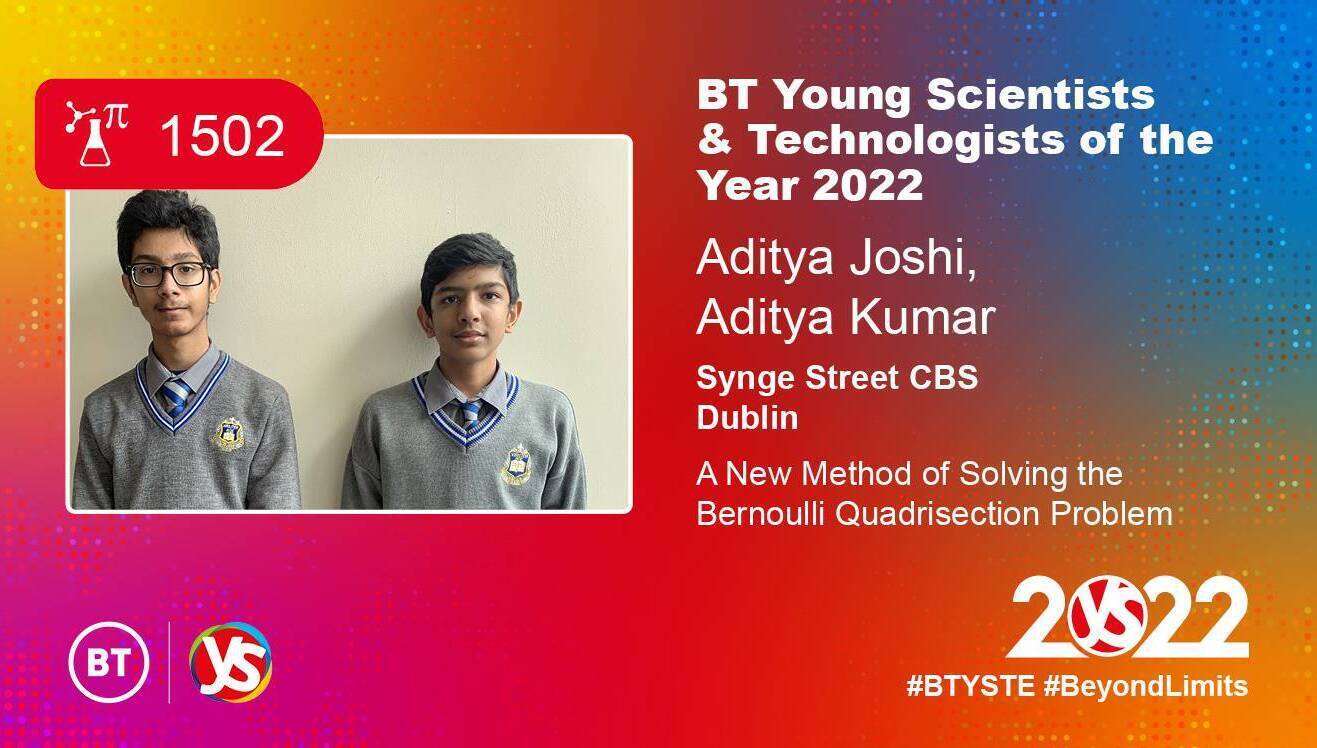
Aditya Joshi and Aditya Kumar from Synge Street CBS have won the grand BTYSTE prize.
Two third-year students were crowned winners of the BT Young Scientist and Technology Exhibition after devising a new method to solve a geometry problem that dates back to 1687.
Dublin students Aditya Joshi and Aditya Kumar from Synge Street CBS have won the grand prize of €7,500, a perpetual trophy and will go on to represent Ireland at the European Union Contest for Young Scientists which takes place this September.
Joshi, who was celebrating his 15 birthday, and teammate Kumar, 16, took home the top prize for a project entitled ‘A New Method of Solving the Bernoulli Quadrisection Problem' — an old but difficult problem in Euclidean geometry.
Applying modern computation methods, they used the technique of “particle swarm optimisation”, an algorithm inspired by biological phenomena seen in the behaviour of flocks of birds or swarms of bees.
The quadrisection triangle problem concerns finding two perpendicular lines which divide a given triangle into four equal areas.
In 1687, Jacob Bernoulli published his solution to the problem with a general algebraic solution.
Commending the winning project, Professor Pat Guiry, Professor of Synthetic Organic Chemistry at UCD said, "The judges were highly impressed by their elegant work, their creative ideas and their excellent presentation skills.
"The students presented a new approach to a problem that dates back to 1687, while also identifying areas of possible application in contemporary engineering.”

In other wins, the award for Individual Winner went to Ross O’Boyle, 16, a TY student from Portmarnock Community College, Dublin for his project entitled 'An investigation into the effectiveness of various ventilation methods using CO2 as a proxy for the spread of Covid-19 in both controlled and real-life scenarios.'
Tralee students Conor Bradshaw, 18, David Hughes, 17, and Dara Newsome, 17, who are in their Leaving Cert year at Mercy Mounthawk, took home the Group runner-up award for their project entitled 'A Wearable Smart Device for Dementia Patients'.
The talented students have invented an intelligent spectacle system that helps reduce anxiety and fear in people with dementia. This includes an advanced product design, an embedded AI visual recognition system, with multi-mode communication capability.
Over 1,000 students from across the nation took part at the 58th BTYSTE - the second-ever virtual held event for the science competition.
Virtual judging took place this week where students were interviewed on their projects.

Education minister Norma Foley who spoke at the online event said it is "encouraging and heartening to witness the level of creativity and innovation of this year’s entrants."
"The calibre of entries is a testament to the tenacity and talent of the students behind them, and it is this constant high standard that makes BT Young Scientist one of the longest-running, and most successful STEM events in Europe," she said.