A hospital for children, 'designed' by children
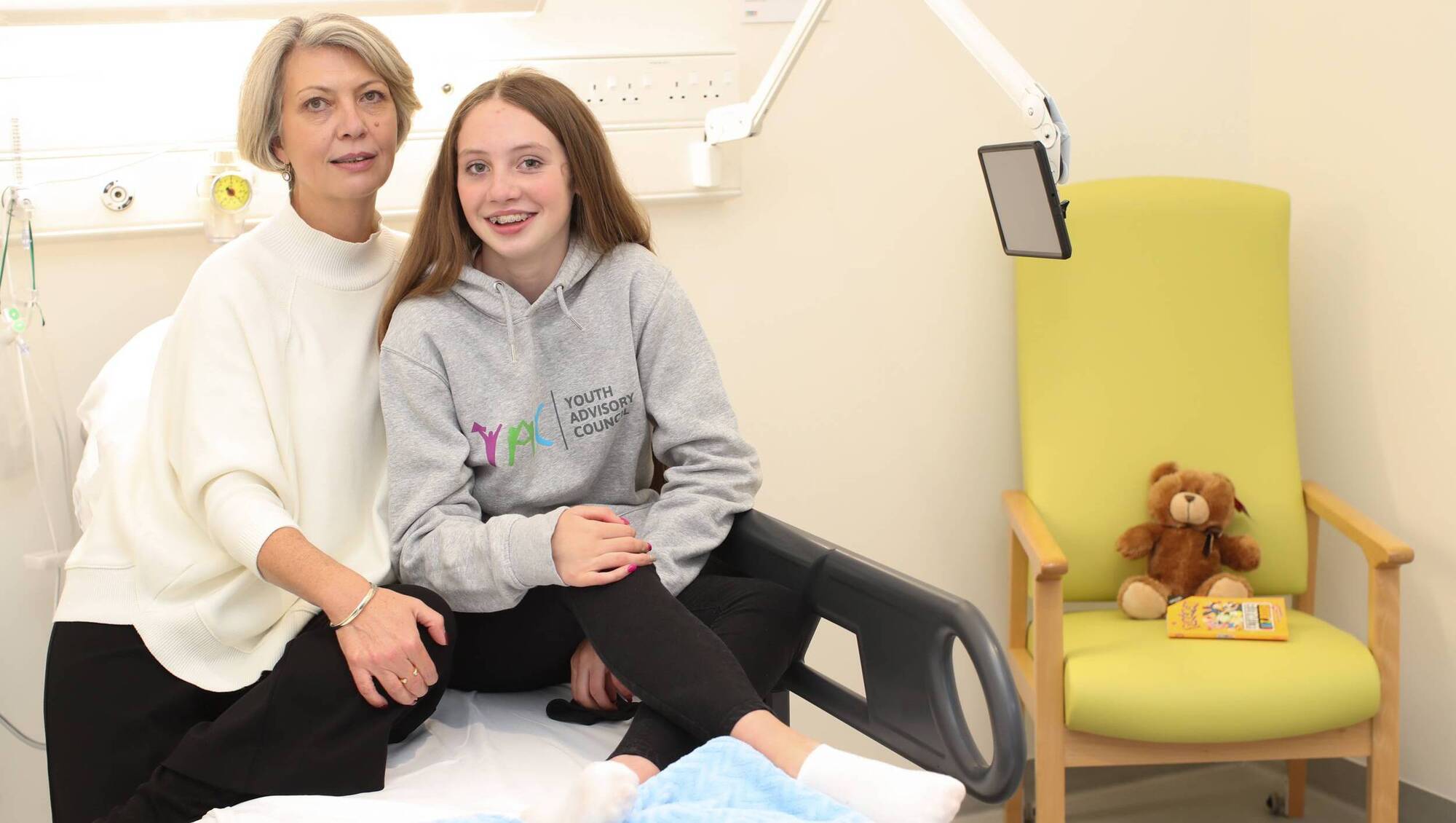
Molly Lynch, 13, with her mother, Diane Lynch, from Co Kilkenny, in the demonstration rooms for the new Children's Hospital Dublin. Picture: Children's Health Ireland
Molly Lynch is 13, but has been around hospitals long enough to know what she likes and does not like.
This gives her the perfect qualifications for being on the Youth Advisory Council for Children's Health Ireland, providing input into the new children's hospital, now set to open sometime in 2024.
Her 'not good' category starts with talking to doctors on large wards, while other patients and their parents can hear. It makes her 'nervous'.
Doctors or nurses referring to her parents as mum and dad, instead of by their names, is just "awkward", the teenager said, with an eye-roll.
Council members are also not impressed by all-white hospital uniforms, which make it hard to tell staff apart. Colours, please, they asked.
So while Molly was happy to see "soft and colourful" new furnishings in demonstration rooms set up like the planned 380 in-patient rooms for the new hospital, she is just as focused on the hospital's future culture.
"We link up with different people in the hospital services, we talk about what could be improved. A lot comes back to the communication part," she said.
Diagnosed shortly after birth with PKU (phenylketonuria), she travels regularly to Temple St hospital from her home in Co Kilkenny.
PKU is a rare inherited disorder, which means a person cannot break down proteins in food. The main treatment is a restricted diet and constant monitoring is required.
The new hospital, under Children's Health Ireland (CHI), will take over from Temple St, Crumlin, and Tallaght Hospitals. It is expected to treat about 25% of all children in Ireland, including those referred for specialist treatment from around the country.
Satellite units have already opened: CHI at Connolly (2019) and CHI at Tallaght (November 2021), offering paediatric outpatient and emergency care.
In the meantime, Molly and her friends are treated in buildings that are overcrowded.
"Everyone else can hear what you're saying," she said. "Obviously, not everyone has the same view on everything; you would feel a bit nervous about what to say." Headphones are vital, council members who spent long periods as in-patients have told her. They block out other conversations and you can listen to music or play games without disturbing anyone.
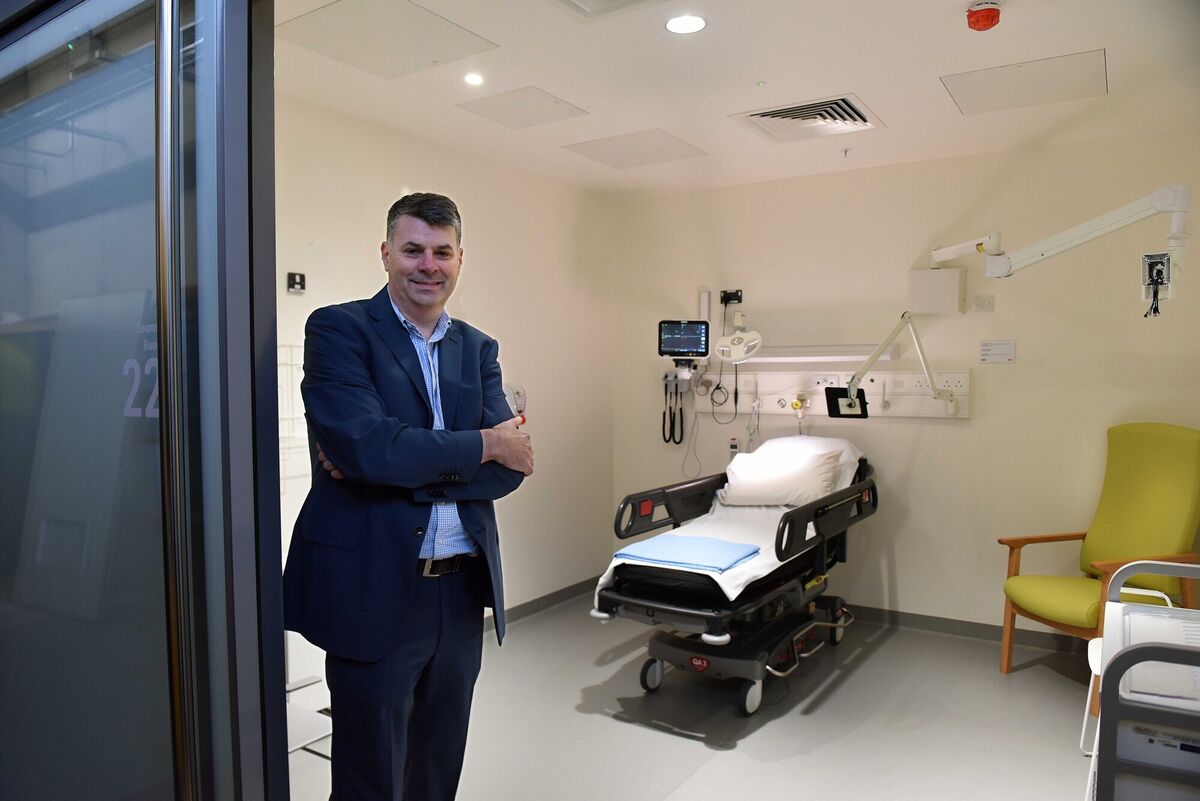
The planned 70-room emergency department has more privacy.
She was intrigued by a tablet positioned on a moveable arm over in-patient beds. "You can order your food from it as well. That just blows my mind. I really liked that,” she said.
The hospital will be paperless, with a project team two years into digitalising existing records.
"The new rooms are so bright, all the clinical stuff is on one side," she said, pleased that staff won't have to squeeze past her parents to reach her.
However, Molly circled back to communication often as she talked, insistent this has to improve.
"One of the guys in the council, up to when he was 17 and still going to child services, his parents were still being called mum and dad (by staff). It gets really awkward," she said.
She welcomed "a big difference" in recent years, saying: "They’re directing the conversation more to the children, not the parents."
For her mother, Diane Lynch, pull-out sofa-beds in each room and the 53-bed accommodation unit will change how families experience a hospital stay.
"You either have to sit on a chair, or sleep on a chair next to the child or you have to book into a hotel. You want to be close to the hospital, and it is an expense that is beyond a lot of families," she said of the current options.
Having worked from home for much of the pandemic, she said individual rooms could give some parents the option of working, depending on their child’s situation.
The Lynches usually drive from Co Kilkenny, leave their car at Heuston Station car-park, and take the Luas to Temple St, as there is so little parking near the hospital.
They tried the train, but it is difficult to predict how long appointments might take. Sick children often can't travel on public transport anyway, she said, not to mention bags of equipment and special food to be carried.
"I know there have been many conversations about the location of the new CHI. There are pros and cons for that, but I think for anybody in a position where they need to have the car to bring them to the hospital door, the parking piece is a challenge now," she said.
The new hospital will reserve 675 parking slots for parents.
For Dr Emma Curtis, medical director with the National Paediatric Hospital Development Board (NPHDB), the new rooms mean more children will be treated and in a more dignified way.
"The huge change is having all individual rooms. That is really good for the patient and their family," she said. "At the moment, we have multi-occupancy wards, and I am always very conscious when I am talking to a patient and it's divided from the next bed by a curtain that what I am saying can be overheard." The new hospital will house 39 medical specialities, so children stay in their room and doctors will come to them.
"This is a referral hospital for the country, so the speciality areas will have a designated ward where children will come from around Ireland for specialist care," she said.
Dr Curtis, a paediatrician in CHI at Tallaght, said there are plans to develop the child sexual assault treatment unit (child SATU) at the new hospital and in CHI at Tallaght.
She is part of a "forensic medical examiner service" with paediatricians and a specialist nurse. The aim is to deliver a 24-hour service, drawing on work done already at Crumlin and Temple St.
"What we always say is the recognition of child abuse is the responsibility of every paediatrician," she said, adding that this expanded service will cover historic and current abuse for under-14s.
Children over 14 are treated through adult SATUs, with the Child and Adolescent Sexual Assault Treatment Services in Galway also offering 24-hour help for younger children.
Dr Curtis said huge waiting lists are often linked to shortages of assessment rooms as much as of staff. CHI at Tallaght has recruited in recent years, she said, but the "scarcity of physical outpatient rooms" has reduced their work-rate.
97,000 children are on waiting lists, including 38,600 waiting longer than a year, according to the Irish Hospital Consultants' Association.
"The (new) outpatients rooms are designed with a view to address the backlog and future need. We have taken current activity and acknowledged there is a backlog. It's about having the physical resource to accommodate the patients," Dr Curtis said.
Babies coming in with RSV (a winter virus) can have their own room instead of staff needing to "cohort" together groups with similar illnesses, she said.
Since CHI at Connolly opened, they have "contributed" to a 65% reduction in waiting lists for general paediatric services, a spokeswoman said.
There has also understandably been focus on the growing costs of the build and set-up, with an expectation it could go over €1.7bn.
In December, Robert Watt, secretary general at the department of health, told the Public Accounts Committee that a final cost projection could be made public when they hit 75% completion or some issues under dispute are resolved.
Phelim Devine, project officer with the NPHDB, said the impact of Covid-19 and Brexit cannot be denied, with construction costs and inflation rising sharply.
"We are just under about 60% (complete), based on certified payments made to (construction firm) BAM by the employers' representative," he said. "We have paid them just under 60% of the contract sum." He also declined to comment on costs.
"I'm not going to speculate on the final cost," he said. "We know what the potential final cost is, of course we do, that is our job. But I am not going to disclose that, because that is not in the best interest of the project." Weekly PCR tests for the 1,350 workers on site have reduced absences, but it has been impossible to avoid completely, he said.
He said 'design changes' are often "normal construction stuff", such as the lattice of pipes for gases and other medical systems that may need adjustments.
The seven-storey building, now clearly visible around Dublin 8, has some medical equipment installed under a €25m agreement. Another €100m will be spent when construction is complete on MRIs, scanners, and other equipment.
Right now, they are using the demonstration rooms to take input from staff and patients, he said.
Tweaks, like replacing rectangular glass-panels in doors with curved shapes at both child and adult eye-level, are subtle signs someone thought a lot about little patients who will attend.
However, even the most high-tech new hospital cannot overcome one huge challenge — where to find enough paediatric ICU nurses.
Instead, the design has built-in sliding glass doors, which can give nurses a view of more than one area at a time.
"Best international practice is one-to-one care, but hospitals don't always have that.It's so hard to get ICU nurses," Mr Devine said.
CONNECT WITH US TODAY



Be the first to know the latest news and updates