British believed Gerry Adams was on IRA Army Council in 1994
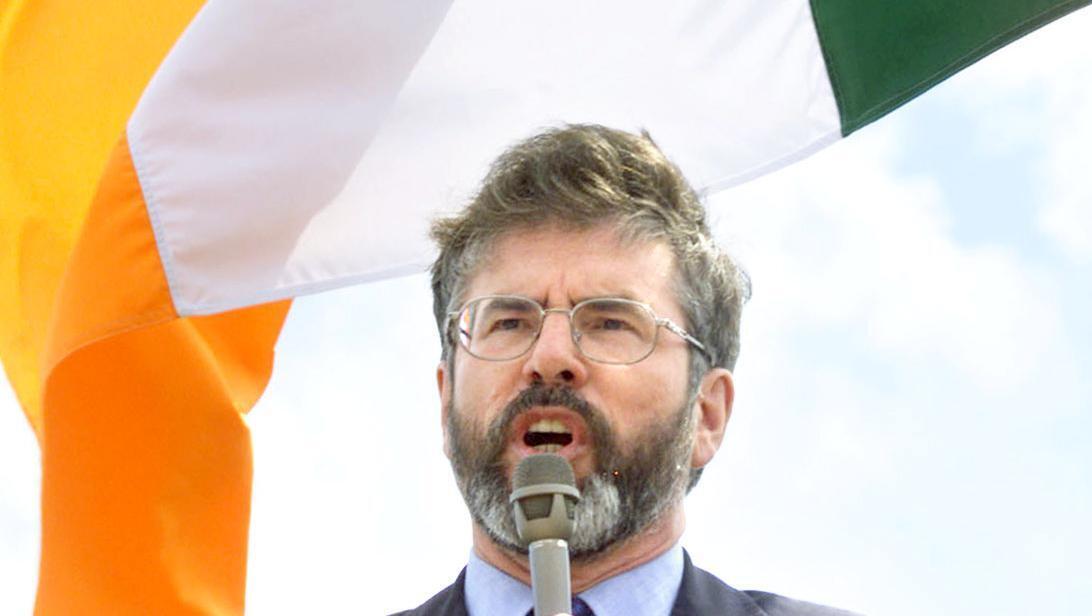
According to a confidential record of a conversation in October 1994 between Irish Ambassador to Britain, Joseph Small, and Paul Lever, a senior official in the British Foreign Office, the UK Government believed that the Sinn Fein president sat on the IRA Army Council.
The British Government believed that Gerry Adams was on the IRA Army Council at the time of the first ceasefire in 1994.
According to a confidential record of a conversation in October 1994 between Irish Ambassador to Britain, Joseph Small, and Paul Lever, a senior official in the British Foreign Office, the UK government believed that the Sinn Féin president sat on the IRA Army Council.
Mr Small referred to the fact that the British civil servant had said that a Mr Murphy "was the member of the seven-man IRA army council who showed most reluctance in relation to the statement of August 31 although he did not dissent in the end".
Referencing the decision of the IRA to announce a ceasefire, the British official appears to be referring to Thomas "Slab" Murphy, who is alleged to have been one of the most powerful individuals in the IRA.
The Irish official says that "another one or two may have had reservations although they, too, went along with the decision".
"According to Lever, Adams sits on this council."
Gerry Adams has always denied that he was a member of the IRA.
Mr Lever had told the Irish diplomat that "there was no evidence over the last month that dissidents were peeling off from the Provisionals and forming alliances with the INLA or Republican Sinn Féin".
The British, according to the document, were "not too worried" about the INLA whom they saw as lacking "operational capacity" and possessing "no clear political agenda".
The Irish ambassador notes of that of Gerry Adams, "it was quite clear that Lever shares the general hatred of the man so evident in British governing circles".
On the recent ceasefire, Mr Small said that the British would have to wait for a "positive nod" from the then Ulster Unionist Party leader, James Molyneaux, before the prime minister, John Major, can publicly indicate that the ceasefire is permanent.
Meanwhile, the State papers also revealed that British leaders spoke of how the European Union would contribute to the peace process in Northern Ireland as early as 1992.
At a dinner in Downing Street in February 1992 the European Community, the precursor to the EU, was praised by both sides for bringing the two governments closer together.
The conversation at the dinner, which was attended by both taoiseach Albert Reynolds and prime minister John Major alongside a number of senior ministers, is recorded in a confidential note made by Irish officials.
Mr Reynolds says that some of the policies envisaged in the Government of Ireland Act 1920, which partitioned the island, "are now coming back from Europe".
Referencing the role of a Council of Ireland, he asks: "How can we input that situation into Northern Ireland to pick up wherever you leave off?"
Peter Brooke, the then-secretary of state for Northern Ireland, responds: "The economists from outside would see it as extraordinary that trade between North and South in Ireland is so small due to the incubus of partition. This will change with the development of the EC but not by 1993."
CONNECT WITH US TODAY



Be the first to know the latest news and updates