6,735 new Covid-19 cases confirmed as testing positivity rate hits 49.7%
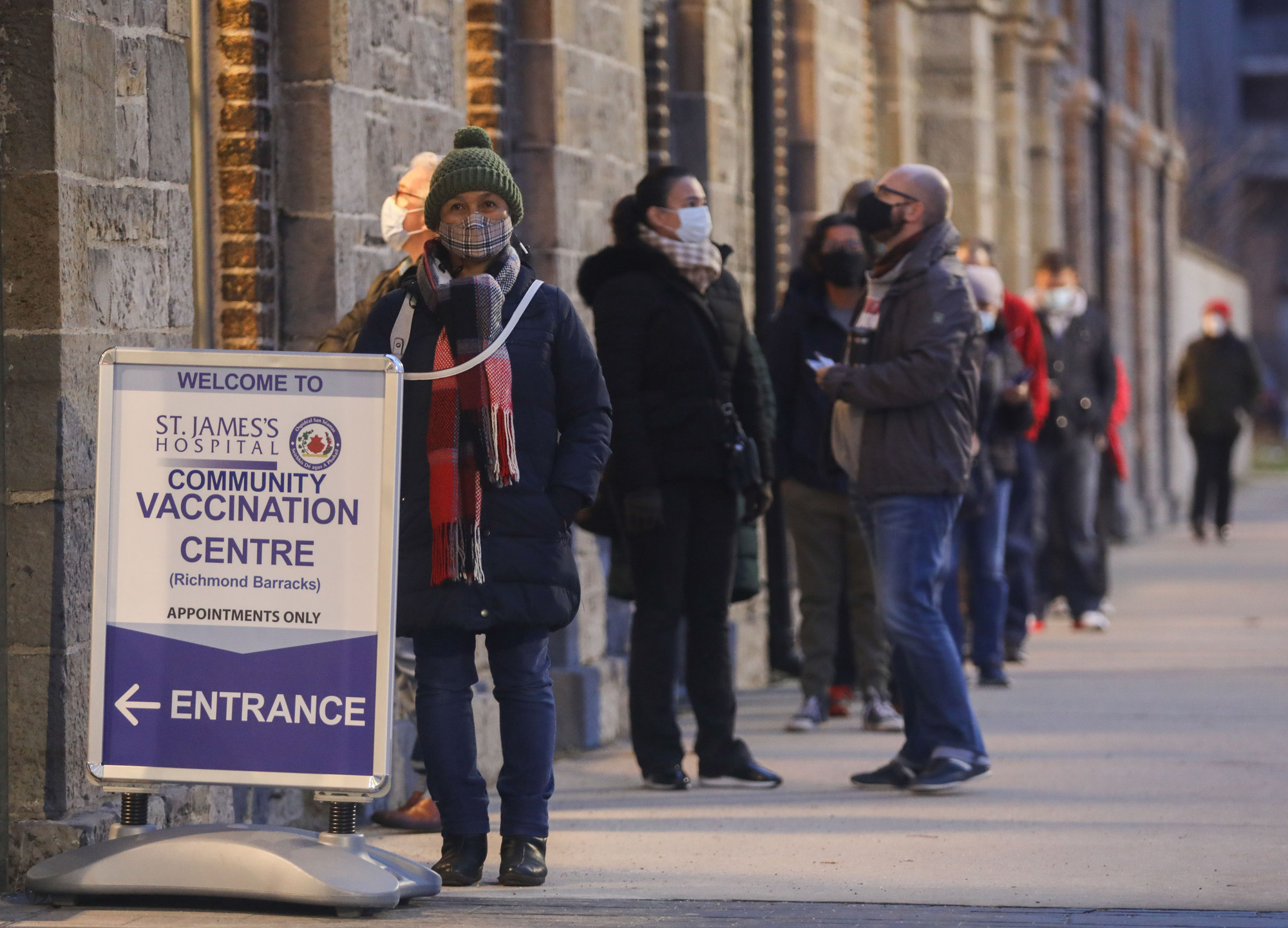
Pictured are members of the public queuing outside Richmond Barracks in Dublin on Christmas Eve, as the clinic continued to roll out booster vaccinations just one day before Christmas. Photograph: Leah Farrell / RollingNews.ie
A further 6,735 cases of Covid-19 have been confirmed in Ireland, as almost half of the coronavirus swabs reported on Sunday returned a positive result.
According to the Covid-19 GeoHive, of the 13,149 swabs administered yesterday, 6,735 returned a positive test result - a positivity rate of 49.7%,
On St Stephen's Day, the test positivity rate was 39.8%, up from the 32.4% recorded on Christmas Day.
As of 8am on Monday, 461 Covid-19 patients were in hospital, 91 of whom were in ICU.
The Omicron Covid-19 variant now accounts for more than 87% of infections, according to Department of Health officials.
Vaccination centres have resumed services across the country this morning after being closed for Christmas and St Stephen's Day.
As well as walk-in clinics, a number of vaccination centres are offering online booking for booster appointments for people aged over 40, pregnant women over 30, healthcare workers over 30, and anyone over 30 with an underlying health condition.
From this Wednesday, everyone aged between 30 and 39 can book booster appointments.
A reduced level of PCR testing had operated since Christmas Day.
An infectious diseases expert believes Covid-19 infections could as much as double before the Omicron wave peaks here.
New record levels of infection were set on Christmas Eve and Christmas day, with yesterday's 10,404 the third-highest since the virus reached Ireland.
On St Stephen's Day, 426 patients with the virus were in hospital, a jump from Christmas Day’s figure of 378, with 91 of those in intensive care.
It is thought it will take at least two weeks for the full impact to reach the hospital system.
Infectious diseases expert Professor Sam McConkey has called on people to isolate themselves if they are sick even if they have had a negative PCR test result.
Prof McConkey believes Denmark is a few weeks ahead of Ireland in the outbreak.
He says he expects the number of cases to double what they are now and the level off if we are being guided by the Danish experience.
Prof McConkey says the severity of the illness caused by Omicron may be less severe, but the sheer level of infection makes it dangerous.
"We're still going to see a lot of admissions because there's going to be so many infections," Prof McConkey said.
"To the extent that Denmark is a bellwether is a marker that we can see our journey to sort of prophesied in the Danish data."
Speaking on radio, Prof McConkey pointed out that the Omicron variant has a replicant rate of four which means that the number of cases is doubling every two to two and a half days, that meant that over 20 days the variant “goes up one thousandfold” which he said was “was a frightening level of speed of rise".
While the good news from South Africa was that patients did not get “too sick”, in the UK the rate of hospitalisation with the Omicron variant had been 70% lower, but that still meant 30% could need to go to hospital.
The fact that the Omicron variant was “less pathogenic” in Denmark could be because of the high level of vaccination and previous infections, he added.
The levels of infection at present are mostly in those aged 20 years to 40 years and the concern now was that the variant would spread to older groups over the next few weeks, which could lead to high numbers in the first two weeks of January requiring hospitalisation and oxygen.
Prof McConkey also warned that there could be more variants in the future which could be more pathogenic. “We’re not out of the woods yet.”
The argument that Omicron should be let “run its course” is not valid, he said, because if the widespread transmission was delayed by a week or two, it would mean less pressure on the health service and more time for the expansion of the vaccination and booster programme.
With 90,000 to 100,000 people getting the booster vaccine on a daily basis, a two-week delay could mean one million people boosted.
“That’s one reason to follow Tony Holohan’s advice," he said.
Over the weekend, the chief medical officer urged people to reduce their contacts as Covid-19 cases soar.
Dr Tony Holohan was speaking as Ireland recorded a new record high number of 11,182 daily cases on Christmas Day.
The Department of Health said, “large volumes” of case numbers are anticipated over the coming period.
Dr Holohan emphasised that Omicron is more transmissible than Delta and urged that everyone continues to reduce contacts and avoid crowded places as much as possible.
CONNECT WITH US TODAY



Be the first to know the latest news and updates