New Covid restrictions should not see venues shuttered, says Taoiseach
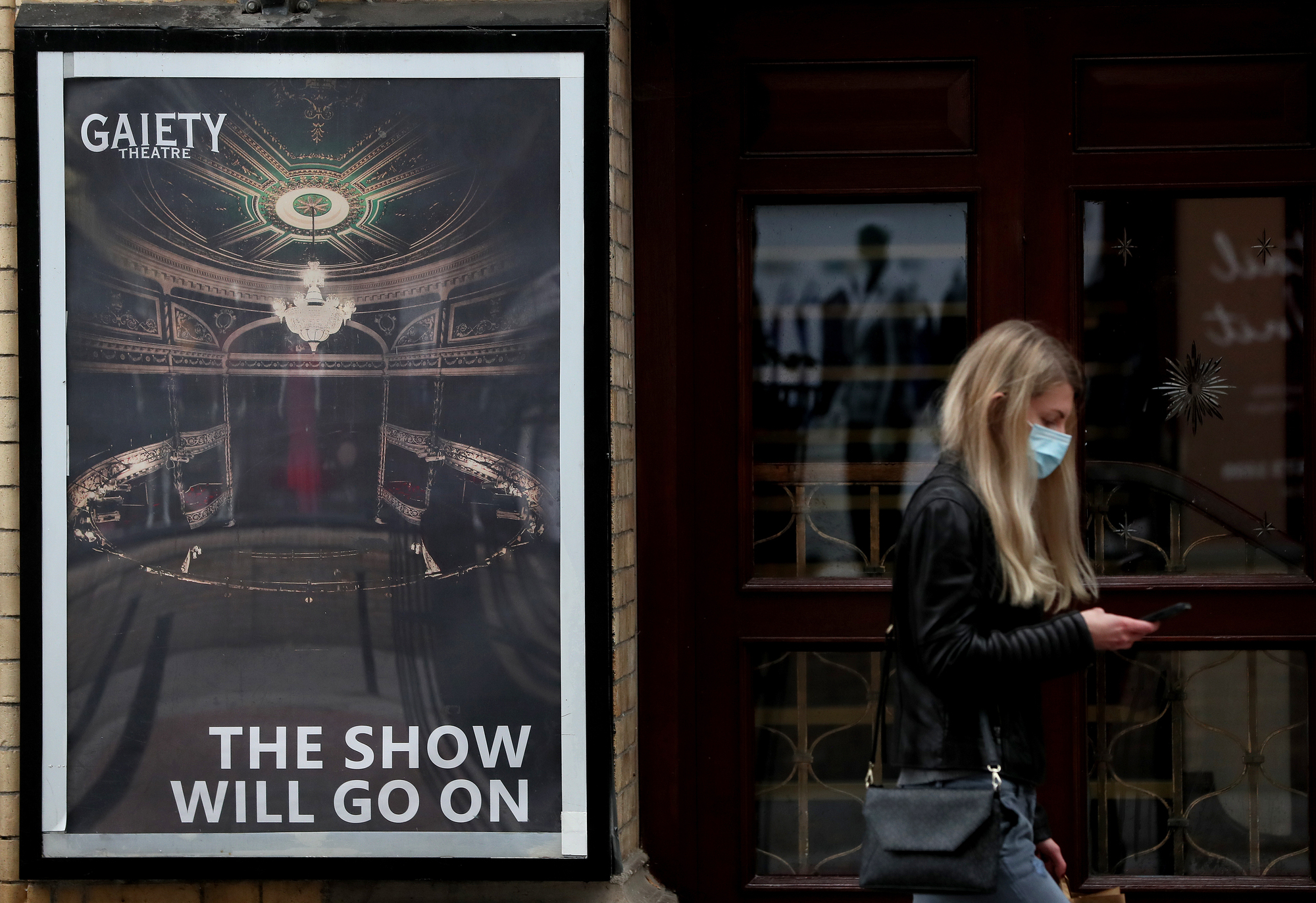
A sign outside the Gaiety Theatre in Dublin’s city centre (Brian Lawless/PA)
The Taoiseach has said he would like to see theatres and gig venues staying open, despite fresh Covid-19 restrictions.
The new measures, designed to curb the spread of Covid-19 amid high rates of the virus, will take effect on Tuesday and last until early January.
Nightclubs will close and there will be a maximum of 50% capacity at entertainment, cultural, community and sporting events.
On Monday Micheál Martin said: “We don’t want people taking a financial hit in terms of organising concerts and events.
“We want theatres to be kept open, we want artists still performing and I believe the nature of targeted supports should be such that we can enable concerts like this to take place and also that they should be viable for participants.”
Mr Martin described it as “one sector that has suffered more than most and we don’t want concerts cancelled”.
Indicating that further Cabinet discussions will take place, he told reporters: “The challenge then is, can we make up the losses for those who are putting on shows.”
Culture Minister Catherine Martin acknowledged the pressure the industry is under, speaking alongside Mr Martin and Tanaiste Leo Varadkar at Dublin Castle.
“So my focus is on now getting supports in place, a scheme that means they can keep their doors open even at reduced capacity. I’d hope to be in a position to announce something in the coming days on that,” she said.
Michéal Martin said on Monday that a full understanding of the effect of the new Omicron variant will "determine to a certain extent the direction of travel", however says he believes the current restrictions will remain unchanged.
"We've laid out our plan until January 9 and that's it," Mr Martin said.
"I think it's different last year because of the vaccination situation and as we go through the fourth wave, I think our responses have to change and reflect the wave we are going through and that is in respect to both public health measures, vaccination but also in terms of how we targeted supports to key sectors of the economy that still suffer and are most affected by restrictions."
Micheál Martin also defended the government's decision to implement new protocols around members of the National Public Health Emergency Team (Nphet) speaking to the media, which will now see members informing government before they speak to journalists.
"Public health is essential to our response to the pandemic and always has been a core principle of mine and of government," he said.
"Nphet will always be facilitated and I want to make that clear, and at no stage will ever an attempt be made to compromise the independence of that advice because it is so central to our response.
"Since the beginning of the pandemic, even when in opposition, I'm very clear that public health advice, independent public advice, sometimes we might not like it, in terms of the messaging, is very very necessary to combat a pandemic.
"We do need to coordinate and we need to evaluate how the messaging is being received by the public as well and sometimes there has been a plethora of voices out which at different times may not have been as helpful as it could have been."
Earlier, the Department of Education reversed controversial instructions which said that pupils who refuse to wear masks should be refused entry to primary schools.
New advice on Monday said children in third class and above should not be excluded from lessons “in the first instance” for refusing to wear a face covering.
Schools have been urged to “engage pragmatically and sensitively” with parents, and in incidents where no progress is made then the department will provide further support.
The fresh advice comes after primary schools were sent instructions last Tuesday to refuse pupils in third class who went to school with no masks.
There was widespread criticism over the language used in the memo and that there was no lead-in time for schools.
The new guidance says parents are encouraged to “work with schools in a spirit of partnership and co-operation”.
Louise Tobin, principal of St Joseph’s Primary School in Tipperary, welcomed the new guidance.
Ms Tobin, a member of Irish Primary Principals’ Network (IPPN), said: “The information that came out late Tuesday evening was suggesting that if children didn’t comply or their parents didn’t wish them to comply with the mask-wearing, then they would not be allowed entry to school.
“That was something that we didn’t feel comfortable with.
“We needed further explanation on how indeed were we going to manage this.
“At the end of the day we would never want to exclude a child from their education and from school.”
She said the department has used a more sensitive approach.
“Without guidance, we didn’t really know quite what to do,” Ms Tobin told the Today with Claire Byrne programme.
“Children do not need to wear their masks when they’re outside, which is good to know, that they can have a break from their masks during their breaktime and their lunchtime.
“We don’t need to obviously wear masks while we’re having our lunch during class, that would be impossible.
“We don’t need to wear masks if we’re outdoors for PE, and if we’re inside, well, then there has to be good ventilation and we keep a one-metre distance.
“We don’t have to wear masks while playing sports or singing or playing an instrument.”
She added: “With young children there always has to be the lead-in, you can’t ask young children to manage or deal with something overnight.
“I imagine a lot of children went to bed on Tuesday night thinking all was fine, and woke up Wednesday morning to be told they had to wear a mask.
“I certainly could see levels of anxiety amongst the pupils that were maybe self-conscious about wearing the mask.
“Adults need to explain to them that this is to keep us safer in schools.
“I’m very happy to say that I have full compliance this morning.”
She also said that schools have not secured additional funding to buy extra masks for primary school children.

CONNECT WITH US TODAY



Be the first to know the latest news and updates