85% of Irish adults worried about global warming implications
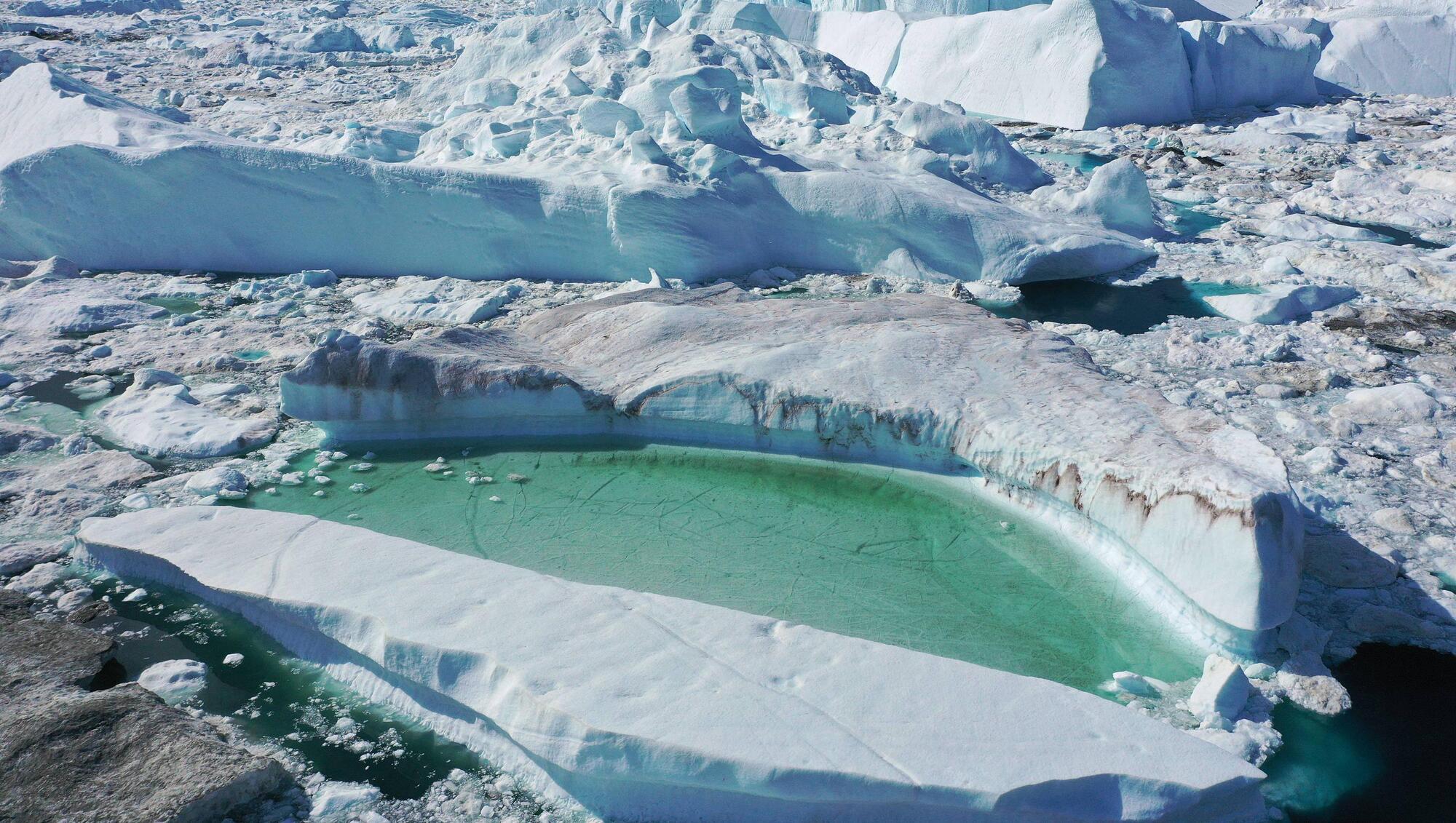
The vast majority of Irish adults are concerned about the implications of global warming on the country. This pictures shows melting ice forming a lake on free-floating ice jammed into the Ilulissat Icefjord during unseasonably warm weather in 2019 near Ilulissat, Greenland. Photo: Sean Gallup/Getty
The vast majority of Irish adults are concerned about the implications of global warming on the country.
New research, commissioned by Coillte, asked more than 1,000 people for their views on climate change and the use of afforestation - the planting of new trees and forests - and reforestation - the restocking of existing forests and woodlands that have been depleted - as tools to combat its effects.
As we know, carbon dioxide traps heat in the atmosphere. Trees and forests, in effect, act as ‘carbon sinks’ converting carbon dioxide (CO2) into oxygen and helping lower global temperatures in the process.
Some 92% of those Coillte surveyed said they agreed that trees were vital in helping to “clean” the air we breathe. Some 85% of respondents stated that Ireland needed to be growing more trees and increasing its forest cover “significantly and quickly” to help in the fight against global warming.
A 2020 study from the Department of Agriculture, Food and the Marine showed that, in 2019, Irish forests absorbed close to 5m tonnes of CO2 - equivalent to 80% of annual car vehicle emissions that year.
"Trees and forests have a very important role to play in our fight against climate change,” said Imelda Hurley, CEO of Coillte.
"Well-managed forests have a triple climate benefit. Trees not only clean the air, but they also store carbon in their trunks and branches and produce wood, an environmentally friendly substitute for the construction of homes and buildings."
At present, just 11% of the land in Ireland is covered in forests. The EU average for forest cover is 38%.
While Coillte planted 22 million trees around Ireland last year, Ms Hurley conceded that the country had "a long way to go to catch up with our European neighbours."
That said, Ireland's forest cover had been as low as 1% around the year 1900. Since then, some 770,000 hectares of new forests have been planted.
Coillte managing director said his organisation has ambitions to continue to increase the level of forestry to 18%.
"These forests are not only providing effective solutions to climate change - they also provide renewable wood products, valuable habitats for nature, places for people to visit and enjoy and rural jobs to support local communities," he said.
For Ireland to make a significant contribution in mitigating climate change through planting trees, Mr Carlin stressed the importance of scale.
"It will be critical that landowners, mainly farmers, take the opportunity to plant some of their land that is suitable for forestry," he said.
The survey comes just days after the government moved to increase plastic recycling in Ireland and ban the worst-polluting solid fuels.
On Monday, it was announced that all plastic packaging waste, including soft plastics, could now be placed in household recycling bins.
The Government said the change had been made possible by a major scaling-up of plastic recycling capacity at Irish facilities through enhanced sorting technology.
On Tuesday, it was announced that the most-polluting solid fuels would be removed from the Irish market under new rules to be introduced by winter of next year.
Environment Minister Eamon Ryan said the announcement was made this week so as to give solid fuel suppliers ample time to plan for the changes.
Mr Ryan said the move would bring about "better air quality and improved health for all."
"During this period, people are being empowered to make a conscious, personal choice to contribute to cleaner air and a healthier environment,” he added.