Irish scientists part of team to record first-ever detailed description of volcanic eruption
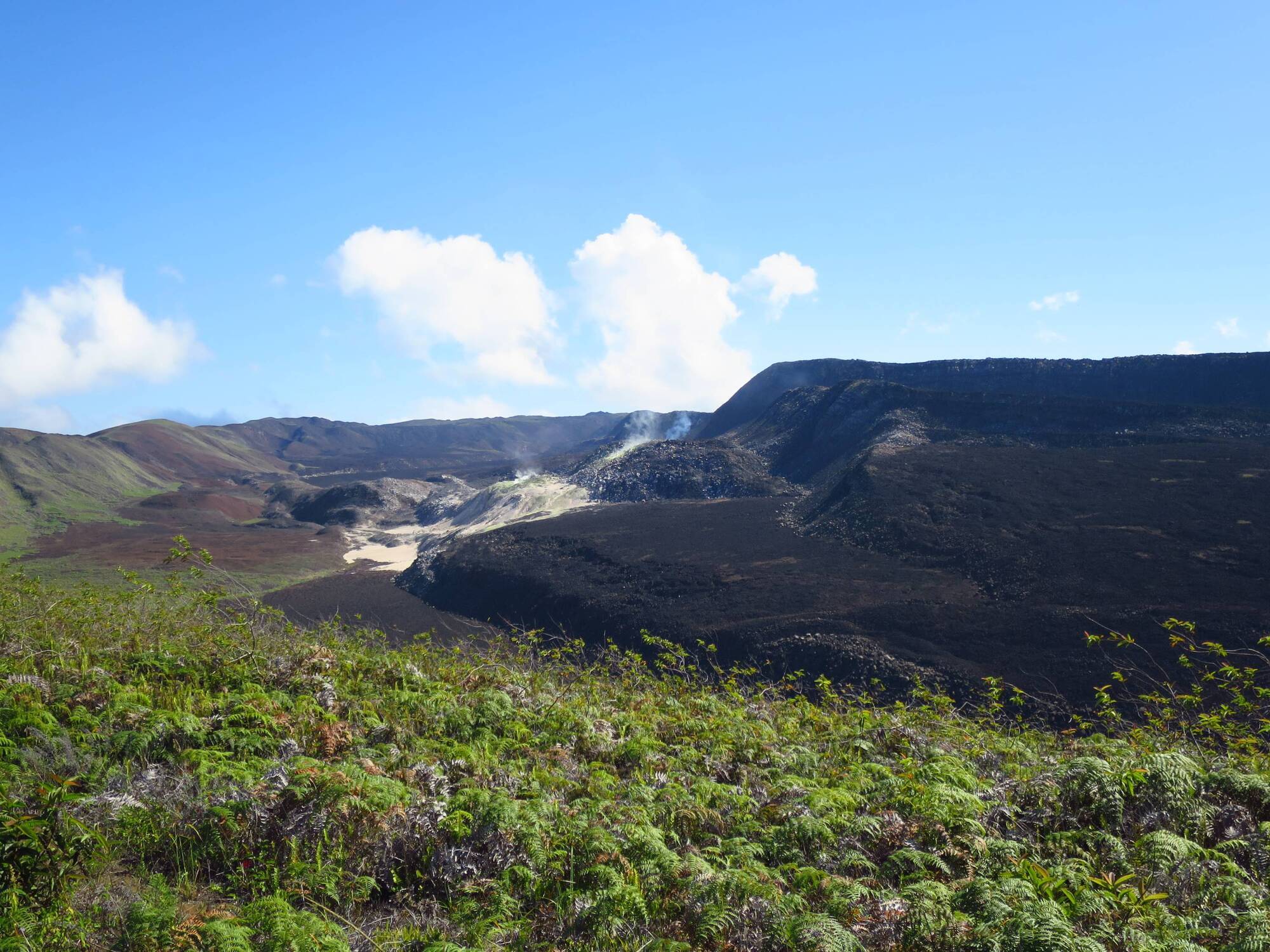
Sierra Negra volcano. Photo: Dr Andrew Bell
Irish scientists were members of an international research team that recorded the first-ever detailed description of a volcanic eruption in Ecuador.
A volcano in the Galápagos Islands has given scientists a new insight into how volcanoes behave and provided vital information that will help to predict future hazards on the islands.
Irish scientists, based at Dublin Institute for Advanced Studies (DIAS) and Trinity College Dublin respectively, made the discovery alongside other scientists from the United Kingdom, United States, France and Ecuador.
The research was carried out on Sierra Negra, one of the most active volcanoes in the world found on Isabela Island, home to nearly 2,000 people.
The new understandings developed from the research will allow volcanologists to track the evolution of unrest for future eruptions in the Galápagos Islands, and communicate these developments to local authorities and the public.
Professor Chris Bean, Head of the Geophysics Section and Director of the School of Cosmic Physics at DIAS, who was a member of the research team said: “We managed to examine the Sierra Negra volcano with an unprecedented level of detail which has produced some ground-breaking results. Although the volcano had been slowly inflating for over a decade, the final trigger to the eruption was a violent earthquake strong enough to make anything that wasn’t tied down hop clear off the ground.”
Dr Michael Stock, Assistant Professor of Geology at Trinity College Dublin, who was also a member of the research team said: “This is a genuinely multidisciplinary study which brought together a diverse team of international scientists to produce one of the most detailed records of pre-eruptive processes at an active volcano to date.
“The data will be invaluable in improving volcano monitoring in Galapagos, where eruptions pose a risk to the unique and fragile ecosystem.”
The eruption the scientists analysed occurred in June 2018, and the research has been published in
CONNECT WITH US TODAY



Be the first to know the latest news and updates