Border question settled, but mood around Brexit talks remains 'pessimistic', says Coveney
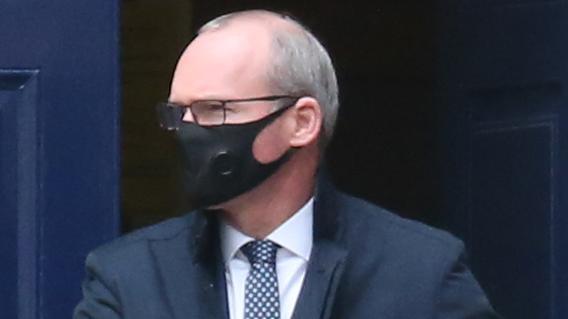
Foreign affairs minister Simon Coveney says that the meeting between European Commission president Ursula von der Leyen and British prime minister Boris Johnson will be 'pivitol'. Picture: Sasko Lazarov / RollingNews.ie
Foreign affairs minister Simon Coveney says that, despite a “historic agreement” made between the UK and EU on the North, the mood is “pessimistic” for a trade deal.
The EU and UK reached an agreement yesterday on the most contentious issues around the Northern Ireland protocol.
Mr Coveney told RTÉ last night that “there is no longer any concern about British domestic legislation undermining that protocol”, which “is hugely important for the future of the island of Ireland, the single market, and the peace process, and people living in border countries. They can now rest easy that the border question is settled.”
European Commission president Ursula von der Leyen and British prime minister Boris Johnson will meet today as both teams have failed so far to agree on the future relationship.
“The failure to get that over the line means we move into next year without a trade agreement in place, which means lots more disruption,” said Mr Coveney, adding that we “can’t put a definitive date” on the negotiations, but that today’s meeting is “pivotal”.
“The prime minister has accepted that the negotiating team has taken it as far as they can," he said.
“As the week has gone on, people have become more pessimistic, and there’s a big focus on contingency planning for no-deal. My job is to be optimistic. I do think the British want a deal.
“Both sides want a deal — but from an EU perspective, we can only have a trade agreement based on free and fair competition in the future and assurances that the UK would effectively operate on the same level playing field as the EU so we can trade barrier-free in the future.
“The EU cannot allow a future British government to derive competitive advantage, and a year ago Britain signed up to that, they have subsequently moved away from that position.
"We want a deal the UK can accept and live with, but we’re also part of the EU single market and need to ensure a trade relationship is based on fairness.”
The agreement was announced in a joint statement by European Commission vice-president Maroš Šefčovič and UK Cabinet Office minister Michael Gove.
🇪🇺🇬🇧 Pleased to announce that thanks to hard work, @michaelgove and I have reached an agreement in principle on all issues re the #WithdrawalAgreement implementation. This will ensure it is fully operational as of 1 Jan, incl. the Protocol on Ireland/NI 👉 https://t.co/RaWNEVbxrt pic.twitter.com/1OCjapNd3F
— Maroš Šefčovič🇪🇺 (@MarosSefcovic) December 8, 2020
The UK has agreed to withdraw clauses in the Internal Market Bill which breached the Northern Ireland protocol, and says it will not introduce similar provisions in its Taxation Bill.
Taoiseach Micheál Martin told the Dáil that even in the event of a deal, Ireland is still facing a significant degree of disruption, and also warned that a no-deal is now likely.
“I must alert the House to the fact that we could be very well discussing preparations for a no-deal Brexit," he said.
"Unfortunately, we are facing the prospect of a no-deal Brexit if something does not break that over the next day or two.”
Mr Martin said that we will be going from 1.5m customs declarations per annum prior to Brexit to 20m per annum, even in the context of a trade deal, adding that “the enormity of this cannot be understated”.
Mr Martin welcomed the decision of the British government to pull back and withdraw the offending clauses in their bill.
“That paves the way for the operation of the protocol and the withdrawal agreement which the European Commissioner, Maroš Šefèoviè, and Michael Gove have been negotiating for quite some time,” he said.
He told a meeting of the Fianna Fáil party last night that a no-deal crash-out remains a “strong possibility”, as he prepares to travel to Brussels today. He said the “level playing field” continues to be an issue.
On fishing rights for EU fishermen in UK waters, Mr Martin said there is a “route to resolution”.
CONNECT WITH US TODAY



Be the first to know the latest news and updates