Farmers standing tall this season with Christmas tree trade
Farmers standing tall this season with Christmas tree trade

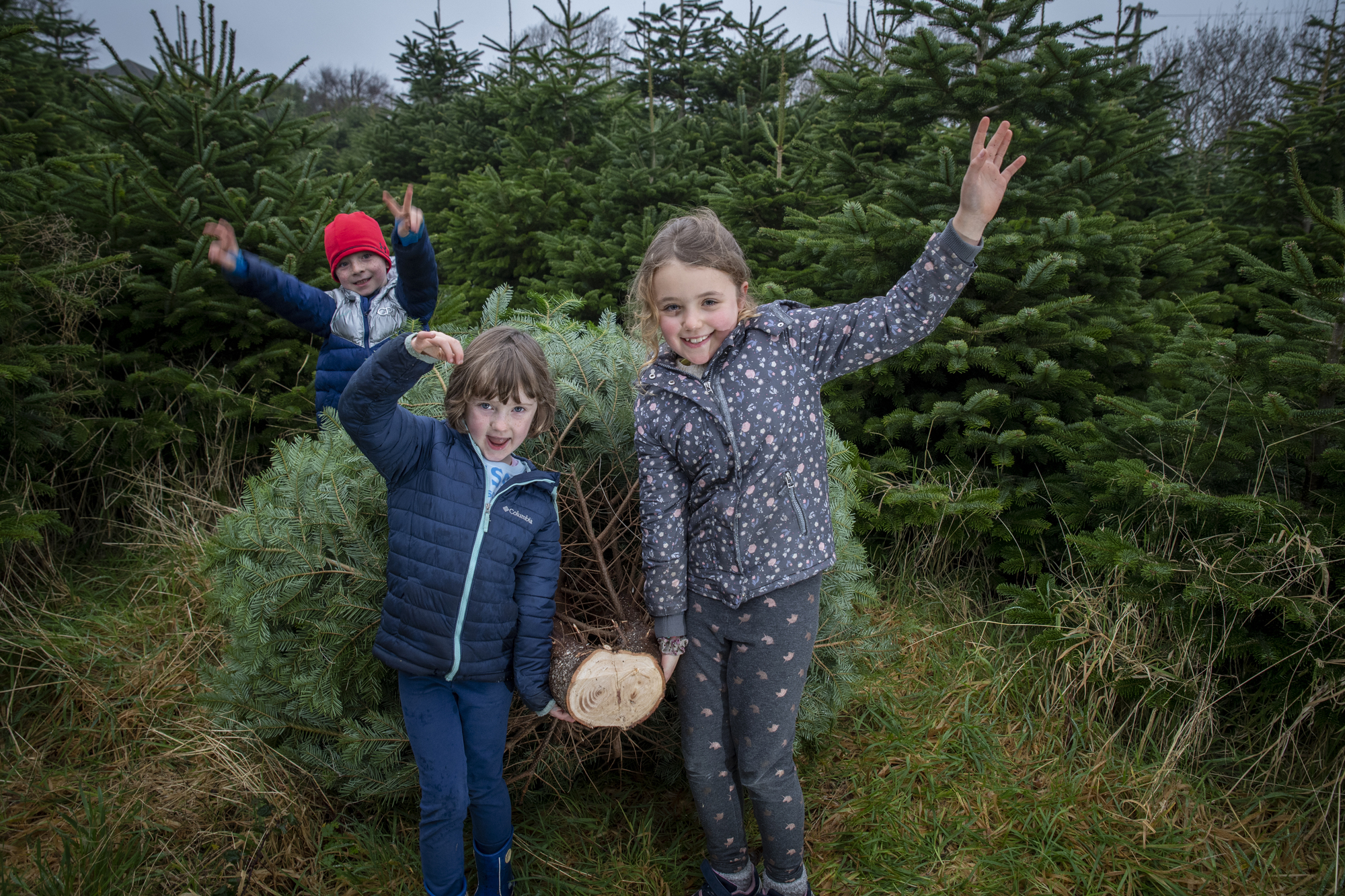
Lilly and Liam McDonnel and Emma O’Sullivan, from  Ballyheigue, Co Kerry, pulling out the perfect tree from the North Kerry Christmas Tree Farm. Picture: Domnick Walsh

Also in today's Christmas tree feature:

  • How to care for your Christmas tree
  • 'Best year yet' for Christmas tree sales, says Cork seller - People looking to lift their spirits with yuletide traditions means it will be the busiest season on record for a Cork Christmas tree grower.
  • Poinsettias grown with TLC in Ireland - Joyce Fegan finds out how Ireland’s largest grower of poinsettias has been growing them for more than 30 years.
  • Caring for your poinsettia

For the first time in almost 70 years, Irish people have been buying Christmas trees since the end of October – all in the search for positivity.

In business since 1952, Christy Kavanagh – Ireland’s most celebrated Christmas tree grower – says he has never seen such early demand.

“My family has been growing and selling Christmas trees since 1952, and this year is the earliest ever, I mean ever, that people started buying and decorating their tree,” he said.

Traditionally, December 12, has been the “kick-off date” for Irish people buying their trees. This date has slowly become earlier and earlier, thanks to Americans living in Ireland.

Christy’s first customers have always been Americans buying their tree in time for Thanksgiving at the end of November.

However, this year, as soon as Halloween ended, the demand for trees started.

“The demand has been phenomenal. Since October we've been selling trees and people have been putting up trees since the end of October, I’ve never seen that before. 

"The earliest has always been Thanksgiving Day when I’d start trading with the Americans. 

"I’ll tell people the tree won’t last and they just tell me they’ll get a second one. It’s about joy, I reckon,” says Christy.

The Americans call it PMA, a positive mental attitude, you have to change your mood with the Covid. 

"So getting the tree, getting it into the house, decorating the tree - imagine all the fun for the family? You forget about Covid for the day. Mental health and hygiene are so important at this time,” he adds.

Christy is one of Ireland’s largest Christmas tree growers, selling 10,000 trees a year. He grows his trees on 100 acres in the Wicklow Mountains, one of the best places in the country to grow them.

“We're blessed with an ideal site, it’s a high altitude - 900 ft above sea level. They like to be on top of hills, they like shaley soil, they’re happier in that than in very fertile ground,” he explains.

The land might be the secret to his awards, as his trees have won the most rosettes in the annual Irish Christmas Tree Growers’ competitions over the years, which is a 32-county competition.

As a result, his trees have decorated the offices of three Taoisigh, Bertie Ahern, Brian Cowen and Enda Kenny. His trees have also decorated Áras an Uachtaráin and some of the country’s five-star hotels, as well as nearly every office in the capital.

But for the ordinary family, what do they want in a tree?

“Slimmer, fuller and taller,” is the answer.

And how do you grow trees to match the public’s demands?

When you get your Christmas tree it is already 14 years old.

Christy grows his trees from seed in a nursery. They spend about four years there and are planted in soil when they reach about 10 to 12 inches in height.

They then spend eight to 10 years growing in the Wicklow mountains, until they reach about 7 to 9ft tall.

But they’re not left to their own devices.

Christy explains:

Each tree is treated as an individual, each individual tree has to be cared for all year, be it pruning in January or bud picking in May, to be a fuller and slimmer tree.

These trees are then harvested and sold nationwide.

His family business was also an early online adopter, and their online shop is open 20 years this year, allowing people all over Ireland to buy an award-winning tree from the comfort of their phone.

There are approximately 80 Christmas tree growers on the island of Ireland, and while there was a need to import trees in the past to meet demand, Ireland is now an exporter of trees.

Therefore, every Christmas tree you see on the island is from here. That is, unless, it’s made from oil and not soil, says Christy, which brings up the issue of climate change.

Christy Kavanagh at his farm in Newtownmountkennedy, Co. Wicklow. 'Each tree is treated as an individual, each individual tree has to be cared for all year, be it pruning in January or bud picking in May, to be a fuller and slimmer tree.'. Picture: Chris Bellew

“The environment – that’s the difference in our product compared with the plastic product, we talk about the oil versus soil. 

On one hand, you have an oil-based product made from crude oil that can't be recycled and it ends up in landfill, and it’s already been drawn across the world, it's crazy.

“Then on the other side you have grown something from seed - that tree takes in carbon from the environment, a conifer is the best tree for this, and it stores CO2 in its root system. 

"A 10-foot conifer is better than a 100-ft oak tree, for taking in carbon,” explains Christy.

But what about January 6, when the decorations come down and the tree has reached its sell-by-date?

“The tree can be mulched and the mulch is then incorporated back into soil as organic matter,” he says.

But Christmas trees aren’t Christy’s only business this December.

Because of the global pandemic, he decided to sell the “tree of hope”.

“Grown in a container, you plant it in your garden and allow your children to see its buds burst with new life in April or May of next year.

“It’s to show new beginnings, I was doing it as an anti-Covid thing. I believe next year is going to be a good year,” says Christy.

“We all have to get through this as a nation, we need to work together and move forward,” he adds.

How to care for your Christmas tree:

  • Buy right: First, look for a healthy, green tree with the least amount of brown needles and choose a tree that’s displayed in a shady location. Then, run your hands over a few branches - the needles should feel pliable and not fall off.
  • Water it: For every inch of the trunk's diameter, fill your stand with approximately one litre of water.
  • TLC: Don’t just water it once and walk away. Check the water level daily — it should always cover the cut end of the trunk.
  • Cooler climes: While the movies and the ads and the Instagram posts might show you a fairy light-lit tree next to a roaring open fire, this is not what your tree wants. If you lower the temperature in the room, it can help slow down the drying process of your tree.

'Best year yet' for Christmas tree sales, says Cork seller

Pet O'Connell 

Covid-19 has been bad news for many businesses, but as people look to yuletide traditions to lift their spirits during the pandemic, a Cork Christmas tree grower is on course for his busiest season on record.

Con O’Riordan has sold almost 70,000 Christmas trees since he started his enterprise in Cill na Martra in 1986, and can usually expect to sell in excess of 2,000 each year.

However, with more people opting for a real tree over artificial alternatives, and some households adding a second Christmas tree this year, trade is booming like never before.

“We’re after such a rotten year that what people are saying is ‘we’ll have a small bit of light at the end of the tunnel and we’ll buy a tree’,” said Mr O’Riordan.

“People that never bothered with a Christmas tree are buying one this year. I never did 3,000 trees but I’m thinking I’ll beat that this year – this is my best year yet.” 

Con, who is battling Parkinson’s disease, was for two decades the supplier of Christmas trees for the annual Irish Guide Dogs fundraiser on Cork’s Model Farm Rd.

“I was doing the guide dogs for about 20 years. 

"It was I started it and I did it up til last year but it got too hard on me – I wasn’t able for it,” he said.

People that never bothered with a Christmas tree before are buying one this year, says Con O'Riordan.

Though no longer able to fulfil that commitment, the former Dairygold and Clóna milkman takes great pride in maintaining the land in Lios Buí, near the Gaeltacht village of Cill na Martra, where he said his Nordmann and Fraser fir trees have become a haven for nature.

“My Christmas tree farm in Lios Buí is a little gem,” he said. 

“It’s a beautiful place. I was back there one morning in the month of May last year and my little dog with me, at a quarter past six.

"There was dead silence in the place, and the next thing I heard was cuckoo, cuckoo. What a lovely scene – it was like being in heaven.” 

Con, well known in the Macroom area as a composer of witty songs and recitations, hopes to share that joy as his trees help light up Christmas in a dark year like no other.

The trees, ranging in height from 3ft to 20ft, are on sale in the Maxol garage in Ballincollig or on 087 6290712.

Poinsettias grown with TLC in Ireland

Joyce Fegan

You see them at the checkouts, you notice them in porches, and you might even get one as a present — it’s not Christmas without a poinsettia.

These plants, unlike most other botanical creatures, flower in December, hence their association with Christmas.

And in their native homelands of Mexico and Guatemala, they’re known as the Flower of the Holy Night — Christmas Eve.

But the plants you see in SuperValu and Tesco have not been grown in Central and South America and shipped in, they’ve been grown in Ireland.

Sean Grimes, Production Manager at Uniplumo and Ana Smith from Portmarnock as SuperValu announced that they expect to sell 135,000 Irish-grown poinsettias in the run-up to Christmas. Photo: Marc O’Sullivan

Uniplumo, Ireland’s largest grower of poinsettias, has been growing them for more than 30 years.

“We’ve grown several million over those intervening years,” says Tom Summerville, the company’s general manager.

Such is the plant’s popularity at this time of year, they’ve grown 250,000 of them, all of which were pre-sold to their retail partners months ago, to meet the demand.

And when you admire those red leaves at the checkout, it’s worth knowing that a lot of manual labour and tender loving care has gone into each and every plant that sits on a supermarket shelf.

“They’re a five-month crop, we sew them in June, they’re quite a demanding crop to deal with it. They have to be pinched to shape their buds and spacing is important," says Tom. 

"There is quite a lot of manual labour that goes into them from when we get them in tiny little cuttings.

“They need a certain constant temperature, and feeding wise, the feed comes through in their water which is programmed to come on at certain times via a computer. 

"The poinsettia is watered from the bottom and the roots will head for the water, you never water from above,” explains Tom.

He credits Uniplumo grower Sean Grimes with their successful 30 years of growth.

“He’s pure genius, you could put a spirit level over the crop and find it in balance. We grow 250,000 of them, and they’re all the same height and size,” says Tom.

Poinsettias are as interesting a plant as they are demanding.

Unlike other plants and flowers, they need darkness in order to bloom.

“It’s all about the equinox in the autumn, as the light changes in autumn and you get longer nights and shorter days, that’s when the leaves turn red. It’s actually sudden when it happens,” explains Tom.

“If there’s artificial light, the leaves wouldn’t colour out properly."

Tom Summerville: 'We’ve grown several million poinsettias over those intervening years.' Picture: Maxwells

Uniplumo grows on 15 acres of land in Dublin countryside and in 60,000 sq m of glasshouse.

And if poinsettias are demanding, they’re also temperamental, hence why you need to buy one grown here rather than imported.

Tom says you simply look out for the Bord Bia sticker, the same one you’d see on a packet of meat. If you do this, not only are you supporting local jobs and keeping a niche Irish industry going, but your poinsettia will last longer.

“If you put them in a dark van for two days they won’t do well. The thing consumers need to look out for is the Bord Bia quality mark — the stress on the plant is zero, as opposed to a plant from Germany or Holland that will collapse and won’t give you the longevity over Christmas at home,” explains Tom.

Buying a poinsettia with a Bord Bia mark means that the plant has just been harvested, literally taken out of the soil the day before, at the latest.

It has arrived in the supermarket depot in a cardboard box with a red danger sticker on it, alerting staff to take it out of the darkened box immediately.

“They’re probably not expecting to see a plant in the box when they open it after seeing that sticker,” says Tom.

Caring for your poinsettia:

  • Water: When a customer takes it home, people have this massive tendency to drown plants; just because it’s a plant doesn’t mean it wants loads of water. Poinsettias do not like to have wet feet — never put water on their foliage. Sit it in a saucer and let it soak up water;
  • Cosy: Keep it in a room that has the most constant temperature, fluctuation temperature makes it drop its leaves. They’re not for a porch and not for window sills. Don’t put them on or near a radiator;
  • Soil: If the compost feels moist, don’t water it, Poinsettias are not huge drinkers.
x

More in this section

Lunchtime News

Newsletter

Keep up with stories of the day with our lunchtime news wrap and important breaking news alerts.

Cookie Policy Privacy Policy Brand Safety FAQ Help Contact Us Terms and Conditions

© Examiner Echo Group Limited