FIE ‘can’t claim human rights breaches’
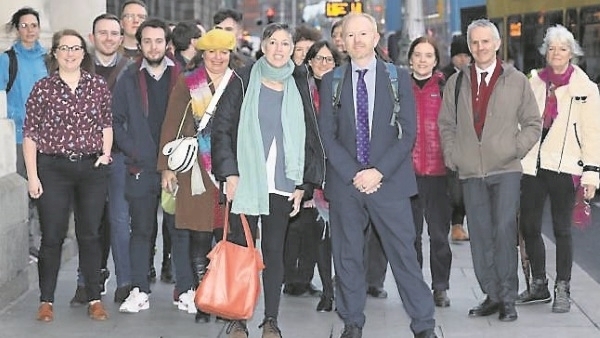
It is rare that a campaign is faulted for representing too many people but that, in essence, was one of the arguments against the group who took the State to court for failing to meet its climate change responsibilities.
Rory Mulcahy SC told the High Court that Friends of the Irish Environment (FIE) could not assert that any failures breached human rights under the Constitution and the European Convention because the group was not a “human person”.
It would have to be shown that there was a specific, imminent risk to an identifiable person or persons before even addressing the question of whether the State had failed to adequately protect that person or persons against that risk.
Mr Mulcahy was addressing the court on the closing day of the case taken by FIE, a group supported by other environmental and human rights groups and backed by an online petition with, at last count, the signatures of 16,800 human persons.
More than 100 of them squeezed into a compact Court 29, Judge Michael McGrath inviting them to fill the narrow aisles and vacant jury box and thanking them for their attentiveness throughout.
FIE has asked the court to quash the National Mitigation Plan (NMP) and direct the Government to remake it, on the grounds that it is weak and vague and does not set out how the country is to achieve the substantial reductions in our carbon emissions to which we are committed under EU and international agreements.
By those failures, it argued, the NMP did not comply with the Carbon Act 2015 and breached human rights including the right to life, property, livelihood, and an environment consistent with human dignity.
In addition to his contention that FIE was not entitled to claim human rights breaches, Mr Mulcahy said the European Convention did not cover the kind of “general environmental deterioration” envisaged under climate change. Localised pollution, yes. Wholesale environmental destruction, no.
He also argued that FIE was attaching too much weight to the NMP.
It is part of the picture of how the State intends to achieve that national transition [to carbon neutrality] objective,” he said.
In fact, he said, there was “overabundance” of environmental legislation beyond the NMP.
Brian Kennedy SC, summing up for FIE, said on the contrary, the NMP was central to the issues and it was “simply not fit for purpose”, resulting, in the words of the State’s own Climate Change Advisory Council, a “disturbing” state of affairs.
He said in failing to provide an adequate NMP, the State had “exposed its citizens to risk and danger without justification”.
“It may not be possible to point to an individual that suffered a specific wrong at this particular point in time but there is no doubt that rights are being impacted now and will be impacted into the future,” he said.
Judge McGrath reserved judgement on what he described as a “very complex” matter.