Hard Brexit would pose ‘very significant challenges’ for agrifoods and tourism
The rural economy and rural employers will “suffer most” with Brexit, an economic conference has heard.
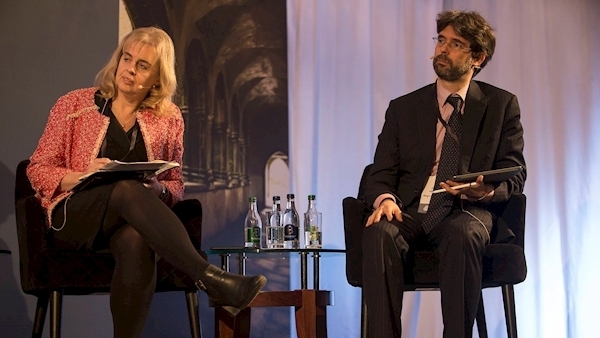
Mark Kennedy, managing partner for Mazars Ireland said there was considerable uncertainty in most scenarios still — but given that 50% of exports by weight from here go through UK ‘landbridge’, there would be “very significant challenges” from a logistical perspective in the case of a hard Brexit.
Agrifoods and tourism are at risk and the areas likely to suffer most, Mr Kennedy told the Killarney Economic Conference.
Mr Kennedy warned also of the uncertainty posed to financial services businesses by a no-deal Brexit scenario, which would do away with “the effective transition period to 2020”. Such challenges included the requirement of financial services firms to be ready for the March 29 exit deadline.
“There is also a challenge for the unregulated service elements of financial services businesses — in that it is not clear how challenges around the recognition of professional qualifications, recognition of standards and precedents, and holding of data will be affected.
“Practically, this makes the provision of services relevant to the running of a financial services firm — whether outsourced or internal — across borders potentially problematical.”
Scottish MP Michael Russell, who is cabinet secretary for government business and constitutional relations in the Scottish Parliament, outlined the strengths of Ireland as an independent country compared to Scotland, which was still part of the UK.
Mr Russell referred to a speech given by the late Garret FitzGerald in 1990 at Edinburgh University where he forecast how “the traditional complex of superiority in the case of Britain and inferiority in the case of Ireland” arising from British self-delusion would change.
However while Ireland had changed, “Britain seems to have reverted to type”, Mr Russell said.
“Perhaps that is because Ireland — like Scotland — has risen to the challenges of the modern world, and driven by the democratic will of its people has delivered changes that even he might not have foreseen — in our case devolution, in yours the Good Friday Agreement, marriage equality, women’s reproductive rights.”
The remarkable capacity of self-delusion by Britain had led many Brexiteers, including Nigel Lawson as chairman of the Leave Campaign, to “cheerfully suggest that the solution to the Irish border problem is for Ireland to leave the EU and rejoin the UK”.
“In other words, the solution to a problem created by them is to ensure that others simply implement the same crazy prescription that has led to the disaster,” Mr Russell said.
However, Ireland as an independent state and member of the EU remained in control of its destiny and the EU had been “staunch in its defence of Ireland,” he said.
“Our own experience in Scotland as part of the United Kingdom has been very different. You have solidarity,” he said.
“We have been patronised, neglected and sometimes treated with outright hostility.”
The conference, examining the legal, economic and political implications of Brexit continues today.
CONNECT WITH US TODAY



Be the first to know the latest news and updates