Stormont deal 'a long way off'
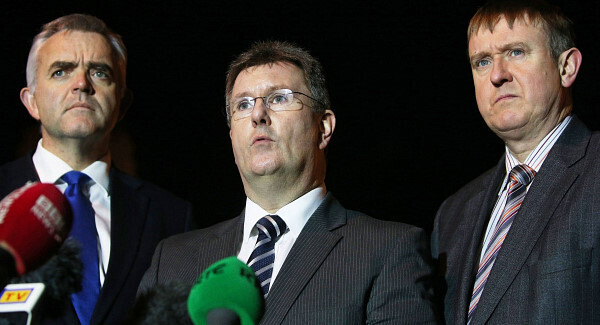
A breakthrough in crunch talks between the Taoiseach, the British prime minister and Northern Ireland’s political leaders is still a long way off, the Democratic Unionists said tonight.
DUP negotiator Jeffrey Donaldson downplayed the chances of a deal materialising within the next 24 hours after emerging from the first round of intensive negotiations with David Cameron and Enda Kenny in Belfast.
The Prime Minister and Taoiseach have cleared their diaries through to tomorrow afternoon in a bid to find a way forward on a range of thorny disputes that are causing gridlock in the power-sharing administration.
“I think there is still a long way to go on this one, there are substantial issues to be resolved but we are here to try to achieve an outcome,” Lagan Valley MP Mr Donaldson said outside the talks venue at Stormont House.
“I don’t think anyone should get too excited about the prospect of an agreement within the next 24 hours, having said that we will do our best to close the gaps where they exist.”
He added: “We are prepared to come back here next week if it is clear that progress can be made to resolve the outstanding issues.”
The discussions at Stormont are set to continue long into this evening.
Earlier, Mr Cameron sounded an optimistic note as he arrived to join the talks process, which is now nearing the end of its ninth week.
“We have got to demonstrate we can resolve these issues,” he said at the steps of Stormont House.
“The people inside this room will be discussing and talking about them but the people outside the room, they are the people that matter. They want to see their politicians deliver.”
Arriving shortly afterwards, Mr Kenny said: “We do hope, during the course of discussions today, possibly tomorrow, to make progress.
“Hopefully we can reach a conclusion on a number of matters that are important for Northern Ireland and for the relationship between Northern Ireland and the Government in the Republic.”
As well as long-standing disputes over flags, parades and the toxic legacy of the past, the five parties in the power-sharing coalition are trying to reach consensus on budgetary problems facing the devolved institutions, particularly the impasse over the non-implementation of the UK Government’s welfare reforms in Northern Ireland.
The structures and governance arrangements at Stormont are also on the agenda.
The most pressing issue is the budgetary situation.
Ministers in Belfast have already had to ask for an emergency £100 million loan from the UK's Treasury to balance their books this financial year, and if a deal on welfare reform is not agreed they will face around £200 million of British Government penalties for non-implementation.
As it is unlikely the administration would be able to absorb such a financial burden, the future of the devolved Executive effectively depends on a resolution to the welfare reform impasse.
Sinn Féin Deputy First Minister Martin McGuinness said the onus is on Mr Cameron to stump up extra funding to address problems he insisted were particular to the region.
Flanked by party president Gerry Adams as he arrived at the talks, Mr McGuinness said all five Executive parties were in agreement that the UK Government had to make more of a contribution financially to Stormont.
“We have reached agreement on what this British Government needs to do in budgetary terms,” he said.
“We are going, through the course of this negotiation, to make the case – this place here is different, this is not the North of England, this is not London, this isn’t Scotland and this isn’t Wales. We are a society emerging from conflict and legacy, all of that has posed huge problems for our Executive, not least in terms of how we bring our community together, how we build a united community, how we increase sharing in education, how we deal with the whole reconciliation process – special problems that aren’t faced by any other region in these islands.”
Mr Donaldson said a deal on the budget is vital.
“The other things can’t be delivered without resolving the financial question,” he said.
He said if an agreement is not reached Stormont would collapse, resulting in a return to direct rule and, with it, the likely imposition of policies the Executive has so far resisted, such as water charges.
“What’s the alternative (to an agreement) – the alternative is this place comes crashing down,” he said.
CONNECT WITH US TODAY



Be the first to know the latest news and updates