Noonan targets 'real test' of full return to markets
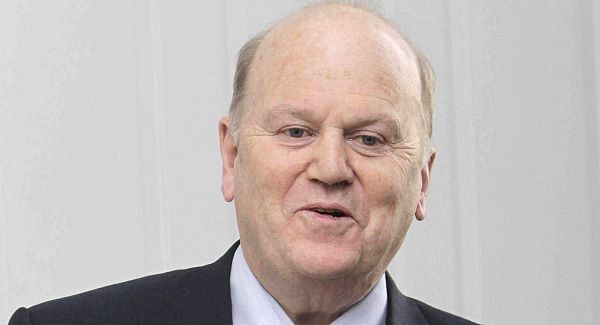
The real test for Ireland's economic recovery will be getting out of the bailout, Finance Minister Michael Noonan has warned.
As the Troika's eighth review ended with confirmation that the Government has met all the latest conditions, Mr Noonan said a bank deal was a key.
More than 160 commitments have been fulfilled on time and 80% of the €85bn funding has been drawn down, the review said.
"We are delivering on our commitments but the real test of Ireland's programme will be emerging from the programme, getting fully back into the markets and building a sustainable and long-lasting economic recovery," Mr Noonan said.
"However, many challenges remain, including the heavy burden of debt associated with the recapitalisation of the banking sector, and work is ongoing with the Troika to reduce this burden in line with the June 29 Agreement."
The International Monetary Fund and European chiefs will give their assessment of Ireland's bailout performance this afternoon.
The overrun in the health budget has been singled out as the biggest issue for the Government.
Mr Noonan said he was confident Ireland would be able to exit the programme without needing a second bailout.
But he said a deal on the country's bank debt would be a major boost in ensuring Ireland was more sustainable in the eyes of the markets.
"We're well positioned at the moment to do that, but the markets looking at us will be trying to decide that even though we're fully sustainable now, we are sustainable in all eventualities in the future," said Mr Noonan.
"There is no doubt that a deal on the debt or two deals on different parts of the debt would make Ireland more sustainable."
He said that was the commitment made by the 27 heads of state in Europe on June 29, and the Government would press hard in negotiating that.
In a statement, the review team from the European Commission, European Central Bank, and the International Monetary Fund said that creating jobs should be top of the agenda.
"Unemployment remains unacceptably high, especially among the youth, making job creation and growth a key priority," they said.
"Engagement with the long-term unemployed should be a priority, including through timely and well designed involvement of the private sector in providing employment services."
The Troika expects economic growth of 0.5% this year and 1% next year.
On the health budget, the review team said: "The authorities are alert to the health sector overruns and are determined to meet the programme target for a budget deficit below 7.5% of GDP in 2013."
Meanwhile, Public Expenditure Minister Brendan Howlin insisted that, while there has been a major budgetary overrun within the Department of Health, the Troika's main concern was ceiling expenditure.
The budget in the Department of Social Protection has also been a concern for the Troika.
Mr Howlin said his own department has been working closely with Health Minister James Reilly and his team to reduce the overspend as much as possible.
He said he was confident that original forecasts of a €500m overrun by the end of the year would not be so high.
“I don’t expect it to be that high, but we will be working very hard to address these issues as we have been for a number of months,” Mr Howlin added.
He said that, while consultants’ contracts was an example of an area where spending had to be trimmed, savings needed to be made across the health sector as a whole.
But he insisted that the debt masters were not overly concerned about singling out the Department of Health.
“The Troika is interested in the ceiling expenditure,” Mr Howlin said. “The main issue they are interested in is reducing the deficit target.”
Staff teams from the European Commission (EC), European Central Bank (ECB), and International Monetary Fund (IMF) visited Dublin during October 16–25, 2012 for the eighth review of the Government’s economic programme and also met with a variety of stakeholder groups.
Policy implementation remains steadfast despite the challenging external environment, helping Ireland to start to regain market access.
It is expected that fiscal targets for 2012 will be met despite expenditure overruns in some areas, and the authorities are committed to the 2013 deficit ceiling of 7.5% of GDP.
Banks remain well-capitalised and downsizing has progressed well, yet further efforts are needed to address their profitability and asset quality challenges.
In line with the euro area summit conclusions of 29 June, EC/ECB/IMF teams continued to discuss with the authorities possible technical solutions to improve the sustainability of the well-performing adjustment programme.
Ireland's gradual economic recovery has continued, but largely due to weaker net exports, real GDP growth has slowed to a projected rate of ½ percent in 2012.
Domestic demand and employment continue to decline owing to ongoing household balance sheet repair, the weak labour market, and low lending to households and SMEs.
Prospects for growth in 2013 are for modest pick up to just over 1% as domestic demand declines moderately, although weak trading partner growth may continue to dampen net exports despite Irish competitiveness gains.
However, unemployment remains unacceptably high, especially among the youth, making job creation and growth a key priority.
Accordingly, plans are progressing to utilise resources from the European Investment Bank, the National Pension Reserve Fund, and private investors to finance job-rich projects in several sectors.
The Action Plan for Jobs will contribute to employment generation through a wide range of measures. It is also important to ensure that job seekers are well prepared to fill positions when they become available by strengthening employment and training services through vigorous implementation of the Pathways to Work initiative.
Engagement with the long-term unemployed should be a priority, including through timely and well designed involvement of the private sector in providing employment services.
It is expected that fiscal targets for 2012 will be met. Revenues remain ahead of profile in the first three quarters of 2012, which, together with expenditure restraint in several areas, has offset expenditure overruns in the health sector, and also on social welfare owing to higher unemployment.
The authorities are alert to the health sector overruns and are determined to meet the programme target for a budget deficit below 7.5% of GDP in 2013. The measures adopted in Budget 2013 should be durable, as growth-friendly as possible, and minimise the burden of adjustment on the most vulnerable.
The authorities are ramping up reforms to restore the health of the Irish financial sector so that it can help support economic recovery. Intensified efforts are required to deal decisively with mortgage arrears and further reduce bank operating costs.
Parliament is currently considering an ambitious reform of the personal insolvency framework.
For this essential reform to succeed, a careful balance should be struck that addresses borrower’s financial distress and protects the family home, while also reinforcing debt service discipline.
An orderly phasing out of the costly Eligible Liability Guarantee Scheme would improve bank profitability and thereby support lending capacity.
Market conditions for Irish bonds are much improved, bringing benchmark 8-year yields below 5 percent, underpinned by Ireland's robust policy implementation under its EU-IMF supported programme.
Significant yield declines also reflect the euro area leaders' statement on June 29 and the ECB's announcement of Outright Monetary Transactions in early September.
Ireland has started to regain market access, including through government bond issues.
This achievement, despite Ireland's still rising public debt, underlines investor confidence in Ireland’s capacity to implement adjustment policies as well as market expectations of European support for Ireland.
Nonetheless, significant risks remain along the path back to full reliance on market funding, requiring continued determined policy efforts by the Irish authorities.
The key objectives of Ireland’s EU-IMF supported programme are to address financial sector weaknesses and put Ireland’s economy on the path of sustainable growth, sound finances and job creation, while protecting the poor and most vulnerable.
The programme includes loans from the European Union and EU member states amounting to €45bn and a €22.5bn Extended Fund Facility with the IMF.
Conclusion of this review would make available a disbursement of €0.9bn by the IMF and €0.8bn by the EFSM/EFSF, with EU member states expected to disburse a further €0.5bn through bilateral loans.
The next review mission is scheduled for January 2013."
CONNECT WITH US TODAY



Be the first to know the latest news and updates