Paterson looks at devolving tax powers to Stormont
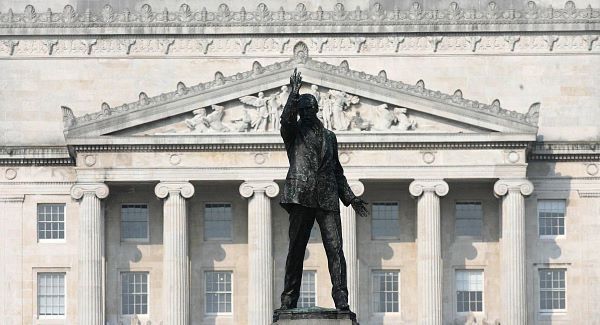
The North’s new Secretary of State Owen Paterson today held out the prospect of devolving corporation tax powers to the Stormont Assembly.
During his first full day in the North in his new role, the Conservative MP met party leaders and sought to calm fears over spending cuts in the region.
But as he sought to build relations with republicans concerned at his party’s unionist links, he had to quickly clarify comments about visiting the “deepest, wildest” parts of the North with Sinn Féin representatives.
First Minister Peter Robinson and deputy First Minister Martin McGuinness reported a positive atmosphere in their hour-long talks with Mr Paterson at Stormont Castle today which they said were dominated by economic matters.
The Secretary of State later said the UK debt was at an unsustainable level and had to be tackled, and he added: “Northern Ireland, as we know, has special circumstances.
“State spending here represents 77.6% of GDP. I have said for nearly three years now, that is also unsustainable. It is irresponsible to do nothing about it. It is equally irresponsible to do anything drastic.”
He said the North would have to pay its share in tackling the UK deficit, and while efficiencies would be sought, he said health spending would be protected.
“But down the road I want to develop the Northern Ireland economy, which I said is going to take at least 25 years,” he said.
“We need to work closely with devolved ministers in building up the private sector.
“I am very keen that we do publish a paper on the mechanics of possibly devolving corporation tax to the devolved institutions here.”
The Conservatives are involved in an electoral pact with the UUP, which proved unsuccessful in the General Election. Republicans have also noted that early this year it emerged Mr Paterson hosted talks between the Ulster Unionists and the DUP on securing “unionist unity” to stop the growth of Sinn Féin.
Mr Paterson today indicated he would remain a pro-Union politician, adding: “But most importantly, now in my role as Secretary of State, I will continue to work with all parties.”
He said he would be even-handed and had already built a relation with Sinn Féin’s Mr McGuinness, claiming the top republican had phoned Mr Paterson on his mobile for progress reports on the coalition talks at Westminster.
Mr Paterson added: “I spent probably more time in the deepest, wildest parts of Northern Ireland with Sinn Féin members of parliament and councillors and I want to very much carry on that.”
Challenged on whether he viewed republican areas to be the “deepest and the wildest”, he referred to trips to the border areas of South Armagh.
“Well I think when you go down to the sort of Forkhill and Cullyhanna, you’re quite a long way from here and it feels a long way from here,” he quickly added, “but I tell you the best bread is in Crossmaglen. I always buy wheaten bread.”
Martin McGuinness later said: “The key point, and the point that I made to him during the course of the meeting that I had with him, was that this British government remains loyal and true to the agreements that were made over the course of recent years. And he gave an absolute commitment that they would do that.”
Peter Robinson said that if the DUP and Sinn Féin can work in coalition together, then their parties could work with a Conservative Secretary of State despite their party political differences.
The First Minister added: “We want to have the best possible relationship.”
He said the meeting was dominated by economic matters and this was echoed by Mr McGuinness who said the progress of the peace process should not be jeopardised by major spending cuts.
Both the North's leaders said they were committed to building the private sector while also resisting unfair cuts to the public sector, with Mr McGuinness calling for politicians to “think outside the box” on the economy.
Mr Paterson also held a separate meeting with the UUP, and its leader Reg Empey said: “It is imperative that the Stormont Executive works with the new coalition to act in both the national interest and the interest of this part of the United Kingdom.”

CONNECT WITH US TODAY



Be the first to know the latest news and updates