Worst disaster on Irish Sea commemorated
Descendants of people lost on the RMS Leinster, the worst disaster on the Irish Sea, were among a gathering today to mark the 90th anniversary of its sinking.
More than 500 crew and passengers died on the mail boat, which operated between Dun Laoghaire and Holyhead in Wales, when it was torpedoed by a German U-boat on October 10, 1918.

Philip Lecane, chairman of the commemoration committee and author of a book detailing the ship’s sinking, said it was an emotional event for many who had lost ancestors.
“It was an incredibly moving day,” he said.
“We had people here who had travelled long distances, including from Canada and France. There were cousins who hadn’t met since childhood meeting up again at the ceremony.”
The names of many of those lost were read out by schoolchildren at an inter-church commemorative service at St Michael’s Church in Dun Laoghaire.
Among those remembered was Gerald Palmer, a boy with a physical disability, who had spent most of his life in care.
“He was lost on the Leinster while on his way from the unfortunately-named Cripples Home in Bray to Barnardo’s Home in London,” said Mr Lecane.
“But his name was never mentioned in any of the newspaper reports, so he was doubly forgotten if you like.
“It was only when I found his name and details on the home’s records that it became clear he was lost on the Leinster too.
“So there was a candle lit in his memory.”
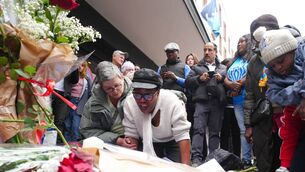
After the service, the gathering made their way to the ship’s anchor which was recovered from the wreck in the 1990s and placed on Dun Laoghaire’s seafront.
Wreaths were laid as the Garda band played 'The Last Post'.
Social Affairs Minister Mary Hanafin, TD Barry Andrews, Labour leader Eamon Gilmore and crew from the naval ship LE Orla were also among those who attended.
The sinking of the RMS Leinster shortly after it left Dun Laoghaire, then known as Kingstown, was the greatest ever loss of life in the Irish Sea.
Rough seas prevented a delegation from Holyhead travelling to the commemoration and they held their own event in Wales, said Mr Lecane.