New drive to stamp out rising sectarian violence
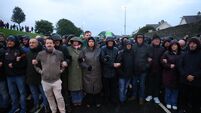
Police came under attack as political leaders met to find a way to end the spiralling levels of street violence in Northern Ireland
Officers were attacked by youths armed with petrol bombs and stones during a security alert in the Ballycoleman industrial estate in Strabane, Co Derry.
The trouble came after a number of houses were evacuated yesterday while an army bomb disposal team examined a suspicious object.
The security alert came to a close just after midnight today, following a controlled explosion of the object, when it was declared a hoax.
The incident occurred as George Bush’s special adviser to Northern Ireland, Richard Haass, was due to have talks with party leaders amid fears of further disorder.
Deputy First Minister Mark Durkan had also called on representatives to provide leadership in facing down sectarianism.
Scores of police offices have been injured in some of the worst trouble since the signing of the Good Friday Agreement four years ago and security chiefs fear it may spread.
As military engineers raised walls separating Protestant and Catholic communities in the flashpoint Short Strand area of east Belfast, Mr Durkan said there had to be unambiguous condemnation.
He told the Assembly: ‘‘We have to move beyond that sort of ‘whataboutery’ if we are to give people the clear leadership that is needed in circumstances where hotheads are trying to drive the agenda.’’
Loyalists have been blamed for much of the trouble, including attacks earlier yesterday in which a school was set on fire and a Catholic church attacked with paintbombs in the seaside town of Bangor, Co Down. Nobody was hurt.
But a Catholic mother and her family narrow missed being injured when a blast bomb was thrown at their home in the New Lodge area of north Belfast.
Police chiefs have warned they will use water cannons in a bid to clear the streets of rioters. Areas of north, east, west and south Belfast have been hit by the trouble.
Sinn Fein president Gerry Adams, who met Britain's Prime Minister Tony Blair for over an hour at Downing St yesterday, denied Republicans had orchestrated some of the violence.
He claimed they had helped calm the situation, and said conflict within unionism was the cause of the problems.
Mr Adams claimed: ‘‘This is the crisis within unionism manifesting itself in sectarian attacks upon vulnerable nationalist communities.’’
Republicans he said, were playing a positive role in east Belfast.
He claimed: ‘‘There certainly is Republican involvement on the ground. I have been in Short Strand myself, I’m glad I went. I went to calm the situation. If there weren’t Republicans involved there it would be much worse,’’ he said.
Mr Adams added: ‘‘I told the Prime Minister that what is happening in the beleaguered community of the Short Strand reaches back here into No 10 Downing Street.’’
He added: ‘‘The government has to... ensure that no-one thinks there is any alternative to the Good Friday Agreement or the changes which it contains.
‘‘So I think there is a need for all of us to knuckle down, and try and get a calming influence.’’ Mr Haass met with Northern Ireland Secretary John Reid in London earlier yesterday in advance of his talks with the party leaders in Belfast.
He renewed his call for Sinn Fein to join the new policing board, but also confirmed growing unease in the US administration about the latest outbreaks of violence.
‘‘Americans have been watching with growing concern what’s happened on the ground in recent days and weeks and obviously we want to see this gradual build-up of violence reversed,’’ said Mr Haass.
‘‘I think the message of the last two weeks is that we can’t afford to be sanguine. There are still real problems out there ... I can measure the progress, but it’s not to say for a second that we are sanguine or over-confident.’’
Mr Haass said it appeared that there remained ‘‘contradictory’’ views on the peace process within Republicanism.
‘‘What I hope is that the Republican movement makes the historic decision to complete its trajectory, to ultimately consign paramilitarism to the past and become simply a traditional political party,’’ he said.
Mr Blair’s official spokesman said yesterday’s meeting with Sinn Fein should be seen as part of a ‘‘continuum’’ of meetings.
The spokesman said: ‘‘Everybody recognises that at this time in the calendar of Northern Ireland it is historically a testing time of year, but last week’s violence - from both sides - was totally unacceptable and the Prime Minister expects leaders on all sides to do what they can.
‘‘The message from the Prime Minister will be consistent as it has been throughout: that all paramilitarism has to come to an end.’’
Government concern about continuing street violence in Belfast was underscored last night by Foreign Minister Brian Cowen.
Speaking ahead of talks with Mark Durkan, leader of Ulster’s Social Democratic and Labour Party and Deputy First Minister of the Northern Ireland Assembly, Mr Cowen commented: ‘‘I find it deeply worrying that there is a continuation of the sort of lawlessness and violence that we are seeing on
the streets.
‘‘I think it is very important that we try to ensure that some sort of calm is restored as soon as possible. It is a very worrying development.’’
The continuing violence topped the agenda at the discussions between the minister and Mr Durkan.
CONNECT WITH US TODAY



Be the first to know the latest news and updates