Cost of protecting corncrake defended as numbers fall
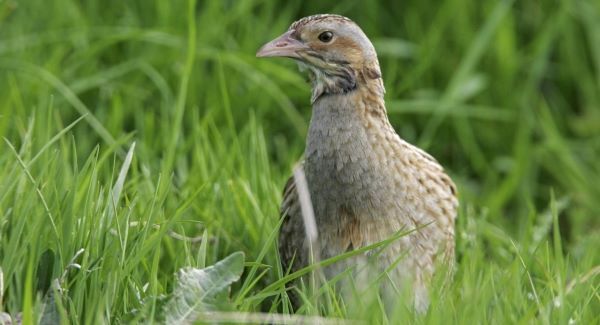
Western Division Manger with the National Parks and Wildlife Service (NPWS), Denis Strong, made his comment as figures show the battle to save the ‘iconic bird’ has this year suffered a set-back with the number of calling males declining from 183 to 168.
Between this year and last year, over €560,000 has been spent on the programme at a time when the population of calling males of the corncrake has decreased here by 27% going from 230 to 168.
The bird once flourished across the Irish countryside but is now confined to Donegal, Mayo and Connemara.
In a blow to the conservation of the bird here, the figures confirm that for the second year in a row there has been no detection of the corncrake in its former stronghold, the ‘Shannon Callows’.
This year, the biggest hit to the corncrake population took place on the Donegal islands, with numbers declining there from 86 to 63, though the numbers in Connemara increased from 13 to 19.
Commenting on the overall figures, Mr Strong said: “It is disappointing because there is habitat there to carry more birds.
“A lot of effort goes into this and of course, tax-payers’ money.”
The spend this year brings to €2.2m spent on the bird since 2012 and Mr Strong said that he is looking to get the budget increased for the corncrake increased for next year in order to offer “more realistic compensation packages for farmers”.
This year, a total of €229,388 has been shared out between farmers who received €180,987 in grants to conserve the bird and corncrake field workers who have received €48,401.
An additional €100,000 has spent on a Predator Control Programme that benefits not only the corncrake but another three protected species which include the lapwing and the red throat diver.
On the overall spend, Mr Strong said: “I believe it does provide value for money.
“This is money that is being put back into the rural economy across a wide area of the country.
“We are doing as much as we can possibly do. It is difficult to know, with all the work being done, why we are not getting a bigger bump in the population.”
He said: “You do everything you can on the ground - sometimes it works and sometimes it doesn’t. There are a lot of factors outside our control.”
Mr Strong said: “Species like the corncrake were unable to adapt to the dramatic speed of change in rural Ireland so we owe it to them to do this. It is the least we could do.”
He said the corncrake programme needs to be carried out.
“We can’t afford to lose any more indigenous species in Ireland — it is simple as that.”
CONNECT WITH US TODAY



Be the first to know the latest news and updates