President Higgins and Scottish first minister Nicola Sturgeon look to future
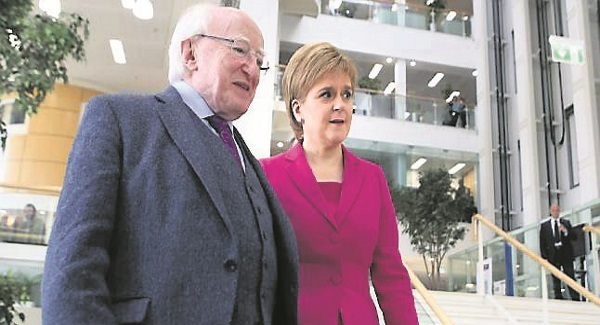
The official visit, arranged before the results of the Brexit vote last weekend, comes at a time when Scotland is considering its position in the UK.
President Higgins held a bilateral meeting with Ms Sturgeon in Glasgow yesterday afternoon where they discussed the relationship of Ireland and Scotland, and other issues regarding human rights.
Mr Higgins, travelling with his wife Sabina, also visited members of the Irish community during his time in Glasgow.
He told those gathered at the Govanhill Neighbourhood Centre that the cultural links between Ireland and Scotland date back over 1,400 years.
Tomorrow, Mr Higgins is scheduled to address the Scottish parliament at Holyrood, and will be the first Irish head of state to do so since the powers of representation were devolved to Scotland and its home parliament was established in 1999.
President Michael D. Higgins meeting with @NicolaSturgeon, Scotland's First Minister, in Glasgow today: pic.twitter.com/atRNPaPTlw
— President of Ireland (@PresidentIRL) June 27, 2016
The presiding officer of the parliament Ken Macintosh formally invited Mr Higgins to visit Scotland and address the parliament some time ago. Speaking on Mr Higgins’s trip, Mr Macintosh said “it is a great honour to welcome president Higgins to Scotland on behalf of all members of the parliament”.
“Our two countries share much in common, including a long history of family, social and cultural bonds,” he said.
“As well as celebrating these historic ties, President Higgins’s visit will focus on the future and how we can further strengthen the links between us. There is great excitement and anticipation at Holyrood around the president’s visit to Scotland and I’m very much looking forward to welcoming him to parliament.”
Text of the speech given by President Michael D. Higgins in #Glasgow this evening - https://t.co/bW5hciTuBJ pic.twitter.com/MhRV5MnUgb
— President of Ireland (@PresidentIRL) June 27, 2016
The backdrop to Mr Higgins’s trip to Scotland is one of political uncertainty and unease in the wake of the British vote to leave the EU. Scotland voted overwhelming to remain in the EU by 62% to 38%, and the overall victory of the Leave vote in the UK has triggered calls for a second independence referendum in Nicola Sturgeon’s country.
Ms Sturgeon has also stated in recent days that the Scottish parliament may seek to block or veto Britain’s decision to instigate an exit from the EU. If Scotland voted to break from the UK to become independent it would seek to enter the EU itself.
Independence survey
Scotland would vote for independence if a snap referendum was held today, a poll carried out in the wake of the UK’s Brexit decision has suggested.
The Survation poll for the Daily Record has pointed to a shift in public opinion, with 53.7% saying they would vote for independence, against 46.3% in favour of staying in the UK.
Including “don’t knows”, the figures are 47.8% for yes with 41.3% backing the no side.
Scottish voters rejected independence by 55% to 45% in the September 2014 referendum.
But the latest poll was carried out after the UK voted on Thursday to leave the European Union by a margin of 52% to 48%. In stark contrast, Scotland opted to be part of the EU, by 62% to 38%.
Scottish first minister Nicola Sturgeon said the situation means a second vote on Scottish independence is now “highly likely” and has warned she would consider asking Holyrood to block the UK’s departure from Europe if MSPs are required to give formal backing for Brexit.
The latest poll results were based on the responses of 1,002 adults questioned over the weekend.
UK Scottish secretary David Mundell accused Ms Sturgeon of “opportunism” to further the “independence agenda”.
He insisted the arguments for Scotland being part of the UK are “as compelling today as they were in 2014”.
But he sidestepped the question of whether Westminster would grant the powers for a second independence referendum to be held.Mr Mundell told BBC Radio Scotland: “What I’ve said is there are two questions. One question is could there be another referendum? Of course there could, that’s a process issue.
“Should there be another referendum? That’s a quite different issue, and my view is that there should not be another independence referendum.“I believe that the arguments for Scotland being part of the UK are as compelling today as they were in 2014.”
CONNECT WITH US TODAY



Be the first to know the latest news and updates