Peaks to rival Carrauntoohil on ocean floor
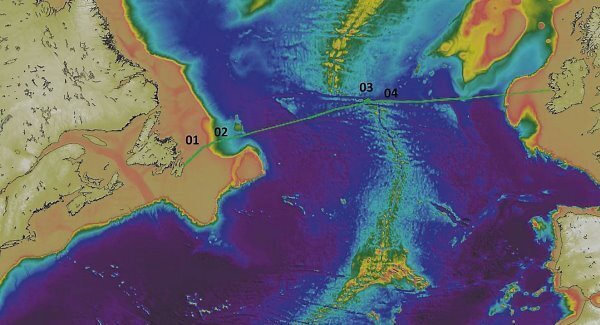
European, Canadian, and American ocean exploration experts carried out the transatlantic seabed mapping exercise – one of the first such studies to be conducted by the Atlantic Ocean Research Alliance, set up in 2013.
It aims to use the marine research resources of Europe, Canada and the US to improve understanding of the North Atlantic Ocean and promote sustainable management of its resources, particularly in the face of climate change.
The team of international researchers onboard Ireland’s national research vessel, the RV Celtic Explorer, were surprised to discover a 140km long asymmetric ridge, which peaked at 1,108m high, taller than Ireland’s highest mountain.
“Seeing dramatic seabed features reveal themselves for the first time was a real highlight of the survey,” said Tommy Furey, chief scientist of the Marine Institute who lead the study.
The Celtic Explorer left Newfoundland bound for Galway on June 1. During the seven-day crossing it deployed its recently-fitted multi-beam echo sounder, which is capable of mapping the seabed to a width of six times the water’s depth.
Among the discoveries made were an uncovered 235sq km of iceberg-scarred seabed; ancient glacial accumulations of dirt and rocks called moraines; and buried sediment channels on the Newfoundland and Labrador shelf.
The ambitious survey also targeted the drop location for the first trans-Atlantic telecommunications cable laid in 1857 between Valentia island and Newfoundland.
“This survey shows what can be achieved when we pool our resources, sharing knowledge, infrastructure and technology,” said Dr Peter Heffernan of the Marine Institute at the study launch yesterday.
Speaking earlier on RTÉ’s Morning Ireland, Dr Heffernan said half of the oxygen we consume has been produced by microscopic plants in the ocean and if we want to help this life-support system we must map, observe and generate an ability to predict climate change occurring there.
Results from the survey will be presented at the Harnessing Our Ocean Wealth conference which takes place from July 10 to 11 in Cork.
CONNECT WITH US TODAY



Be the first to know the latest news and updates