Radon gas, water buoys, and music for chickens: It must be the Young Scientists
Imagination and curiosity are abundant at this year’s BT Young Scientist and Technology Exhibition.
Students show how yoghurt pots can be used to measure radon gas and how water buoys can reduce coastal erosion and generate electricity.
Budding scientists show how retrofitting domestic septic tanks with aerobic digesters is five times cheaper than replacing them.
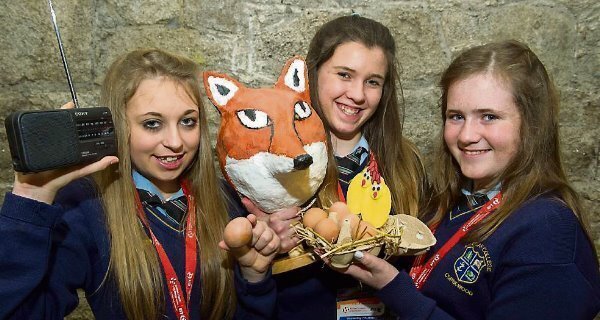
Students also show that horsehair provides better attic insulation than fibreglass and that playing music in a chicken coop keeps hens safe from foxes.
Now in its 51st year, the annual event, held in the RDS, is the longest of its kind in the world.
Dominican College Drumcondra are raising awareness of the positive side of dyslexia #BTYSTE pic.twitter.com/bu4ebttJmZ
— Stripe Young Scientist & Technology Exhibition (@StripeYSTE) January 7, 2015
There are 550 projects on display this year and, for the first year, there are more qualified project entries from Cork (115) than from Dublin (104).
One Cork entry has already played a leading role in managing indoor radon levels in some areas of Mallow.
Second-year students at St Mary’s Secondary School, Shauna Murphy and Caoimhe Cronin, turned used yoghurt pots into radon detectors.
The 14-year-olds found that even though measures had been taken to reduce radon levels in the school, there was a need for increased ventilation in some rooms where high levels of the gas were found.
The girls also identified radon ‘hot spots’ in the town and suggest that building codes could be stricter in these areas.
Caoimhe says they would continue with their project even if they did not win a prize. “Just getting this far is such a huge achievement. It was really fun, too.” she says.
Shauna says they could do a lot more testing by increasing their sample size and make a more accurate estimation of the hot spots.
Students from Gaelcholáiste Chiarraí in Tralee found water buoys could be used to reduce coastal erosion and generate electricity.
Fourth-year students Janine Ní Chonchúir, Lorraine De Nais, and Ursula Ní Mhochóir got the idea for their project after seeing the coastal damage caused by storms in February last year.
“That was in the back of our minds when our teacher asked us what we could do for the Young Scientist and Technology Exhibition,” says Lorraine.
The 15-year-olds have been working on their project since September. “We have developed a working model of a floating break-water that trips the wave and takes power from it to use as electricity,” says Ursula.
Janine says the buoys were very cost-effective because they were smaller and cheaper than turbines.
Brothers David and Paul Hamilton, from Ardscoil Rís in Limerick, found that hair is a better alternative to fibreglass attic insulation.
Second-year student David, 14, and first-year student Paul, 12, tested hair from humans, dogs, and horses.
All of the hair was found to be a better alternative to fibreglass, but horsehair provided the best insulation.
The students believe it would be possible to produce horsehair insulation on a commercial basis.
Instead of using rolls of fibreglass that are very cumbersome, 0.5m sq mats containing horsehair could be slotted into the spaces between the rafters.
They got the idea after their parents insulated their attic with fibreglass and have been working on their project since the summer.
Transition-year students from St Augustine’s College, Waterford, Shane Coleman and Jordan Corby, show that retrofitting domestic septic tanks with aerobic digesters is five times cheaper than buying a new tank
The 16-year-olds reckon their invention would cost €1,000 and point out that it costs around €5,000 to buy and install a new septic tank.
Shane explains that an intermittent compressor blows a bubble of air up through a pipe and over a spreader placed on a mesh where bacteria digest the waste.
Jordan says the digester they have invented has to be replaced twice a year but, at €130, the cost is minimal.
“We have aerated the system to increase the amount of aerobic digesters present. We provided a medium for the bacteria to live on, allowing increased growth, and we cause physical agitation of the waste to increase the digestion rate,” he explains.
Previous winners @CiaraFudgyJudgy and Paul Clarke dropped by today to see the 2015 #BTYSTE entries! pic.twitter.com/cZQ234W19s
— Stripe Young Scientist & Technology Exhibition (@StripeYSTE) January 7, 2015
Second-year students from Salesian Secondary College, Pallaskenry, Co Limerick. show how music placed near a chicken coop deters foxes.
Sarah Heavenor, 13, Hollie O’Connor, 14, and Rachel Judge, 14, keep chickens at home and wanted to come up with a cheap way of keeping their hens safe.
Sarah had found that when she moved the hen coop further away from her home, the fox came and took the chickens. They used oven-ready chickens and a night-vision camera to prove that the fox only took the prepared bird when no music was playing.
Sarah says they are going to build on the project regardless or whether they win a prize at the exhibition.
“We will test what type of music works best and make a sensor so the music is played any time a fox comes near,” she says.
Judging of the stands got under way yesterday afternoon. The exhibition opens to the public today and the top award winner will be announced tomorrow evening.
The overall winner or group will represent Ireland at an EU-wide competition later this year in Milan, Italy.
Around 50,000 people are expected to visit the exhibition at the RDS, the largest to date.
The inaugural Young Scientist exhibition was held in the Mansion House in 1965 — 230 students participated and 5,000 people attended.