Colombia: ’Why did they kill my son, take my husband away?’
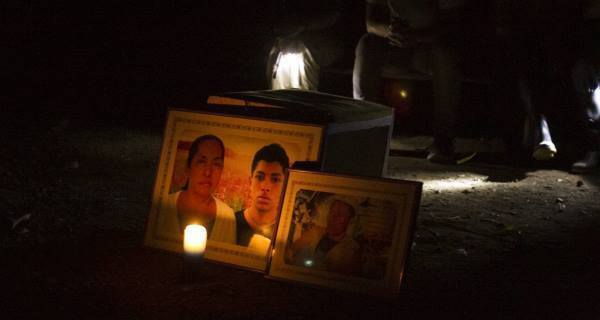
Caroline O’Doherty visits Colombia and finds that communities viciously displaced from their lands are fighting back

Colombia: ’Why did they kill my son, take my husband away?’

THE place where Manuel Ruiz and his youngest son disappeared throbs with the sounds of bird calls and insects.

Only the occasional struggling vehicle intrudes on the rhythm, creaking over the bumps and dips of the dirt road, engine panting in the intense heat.

But on a late March day in 2012, as the air pleaded for rain to lift the leaden humidity, the pulsating soundtrack was stilled by sudden cries of terror and pain.

That’s how the Ruiz family picture it as having happened because nobody saw or said anything to soften their fears. For a long time, nobody saw and nobody said anything at all.

That’s the way it is in Colombia at its worst. A helpless, harmless farmer and his young son can be dragged from a bus at gunpoint and taken to their death with near certainty that nobody in authority will ask anything but the most cursory questions.

The family of Manuel, 56, and 15-year-old Samir didn’t find their bodies for five days, and only then it was after they faced their dread and went to the nearby bridge over the Rio Sucio where they saw with agony the blood stains in the dirt.

Rio Sucio, or dirty river, is so called locally because of the muddy bed that turns its waters the colour of scarcely milked tea, but its name could just as easily derive from the terrible deeds it has witnessed.

During the height of Colombia’s purge of small farmers, the campesinos, in the mid-1990s, the river was a dumping ground for the remains of those who resisted or got in the way or were simply used to illustrate the fate that awaited their neighbours if they didn’t flee — as they did in their millions.

Manuel’s body was found at a bend in the river, just out of sight of the rusting bridge. Samir’s lighter frame was swept further along.

They had been tortured before being killed and the torture continues to this day in the suffering of their widow and grieving mother, Trinidad.

The police played cruel games with her, pretending to be Manuel when she rang his mobile phone, laughing as she begged them to tell where her loved ones were.

“I felt like my world was ended,” she says now, two years into an unending sorrow. “Why did they kill my son? Why did they take my husband from me? The police told me they are alive, they are alive, you have no reason to cry.

“I said, I know this is not true. I felt like my insides were coming out, the pain that I felt. It was very hard for me and I still cry every day.”

Her son, Sandro, at 35 the eldest of the seven surviving Ruiz siblings, says his father was targeted because he possessed probably the most powerful weapon in Colombia — memory.

A land census was being taken in their home district of Curvarado in the Choco region of northern Colombia to establish who owned the violently cleared campesino land and who were the illegal occupiers — the agribusiness companies, rich ranchers, and drug barons — who had replaced them.

“My father had a good memory. He knew over the last 30 to 35 years who had been the people living on the land so he ended up being a threat to the companies. He was the stone in their shoe and that’s why they created this incident to assassinate him.”

The Ruiz family’s story, sadly not unique, illustrates a past and present in Colombia that is complex and troubling.

Blame for the armed conflict is often placed firmly on FARC, the guerrilla movement that grew in the early 1960s with ideas of armed socialist revolution in a deeply unequal country.

Campesinos were extremely vulnerable — subjected to forced recruitment, kidnapping, and murder if they didn’t support the movement, and classed as terrorists by the state security forces if they didn’t oppose it.

But after surviving this precarious balancing act for more than 30 years, the tipping point came in the mid- 1990s when, under the guise of an all-out push against the guerrillas, a massive state-sponsored land clearance began.

The method was simple and savage. The paramilitaries — the private armies of the rich — or the military, or some combination of the two, would enter a community, round up the people, and force them to watch while one or more were selected for slaughter, often mutilated and beheaded and their remains desecrated. Other times people disappeared, their brutalised remains sometimes found, but often not.

Either way the effect was the same. For every one murdered or taken — and there may be 200,000 of the former and 75,000 of the latter — thousands more were terrified and the rich, fertile lands that had sustained campesino communities for generations were emptied.

Some of the 5m displaced fled to the mountains, foraging in the forest to survive; others ended up in the far-off slums of the country’s capital, Bogotá, and many took what they hoped would be temporary refuge in regional cities.

For much of the next decade, they struggled to find work and acceptance, government propaganda having spread the word that the new arrivals from the countryside were FARC sympathisers who had brought their misfortune on themselves.

Some tried coming back but were usually seen off again at gunpoint. That was until they began declaring humanitarian zones which, under international law, prohibit entry by armed forces, legitimate or otherwise.

With hand-painted signs and wooden fences, they created enclosures for themselves, just big enough for a few timber homes and some fruit trees.

ONCE installed, they ventured out into the surrounding fields to try to re-establish their farms, now stripped of trees and the richly diverse native vegetation and taken over by livestock, banana plantations or oil palm.

Oil palm in particular is detested by the farmers. Its nuts produce oil and their kernels are used as biofuel, but the crop sucks the nutrients out of the soil and its thick, dense trunk is so hard to dig up, it has to be burned out of the ground, a process that takes days.

The Costa Azul Humanitarian Zone which is home to the Ruiz family is, like others in the Choco region, supported by Christian Aid through its partners, the Inter-Church Commission for Justice and Peace (CIJP) and Peace Brigades International (PBI). PBI volunteers provide accompaniment for the returning communities, staying with them, travelling with them and performing regular check calls, using their visibility and international profile as protection. CIJP too keeps personnel on the ground but also helps the communities lodge land claims, prepare legal cases and negotiate the criminal justice and local government systems.

None of them are armed and just about all of their adversaries are but the Ruiz family, forced to flee after the murders of Manuel and Samir, were eager to try the humanitarian zone initiative. “I said, let’s go,” says Trinidad. “That’s the land they lost their lives defending so let’s go back and reclaim it for them.”

The rest of the family felt just as strongly. “It’s really hard to be displaced — to leave our land, to leave our crops, to leave where our family has always been together,” Sandro says. “So here we are continuing what my father would have done — moving forward the process of reclaiming our rights.”

The process is far from easy. Their wooden signs may just about keep out armed personnel but red tape can be a very effective weapon of oppression.

Registering claims to their land is a protracted and complicated business and just moving around outside the humanitarian zone can be hugely intimidating.

A massive military presence dominates the region with army barracks still being built –— the newest one completed less than a year ago — and checkpoints on roads and river crossings.

This is the same military presence that somehow fails to spot the consignments of coca leaves and paste being moved up and down the region for the cocaine producers despite the fact that there are only a handful of roads on which they can be transported.

It’s the same military that has failed to address the recent destruction of the only bridge on the road to the remote Cano Manso Humanitarian Zone which has been reduced to a few planks, adding several hours to the journeys of PBI, CIJP, and other unwanted visitors who can no longer drive there.

Such acts cause anxiety within the precarious protections of the humanitarian zones and some feel it more than others.

Yomaira Mendoza, a 33-year-old widowed mother of two, came to Cano Manso in fear of her life.

Her husband, Jose, was shot dead in front of her in 2007 after the couple returned to their land and he refused to pay a “fine” for removing felled trees to sell as lumber.

Yomaira fled to Colombia’s second city, Medellin, but in 2011 she lodged a formal claim for her ancestral land. The threats began then and lately they’ve intensified.

Her battered mobile phone, with its tenuous signal, is meant as protection and having it abused as a weapon of intimidation is a cruelty in itself.

“I received phonecalls telling me don’t get involved, telling me: ‘You can look at people like Manuel Ruiz. You see what happened to them — do you want the same thing to happen to you?’”

“On January 27 at around 12 noon I received a text message that said they were going to kill me — that I already smelled of formaldehyde. They considered me dead already. That’s when I decided to come here.”

The threats followed her to Cano Manso, adding that her sons were also a target. Yomaira’s boys, aged 15 and 18, now live with extended family in Medellin.

The messages are terrifyingly precise. When Yomaira she showed the Irish Examiner and Christian Aid around Cano Manso, pointing out the river that has been diverted by the illegal occupier, leaving its waters pitifully depleted, messages followed detailing her exact movements and warning her that the “gringos” would not save her.

For her protection, Christian Aid arranged for her evacuation to Bogota but she has since returned to Choco and is being moved regularly between the various humanitarian zones.

She has been assigned a car and bodyguard by the state’s National Protection Unit but the threats still keep coming.

LEYDIS TUIRAN, one of the leaders of the Cano Manso community, knows all about living with threats.

The a 30-year-old mother of four is among 32 families who have spent the last seven years gradually regaining control of their lands from the hands of a cattle rancher.

The community, originally 80 families, was displaced in 1997 after two of their leaders were murdered, and 10 years later the danger had not dissipated.

“We returned on August 5, 2007, and on September 17 was the first assassination attempt,” she says.

On that day, community leader Walberto Hoyos and his brother Miguel, were both shot but survived. A year later, Walberto was shot again and this time, his attackers made sure the job was done properly.

Leydis points to a rickety wooden hut containing faded plastic flowers and photos that serves as memorial to murdered community members.

“They killed Walberto right here. They walked right by me. I challenged them. I said, who let you in? They pulled out a weapon. He tried to tackle them to get the weapon off them and they shot him. Once he fell to the ground they shot him again.”

Leydis ran to a neighbour’s house, pushed her children under the bed and watched in terror as the gunmen went to her house, searched it, and took her mobile phone. “They came back then and they flipped Walberto’s body over and shot him again. They shot him several more times. There was a pig nearby. They shot the pig too and then they left.

“They killed him about 2.30pm in the afternoon and at 7pm still nobody [from the police] had come. Justice and Peace [CIJP] were the only people who came.”

Eventually four official looking men in civilian clothes arrived and began trying to take statements. Leydis believes two of them were among the gunmen.

“I can’t leave the humanitarian zone,” she says of the threats she faces to this day. “They are trying to keep me in a jail.”

In the evening, the community gather in what is meant to be the schoolhouse but which has been left without a teacher despite the promises of the local education authority.

The country’s presidential elections are coming up later this month and there are peace talks taking place in Cuba between representatives of the government and FARC but nobody in the gathering sees those national developments as relevant to themselves or believes their concerns form part of the agendas.

“We don’t have enough money for food or clothes or health care,” says Leydis’ sister, Anna.

“We have to ask for help from other people to get to hospital. We have to carry people on hammocks because we don’t have transport or roads.

“I feel we are isolated. People say we are guerrilla members — that is a way of isolating us from the rest of the population.

“They say the peace talks will bring change but I think there is a lack of political will to implement change.”

Political will is also called into question in relation to another major stumbling block to the normalisation of life across the Choco region — drugs.

The Colombian government’s official policy is to eradicate cocaine production by literally rooting out the illicit coca leaf plantations that provide the main ingredient, but the country remains one of the world’s top three producers of the drug.

The abundant crop presents problems for farmers like Jorge [not his real name] who must cultivate a great of diplomacy alongside his yucca, corn and rice. “My farm is surrounded by coca fields,” he says.

“There can be 20 workers that come to collect and process the leaf. Sometimes they will sleep in my house. Because I live in the region, I can’t discriminate against people. I have to have relationships with pretty much everyone.

“It’s dangerous to talk about the coca plantations. The army is pretty relaxed about the whole thing,” he continues.

“They only time they come to pull out the plants is when a general comes from outside the area. Not too long ago the army pulled up about 100 plants but they left the rest.”

Jorge is under constant pressure to sell his land to enable his neighbour expand his operation and wonders how long the excuses he uses to decline the offer will last.

“If we don’t give them our land or if we don’t rent out our land to them, they could kill us,” he says.

Yet despite the everyday perils and slow pace of change, progress is being made. The large and well-established Las Camelias Humanitarian Zone feels less of an enclosure and more like a town.

Strength in numbers and robust organisational structures create a notable sense of security and confidence among the community.

Lucy Rodriquez is a smiling example of the energy that permeates the place. At 26, she is one of the youngest members who remembers the land clearances first-hand, recalling how, at the age of nine, her beloved grandfather was murdered.

“We lived well, we were happy,” she says of her upbringing.

“In 1997 they took away my happiness because my grandfather was everything to me.

“He had always liked me to sing since I was very little. He told me he was going to help me study so I could be a singer. He was killed on August 24, 1997. Because of that we had to leave.”

The family were on the move for several years, evading marauding troops and machetes, before stopping in Murindo, about three hours away.

Three years ago, Lucy returned to their homeland to reclaim her family’s farm — turned over to oil palm in their absence — and to honour her grandfather’s memory.

But Lucy is not just thinking of the past. “I have something very beautiful in my life, my son, Erlin,” she says with pride.

Erlin is nine years old, as Lucy was when her childhood ended, and he lives in Murindo with her parents, but she is determined he will have the opportunities she was denied.

“I was never able to finish school. My son, with the help of God, will be able to. He writes beautifully and he also sings. Even though I am far away he never forgets that I am his mother.

“With the help of God, he will come here and we will start our lives again.”

Huge challenge of returning millions of people to their lands

The brochures Iris Marin hands out are full-colour, glossy, full of smiling faces, and available in English for an international audience.

As deputy head of the Unit for the Comprehensive Care and Reparation of Victims, Marin is keen to stress the unit’s noble intentions and ambitious plans, and the eye-catching publicity materials are just part of her armoury.

Located in offices on the 32nd floor of one of Bogotá’s swankiest skyscrapers, busy with teams of smartly dressed young employees who show no signs of leaving their desks although it’s past 6pm on a Friday, the impression is certainly created that this is an outfit that means business.

More than 6m Colombians — one in eight of the population — who have been officially recognised as victims of the country’s decades of internal armed conflict hope that’s the case, but the majority have yet to be convinced that the promises will be fulfilled.

The Victims Unit was set up in 2012 as part of the government’s response to growing pressure for redress for civilians caught up in the conflict.

One function is to provide monetary compensation. The maximum any individual can receive is about €8,000, but to qualify for that they would have to have suffered multiple violations such as displacement, kidnapping, torture, sexual violence and bereavement so most payments will be smaller.

Still, it’s a huge financial commitment and one that could dwarf the €2.4m annual budget the unit has so far been granted for each year up to its target completion date in 2021.

“It’s not enough because, when the plan was established, we were talking about the reparation of 4.6m victims and now two years later we’re talking about 6.2m,” Marin concedes.

“This probably means that we’re going to have to establish a new financial plan.”

Yet finance is not the biggest issue facing the unit. Returning millions of displaced people to their land and homes and restoring the schools, health services, utilities and infrastructure to enable them pick up the pieces of their disrupted lives is a far greater challenge.

For that to happen, the lands have to be vacated by the quaintly titled “bad faith occupiers”, many of whom have profited there for decades and show no intentions of going quietly.

New local structures — more than 1,000 territorial transitional justice committees — have been set up to oversee the reparation process but officials at local government level, where corruption is rife and enthusiasm lacking, also have to be encouraged to buy into the national plan.

Crucially, the people coming home also need to be protected and, as the continuing murders and intimidation show, personal safety is not guaranteed.

Marin speaks frankly about the problem.

“We see, as people begin the process of demanding their rights, that there’s an increase in violence as a response to that because they’re putting at risk territorial, economic, political powers that are in the region,” she says. “The presence of the state security forces does not always ensure the protection of the community.”

A key test of the Victims Unit’s credibility is its handling of the case of the Cacarica community from Choco who last December won a landmark ruling from the Inter-American Court of Human Rights declaring the Colombian government responsible for forced displacements and murder in the infamous Operation Genesis in 1997, and ordering reparations be made.

The community, the pioneers of Colombia’s humanitarian zone projects, compiled a list of modest demands. For each family they wanted a fishing boat, five cows, one bull, three pigs, and a pair of sheep.

For each humanitarian zone they asked for a corn mill, sugar cane processor, tractor, warehouse, and protection.

For the wider region they sought road improvements, river dredging, a park, sports hall, football field, and money for an annual football tournament.

Several months after the court made its ruling, the Victims Unit had yet to meet with the community and when their representatives came to Bogotá for a press conference detailing their demands, the only mainstream press that turned up were Venezuelan.

Marin insists the delay is not a sign of reluctance but merely of caution as the Victims Unit want to get the template for reparations right.

“This is a long process that we are beginning. If we are just going to be paying indemnifications, that we can do within a month. That’s not a difficult process. But the reconstruction of trust between the communities and the state, this is something that takes a lot longer.”

Ultimately, she says, it is peace in Colombia that will ensure the protection and prosperity of all returning communities and although the campesinos feel disengaged from the peace talks currently under way between the government and FARC in Cuba, a settlement would undoubtedly bring benefits.

One of those would be a reduction in the country’s massive military spending which, in theory at least, would free up money for use in the reparation of victims.

But that’s only half the battle, says economist, Mario Alejandro Valencia, who warns that much more radical changes are required to achieve social peace.

Valencia is deputy director of the recently formed thinktank, the Tax Justice Network, a Christian Aid-funded grouping of academics, trade unionists, and former state officials which critiques government policies and provides analysis and opinion for the media and for general public debate — a new idea in Colombia, where government statements have long been reported unchallenged.

“Colombia is one of the most unequal countries in the world,” he says, warning the government’s failure to address the imbalance is fuelling social unrest, as evidenced by a rise in protest marches over the past year.

In the countryside the problem is an old one. “About 76% of the land is in the hands of 13% of landowners,” he says.

In urban areas, the situation is equally daunting. “Officially the unemployment rate is 11% but informally it’s more like 50%. Someone selling gum on the bus is considered employed.”

Valencia challenges official claims that initiatives are being progressed to reconfigure the economy which on paper is growing strongly but at the expense of a soaring external debt.

“In 2012 the government promised tax reform because, at the moment, the tax system benefits only foreign companies, large landowners, and mining. President [Juan Manuel] Santos said he was going to implement reform that would make the business people cry. He did — the rich cry because they are laughing so hard.”

Iris Marin stresses that land reform is part of the agenda for the peace talks and insists those on the ground will see real change.

“We are in the midst of a peace process which is more than just signing an end to the conflict — this is the construction of new politics for our country and new policies,” she says.

Marco Velasquez, a 49-year-old community leader from Cacarica, however, says his people shouldn’t have to wait any longer.

“We believe that, if the government does not fulfil its obligations to us quickly, it will be renouncing the peace process because it is us and other small communities who are constructing true peace in Colombia, and because when there is hunger, there is no peace.”

Bullets and slurs aimed at rights activist

Fr Alberto Franco is, if his detractors are to be believed, a paedophile, drug trafficker, con artist, and illicit goldminer.

The 53-year-old Catholic priest and human rights defender can laugh off the slurs. “If we are goldmining, why are we asking Christian Aid for money?” he says, smiling.

Bullets are not so easily brushed aside. Because of threats to his life, he travels in an armour-plated car provided by the National Protection Unit although his assigned driver is, at Fr Alberto’s insistence, unarmed.

In February last year three shots were fired at the passenger window moments before Fr Alberto was due to take his morning lift to his work as executive secretary of the Inter- Church Commission for Justice and Peace (CIJP).

It was a chilling warning coinciding with hearings on the bloody Operation Genesis land clearance of 1997, the victims of which are supported by CIJP.

Fr Alberto was shaken by the incident but undeterred. “I was frightened, yes, but... back to work.”

The work is multi- faceted. At the heavily fortified headquarters of CIJP in Bogotá, lawyers prepare cases pertaining to land restitution and victims’ rights, a psychologist devises programmes to help displaced people deal with their trauma, a media team runs a studio producing broadcasts for outlying communities and researchers write regular bulletins, documenting incidents of intimidation and harm.

On the walls are carefully hung personal effects of murdered community leaders — a ragged hat, a stained working shirt, a family photo.

A meeting room is lined with empty wooden chairs, each one bearing a plaque with a name and the word “desaparecido” — disappeared.

The doorway of another room is blocked by a ceiling-to-floor metal gate. It’s the documents room where volunteers from Archivists Without Borders work to digitise a quarter century worth of precious legal papers and personal testimonies.

The scale of the work to be done to address so many wrongs can be overwhelming and Fr Alberto was glad of a short sabbatical in Ireland in 2001.

But even while he was supposed to ben recharging his batteries with the Redemptorist Order in Limerick, his mind was travelling across continents.

He recalls an experience spending time with young drug addicts in the city.

“I was sitting down talking to young people who were drug addicts when just a short time earlier I had been talking to a farmer in Colombia who was a coca leaf producer.

“During the conversation, the young people realised that they were both at the extremes of this process — the drugs business. They were essentially making someone very, very wealthy and it was killing both of them.”

But it is not just the drugs trade that is a deadly force. Fr Alberto has come to regard all in power with suspicion.

He cites the example of the murder of his namesake, Alberto Hoyos, and the brick walls CIJP comes up against time after time when it tries to advance the investigation.

“It’s one of the cases where there has been hardly any progress. It’s one of the cases that makes us think there is someone very high up that wants to stop the investigation.”

It is statements like this — statements he isn’t shy about making on the rare occasions a largely indifferent Colombia media give him the opportunity — that make Fr Alberto a walking target for both slurs and gunshots.

He is serious and intense for a moment and then smiles again.

“The people are winning the legal battles. They have won in the Colombian courts and the international courts. All they need is for the government to fulfil the court orders.

“When the UN special rapporteur on internally displaced people came here, he asked what do you want most to happen? We said we would like that a social democratic state fulfil its obligations.

“In that sense we are not very revolutionary. We are nothing to be frightened of.”

More in this section

Lunchtime News

Newsletter

Keep up with stories of the day with our lunchtime news wrap and important breaking news alerts.

Cookie Policy Privacy Policy Brand Safety FAQ Help Contact Us Terms and Conditions

© Examiner Echo Group Limited