Irish stargazer discovers supernova
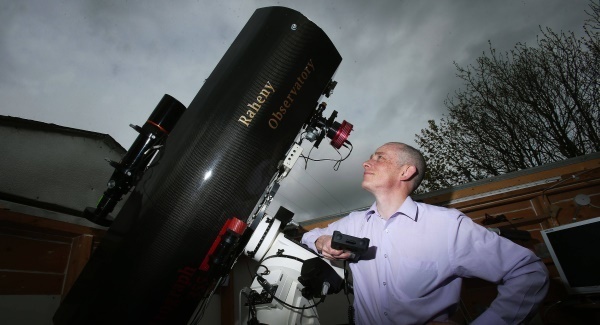
The trail it left escaped professional astronomers worldwide but not the beady-eyed Dave Grennan, who tracked what is classed as a supernova from his home in Raheny, north Dublin.
It took the amateur astronomer four years to discover his third supernova, but it took somewhat longer for light from the dying star to reach his back garden in Dublin — 170m years to be exact.
According to Mr Grennan, 42, the explosion happened 170m years ago in a galaxy called NGC 5410 more than 270 quadrillion kilometres away, a figure he concedes is “probably incomprehensible” to most people but explains why the light is only now reaching Earth.
He discovered the ‘type 1/c’ supernova on Good Friday. Its existence was confirmed on Sunday and announced by the International Astronomical Union, based at Harvard University.
His achievement is astronomical in more ways than one as it forms a hat-trick of discoveries he has made in his garden shed using a largely improvised DIY telescope.
Most discoveries of supernovas are made by professional astronomers with equipment that costs tens of millions or euro.
Four years ago, Mr Grennan became the first person in Ireland to discover a supernova. Two years before, that he discovered an asteroid and named it after his late mother, Catherine Griffin, who encouraged his interest in astronomy when he was a boy.
“It is a significant discovery,” Mr Grennan declared yesterday. “Supernovae are objects which allow astronomers to date the age of the universe and, better than that, they allow us to date how long the universe is going to live for, so discovering these things is very important.”
Supernovae are the bright remnants of a dying star, caused by the violent collapse and explosion of a sun like our own.
Unfortunately, Mr Grennan did not get to name any of his supernovae himself. Planets, asteroids, and occasionally comets can be personalised but the fleeting supernovae are registered differently.
“They are named after the year in which it is discovered, plus a boring old two-digital letter,” he said yesterday during an interview on RTÉ radio.
*

CONNECT WITH US TODAY



Be the first to know the latest news and updates